
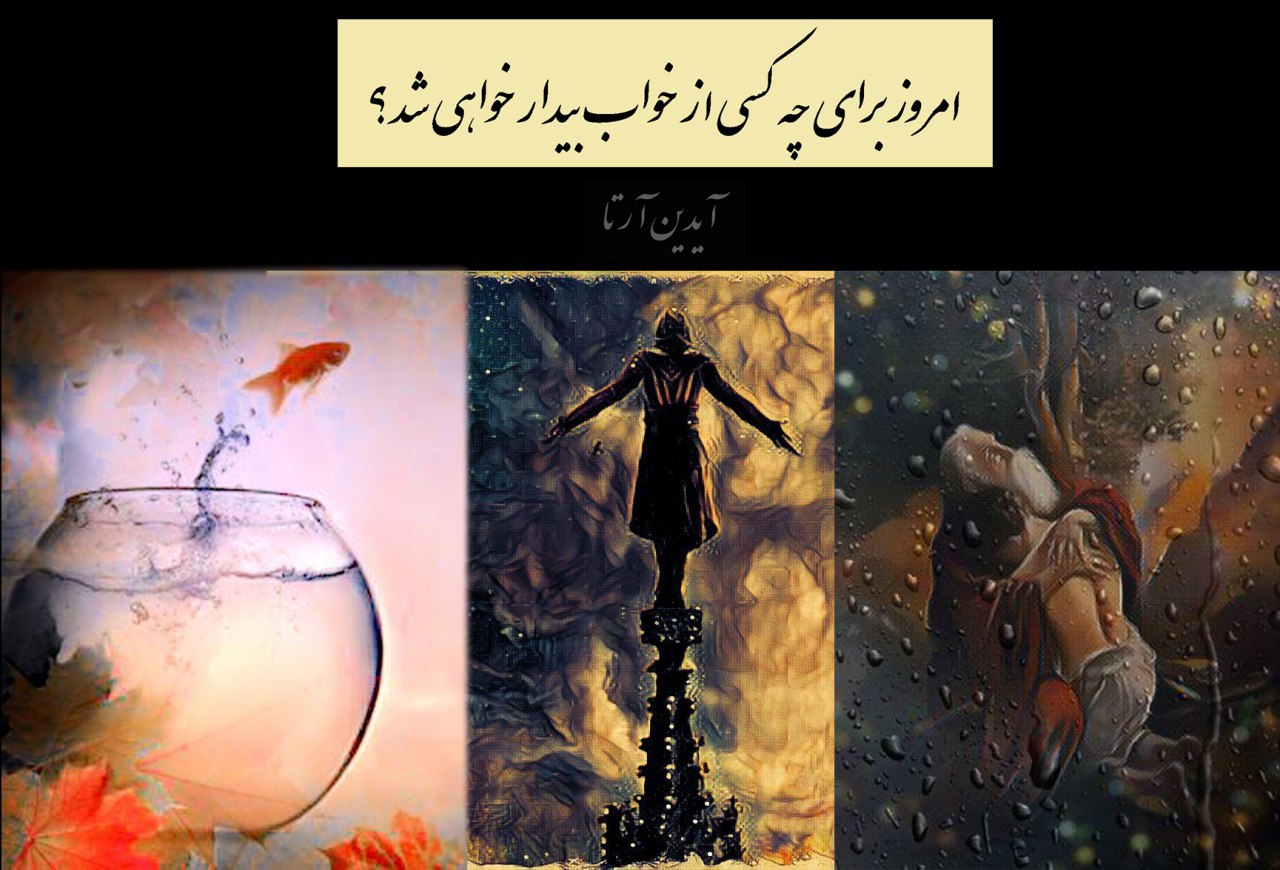
I wrote this piece inspired by the philosophy of Søren Kierkegaard, the Danish philosopher and forefather of existentialism, and I have read it aloud in the audio file below. Kierkegaard believed that there are three ways of living:
1) Aesthetic mode of life (living with the aim of seeking pleasure and loving beauty)
2) Ethical mode of life (living with the aim of realising a moral belief or purpose)
3) Religious mode of life - leap of faith (the leap of faith)
This discussion is presented in three acts. The first concerns the first level of life, which encompasses the dominant approach most people take to living: a condition in which the purpose of every action is to find some pleasure in it and to obtain a good feeling. A person who lives according to this mode is constantly in search of variety and novelty and tries to keep life's suffering at a distance. Yet the truth is that such a person ultimately encounters despair, suffering and purposelessness.
The second part concerns the second mode of living: living in order to fulfil a duty grounded in a belief held in the mind. One lives in order to discharge a duty because society, religion, tradition or morality has dictated it. This mode of life is approved by tradition, society and morality, but Kierkegaard does not regard it as the highest form of living. He sees a profound distance between this kind of devotion and faith. Many religious believers and rigid adherents of different ideologies who dedicate themselves to their belief belong to this group. Kierkegaard calls the highest form of this way of living the knight of infinite resignation: a person who gives up everything in existence for the sake of a belief. This way of living is consistent with rationalising and attempting to justify one's conduct on the basis of what has been learned through belief. It is devotion to a belief dictated to us from outside.
For Kierkegaard, the highest level of living is the leap of faith. Faith, for Kierkegaard, is not profound conviction in a belief. Faith is a leap into the unknown and into darkness, one that may stand in conflict with morality, social traditions and even the outward forms of religious belief. The leap of faith is not the recognition of truth but surrendering oneself to it, and in its essence it is irrational and beyond discourse. It is filled with passion and a will that springs from within, rather than with submission to something external. The leap of faith overcomes all hesitation and doubt and, in Kierkegaard's view, is not merely higher than reason but in conflict with it.
In Fear and Trembling, Kierkegaard closely examines the story of Abraham and Isaac/Ishmael and interprets it through his philosophy. In Kierkegaard's view, if Abraham took Isaac to the place of sacrifice with the thought, “I sacrifice Isaac because this is God's command; I have no choice, and Isaac is condemned to destruction by this command,” that would make him merely obedient and believing, not what Kierkegaard calls the knight of faith. For Kierkegaard, the story symbolises the way faith overcomes social morality, religion, rational command and everything that appears right, and how the knight of faith casts himself beyond good and evil. In this story, Isaac/Ishmael is Abraham's beloved and long-awaited child. Isaac/Ishmael symbolises the most desired and precious possessions of our lives, and to kill him—to perform an act of child sacrifice—is to commit an act condemned by, and indefensible before, morality, religion and ordinary social convention. The leap is not only Abraham's leap; it is Isaac's leap as well. From a Kierkegaardian perspective, we might read the story in this way: to kill the greatest desire of one's life and cross the boundaries of morality, society, tradition and logic is to leap into the darkest darkness with the faith that everything you kill will be returned to you through your inexplicable leap—and no one, no one except the person who chooses the leap of faith, will understand the meaning of what is being done.
In Kierkegaard's thought, faith is neither asceticism nor belief. Faith is an irrational leap beyond good and evil, and within this incomprehensible leap into the depths of darkness there is something infinitely personal and beyond discourse, known inwardly only to the person who chooses the leap of faith.
Kierkegaard believed that what our world suffers from is a lack of passion and faith. In his view, true faith gives us individuality, whereas traditional religion and ideology take individuality away from us. Kierkegaard and Nietzsche were two entirely different faces of a common conviction: a view that sees the human being as powerful and singular, and wants the human being to stand strong before the suffering of life.
The text and audio file follow below....
Aydin Areta
Comments
Loading…
Leave a comment