
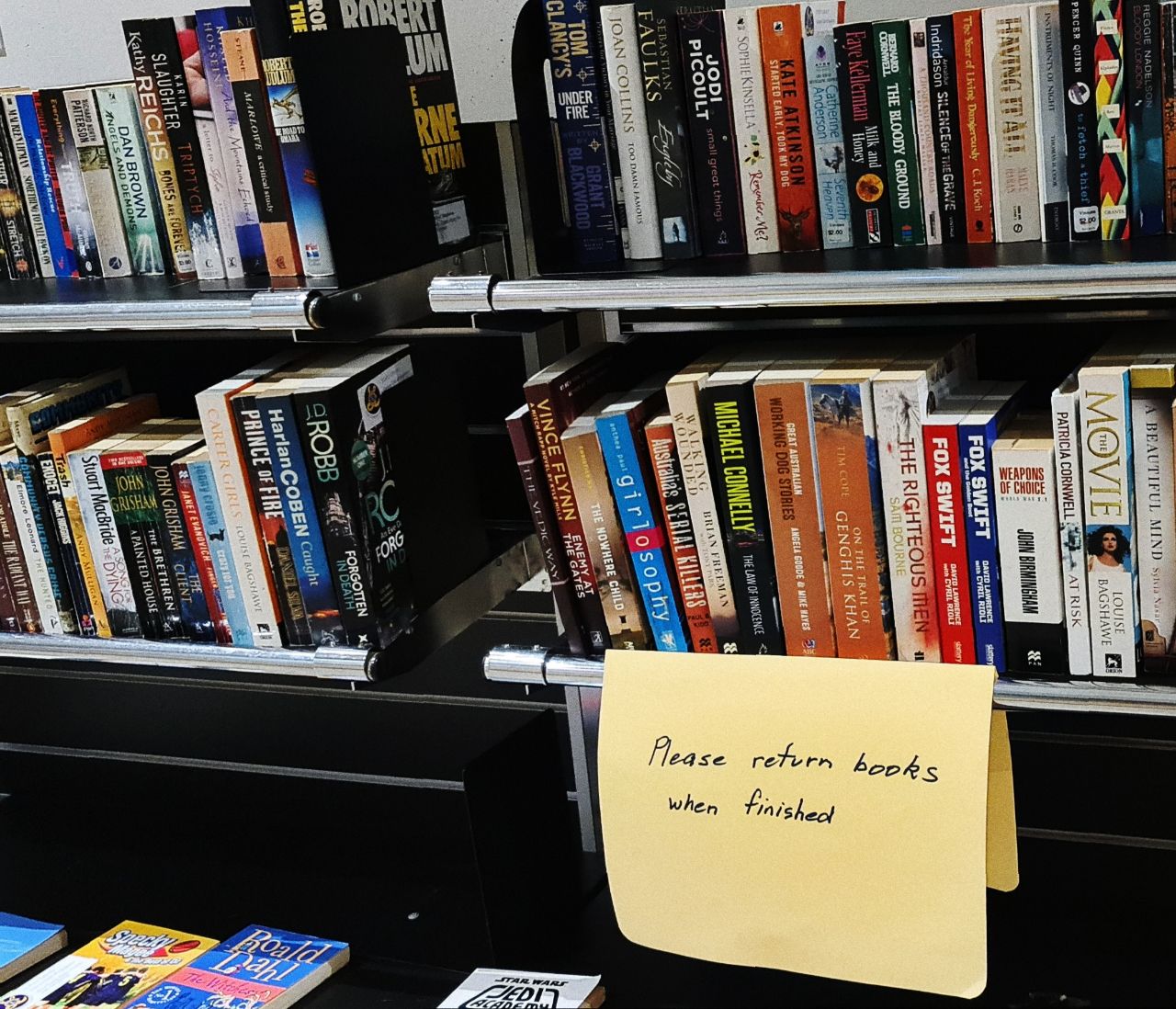
This is a simple book stand in the corner of a shopping centre near where I live in Australia. It is only a modest, inexpensive symbol of social trust in one another, yet despite its limitations and simplicity it conveys a powerful symbolic message to society: we believe in one another and in the possibility that goodness can be realised in our society.
Trust always means accepting the risk and danger of being hurt. When no harm occurs, the willingness to accept that risk begins to grow within a society because the sense of safety, belief in goodness and moral courage all become stronger.
The truth is that a life without trust in others may be safe, but it is profoundly lonely and empty of freedom, courage and love. Someone who is unable to trust others often does not even hold a conscious trust in their own distrust. This resembles paralysis, an inability to live, because what governs such a person is fear, and fear itself destroys the possibility of experiencing love and freedom in life.
One of the most destructive forms of distrust is the political authority’s distrust of the people who live under it. Abraham Lincoln is attributed here with a statement to the effect that when political authority demonstrates firm and complete trust in its people, those people will return that trust with equal strength both to political authority and to one another.
Behaviours and decisions that symbolically communicate a government’s trust or distrust toward its people can have either a constructive or profoundly destructive effect on a nation’s social cohesion. In recent years, during the difficulties of the coronavirus pandemic and even in the recent flood crisis in Australia, the message repeatedly given by governments and banks to people has been: if you have suffered hardship or loss, tell us; you may temporarily suspend loan repayments or make use of government assistance. In many such cases, no documentary proof is requested and your own declaration is sufficient. You are treated as trustworthy, and the institution of power is prepared to take the first step in social trust.
The deepest circle of hell depicted by Dante in the *Divine Comedy* is reserved for those who betray the trust placed in them. In Dante’s moral vision, as it is presented here, no act is more demonic than deceiving someone who has trusted you, because such an act strikes at the very possibility of goodness in the world and destroys belief in goodness.
The issue is not simply that the particular person can no longer be trusted. The possibility of trust itself is thrown into doubt, and this is equivalent to the victory within society of the demons of fear, doubt and separation.
Perhaps nothing, then, is more destructive than a political system or power that deceives its own people, betrays their trust through the plunder of a society’s material and spiritual possessions, and, by spreading distrust throughout social life, sets about destroying people’s belief that goodness can be realised in their society.
Against this, few things are more beautiful or significant than the presence of free and decent individuals who try, even within an atmosphere of mistrust, to keep alive the possibility of trust as a belief in the possibility of human goodness. Do you know such people—those who, through their actions, accept the risk of being deceived within a wounded and deceptive society so that trust in goodness and love in human beings might remain alive? Share your own experiences and examples you know beneath this post with me and with others.
Aydin Areta
Comments
Loading…
Leave a comment