
There Is No Garden Beside the Wall
Aydin Areta
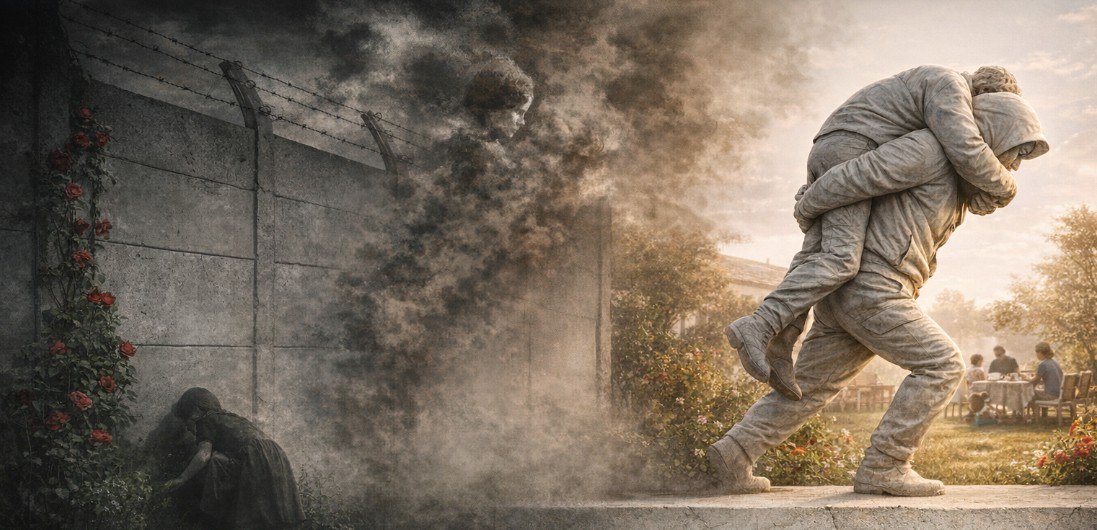
The 2024 film The Zone of Interest unfolds beside Auschwitz. The house and garden of Rudolf Höss, commandant of the camp, stand directly alongside the wall. We rarely see the violence itself. Instead, we hear it: gunshots, screams, the roar of furnaces, trains arriving. The horror takes place beyond the wall, while on this side of it the garden is watered, children play, meals are eaten and ordinary domestic life continues.
The film’s terrifying force lies precisely here. Evil does not always appear wearing the face of a monster. Sometimes it appears as an employee who goes to work every morning, follows orders efficiently and returns home to his family. Höss is not presented as someone who spends every moment in a state of rage or sadistic frenzy. He is an administrator. He attends meetings, solves logistical problems and pursues professional advancement. The machinery of killing becomes part of the routine of work.
His wife, Hedwig, embodies another form of accommodation. She takes pride in the house, the garden, the servants and the life that her husband’s position has made possible. She is not standing inside the crematorium, but she has learned how to make a home beside it. She has domesticated evil by arranging flowers next to its wall.
There is a scene in which Höss and his children are swimming in the river. He suddenly notices human remains in the water, panics, pulls the children out and rushes them home to be washed. The pollution of the camp has crossed the boundary into the family’s apparently separate world. The wall has failed to keep the two realities apart.
Hedwig’s mother cannot remain there. She visits the family, but the smoke, the sounds and what she understands to be happening beyond the wall make the place unbearable for her. She leaves. In this small contrast, the film places before us several possible relations to evil: the functionary who carries it out, the person who learns to live comfortably beside it, and the witness who remains disturbed enough that she cannot stay.
This may be the most unsettling question the film asks. How close can a human being live to horror and still call life ordinary? How many times can one hear a scream beyond the wall before breakfast again becomes only breakfast?
In the film there is also a young girl who, under cover of darkness, secretly leaves apples and food for prisoners. The scenes are filmed in thermal night vision, so her figure appears almost luminous in the darkness. The character was based on Aleksandra Bystroń-Kołodziejczyk, a Polish girl who, according to accounts of her life, risked death by taking food to prisoners around Auschwitz.
She could not stop the machinery of the camp. She could not tear down the wall. But she refused to allow the wall to define the boundaries of her moral world.
The most important division in The Zone of Interest is therefore not simply the physical wall between the Höss family and Auschwitz. It is the moral wall that human beings build within themselves: the wall that permits us to divide the world into what concerns us and what does not; into the suffering we acknowledge and the suffering we learn not to hear.
And perhaps the real danger begins when that wall becomes so familiar that the garden looks beautiful precisely because we have trained ourselves not to look beyond it.
To be continued.
Comments
Loading…
Leave a comment