
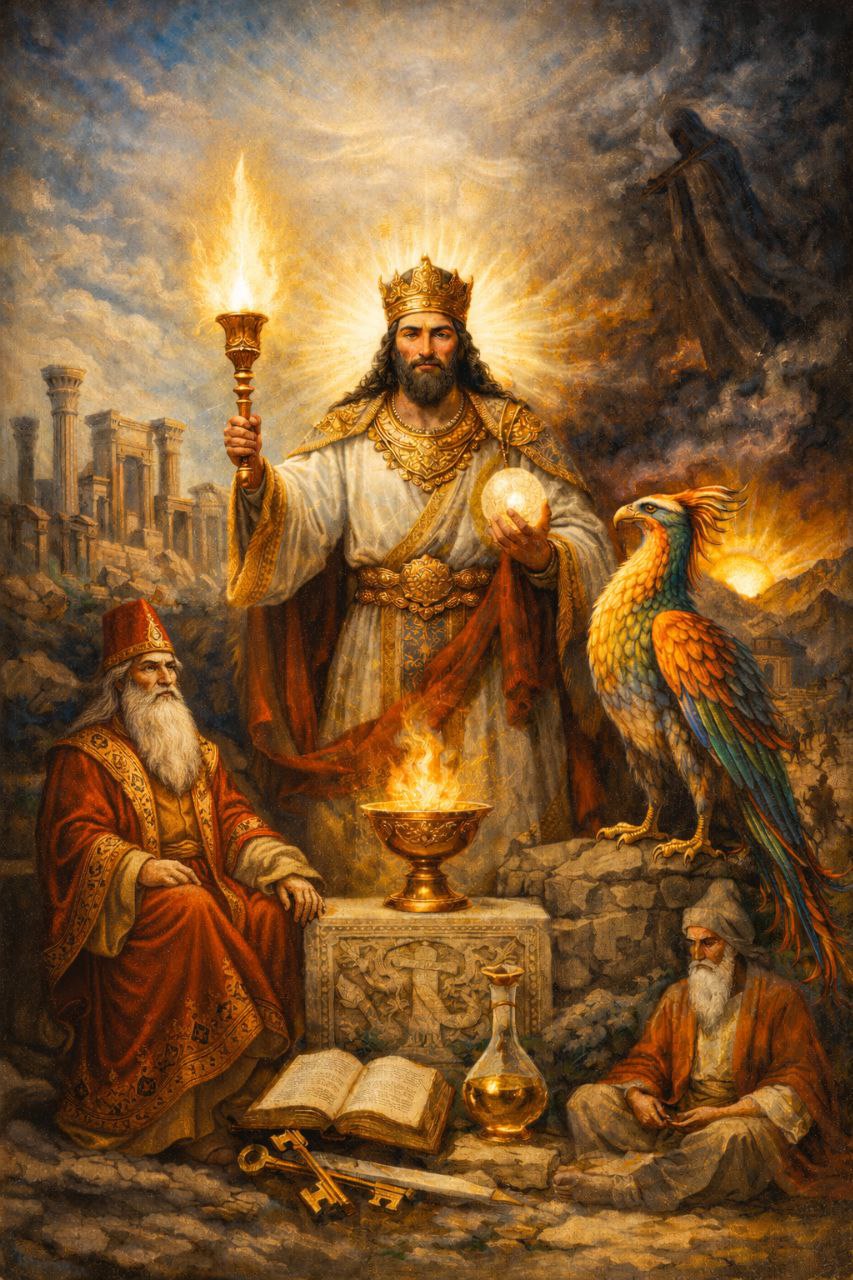
The word shah in Iranian history differs fundamentally from malik in Arabic and king in English.
This distinction, in my view, is one of the most important foundations of Iranian thought. Malik in Arabic is presented here as a hereditary concept, whereas shah in Iranian thought means “the best.” Persian still uses many compounds in which shah signifies superiority and pre-eminence, from shahrah, a main road, to shah-kelid, a master key.
The divine glory of the Iranian shah arises from the purification of the soul:
So purified from evil was the shah
that divine glory shone forth from him.
The Iranian shah is not merely a ruler, but the messenger of Hormazd and one who increases divine light in the world. This idea, the source argues, has been intertwined with the Iranian soul throughout the long history of this land. In the Iranian unconscious, it is still only this ideal shah who is worthy of ruling the Iranian lands.
Many kings in Iranian history lost their divine glory, and many rulers without glory nevertheless called themselves shah of Iran. Even after the Safavids, attempts were made to replace the idea of “living in Asha and truth,” and the divine light of the shah, with a devotional concept such as jurisprudence.
Those who half a century ago saw in an elderly jurist the unconscious image of the Iranian shah-prophet did not know that the spring of light their souls were seeking would not rise from the soil of jurisprudence, just as Sufis could never sit in the place of the Magi. They would remain only a shadow of a light that has not yet revealed itself.
Plato’s ideal philosopher-king, the source argues, was itself an adaptation of the Iranian shah-prophet, and the hostility of Socrates and Plato toward democracy arose from the difficulty of imagining an informed public choice without awakening and consciousness. No force in history has been able to eliminate the influence of money, propaganda, and narratives empty of wisdom but filled with passion and emotion upon people’s choices.
Democracy is the best political system in a world where people have reached awakening and self-awareness. Yet in such a world, people would also have developed the insight to identify the wisest among themselves and raise that person to the position of shah.
The question, then, is never simply the political system. A political system is only a mirror of the consciousness of its people. In an ideal world, the shah is an individuated human being who has brought into unity the archetypes of the warrior of light, the alchemist, the lover, the ideal father, the ideal mother, and the creative wholeness of the child.
The Iranian lands are, in this account, the eternal land of the ideal shah endowed with glory. Yet before a shah, this imaginal land requires awakening. The shah is the golden and conscious choice and the magnificent destiny of this land, but the question is always consciousness and awakening.
Has the time of our historical awakening finally arrived, or are we still in the process of remembering?
Aydin Areta
@AydinArera
Comments
Loading…
Leave a comment