
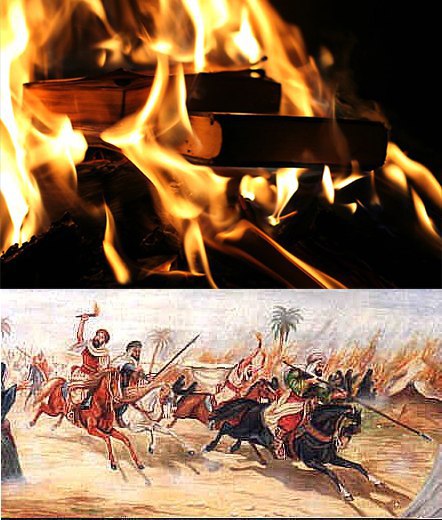
The Third Book Burning
According to Ibn Khaldun’s account in the Muqaddimah, after the Muslim conquest of Iran, Sa'd ibn Abi Waqqas wrote to Umar to say that vast collections of manuscripts had been discovered and asked him what should be done with them. Umar ibn al-Khattab is said to have replied: throw them all into the water, because if they contain truth, we possess something better than it, and if they contain unbelief and error, it is better that they should all be destroyed. And so, it is said, all those books were either cast into the water or given to the flames.
Regarding the Arabs’ burning of books in Khwarazm alone, Abu Rayhan al-Biruni writes in al-Athar al-Baqiya 'an al-Qurun al-Khaliya, pages 35, 36, and 48: “When Qutayba ibn Muslim, the commander of Hajjaj, went to Khwarazm for a second time and reconquered it, he put mercilessly to the sword everyone who wrote the Khwarazmian script and possessed knowledge of its history, sciences, and accounts of the past. He destroyed all the mobads and hirbads of the people, and burned and ruined all their books.”
And now we look at the ghost of our history, imagining that the ruins of civilization are the only inheritance of our past repeatedly burned in the fires of invaders. Yet what has happened to the heritage of thought and culture of the Iranian lands has, in my view, been experienced by no other land, civilization, or culture throughout history. After all this, the Western historian asks Iranians: where is the written evidence of your civilization? If there was a civilization, why have so few books survived?
What many of us Iranians do not know is that, because of Iran’s historical wars first with Greece and later with Rome, the Western world—which understands its own civilization as Greco-Roman—has always regarded Iran as an Eastern stranger and even an enemy. Over the past forty years, relations between Iran and the West have provided an additional motive for this perspective among Western researchers of history and philosophy.
My own experience in Australian universities has been that, out of every hundred doctoral projects in history, ninety concern Greece and Rome and the other ten are devoted to the Far East. Research on Iranian history attracts the least interest because there are very few academics working in the area, and their number diminishes each year.
My effort in these years has been to recover missing lines and articulate a philosophical tradition that began with Mazdayasnian thought and, after Islam, was reborn in the philosophy of Illumination and Iranian mysticism. Suhrawardi believed—and says so in the introduction to Hikmat al-Ishraq as well as in his Talwihat—that there exists an eternal wisdom he calls Hikmat-e Khosravani: a wisdom that began with Zarathustra, travelled through Pythagoras to Greece and through Hermes to Egypt, and was ultimately continued in Plato and the Platonists throughout history. Suhrawardi himself travelled to Syria in search of the historical traces of this wisdom and was killed in Aleppo on charges of heresy.
Amid the painful destruction of our historical heritage, I search through books for the missing lines of this perennial wisdom: in history, to recover its lost route and the historical evidence for it, and in the world of thought. This search takes me from Zarathustra to Plato and the Neoplatonists and to all the Platonic philosophers of history, continuing into the tradition of German Idealism and ultimately existentialism.
My aim is not only to articulate historical evidence for this perennial wisdom, but also to express what it might mean for the rebirth of an Iranian philosophy capable of becoming part of the substance from which the civilization of our future is born and built. Whether I succeed in this work or not, I am certain that a drop of truth cast into an ocean of lies will one day destroy the lie, and that this torch, which has reached me from the hand of Suhrawardi, will pass into the hands of Iran’s future children and travel with them into the future.
Aydin Areta
Comments
Loading…
Leave a comment