
The Power of Individuation
Each of us may think: I am only one among billions. What change could I possibly bring about in this world? Yet the truth is that each of us stands at the centre of a network and affects all those around us. In our time more than at any other point in history, everything we do travels across this vast lake like waves, reaching people we do not even know and perhaps generations we will never see.
The Portuguese writer José Saramago once wrote: “What we do and create, and all the good and evil that flow from our words and actions, continue to live for years, even when we are no longer here to feel satisfaction with what we have done or to ask forgiveness ... and this is the true meaning of the immortality of our actions.”
Thirty years ago, on 4 and 5 June 1989, the People’s Liberation Army of China, acting on orders from the central government, brought a bloody end to a protest movement in Beijing’s Tiananmen Square by massacring thousands of students and citizens who had demonstrated for democracy and a free press.
The movement had begun several weeks earlier following the death of Hu Yaobang, a prominent politician and former reformist leader of the Communist Party. During his political career Hu Yaobang had tried to introduce a series of political and economic reforms in China, but his reforms ultimately failed in the face of severe internal Party opposition, and two years before his death, in 1987, pressure from senior Communist Party members forced him to resign as General Secretary.
On the day of his funeral, 22 April 1989, nearly one hundred thousand people—mostly students—marched toward Tiananmen Square. Their demand was the realisation of Hu Yaobang’s unrealised hopes for China’s future: a country with a more open economy, greater political participation by its people, and ultimately a free press.
As the protests continued and expanded, on 20 May, approximately one month after the movement began, the ruling Communist Party declared martial law. Subsequently, nearly 250,000 soldiers of the People’s Liberation Army entered the capital with heavy weapons. By the end of May the number of demonstrators had grown to one million, making continuation of the existing situation intolerable to the ruling Party.
Finally, at one o’clock in the morning on 4 June, armed troops launched a full assault on Tiananmen Square and began firing directly at the crowd of protesters. In the confrontation and resistance that followed, dozens of military vehicles were set on fire, thousands were killed, and more than ten thousand people—including leaders of the movement—were arrested. Many were sent before firing squads or received lengthy prison sentences. In this way the pro-democracy movement appeared to end in defeat, although in practice it was followed by the beginning of a series of social and economic reforms in subsequent years.
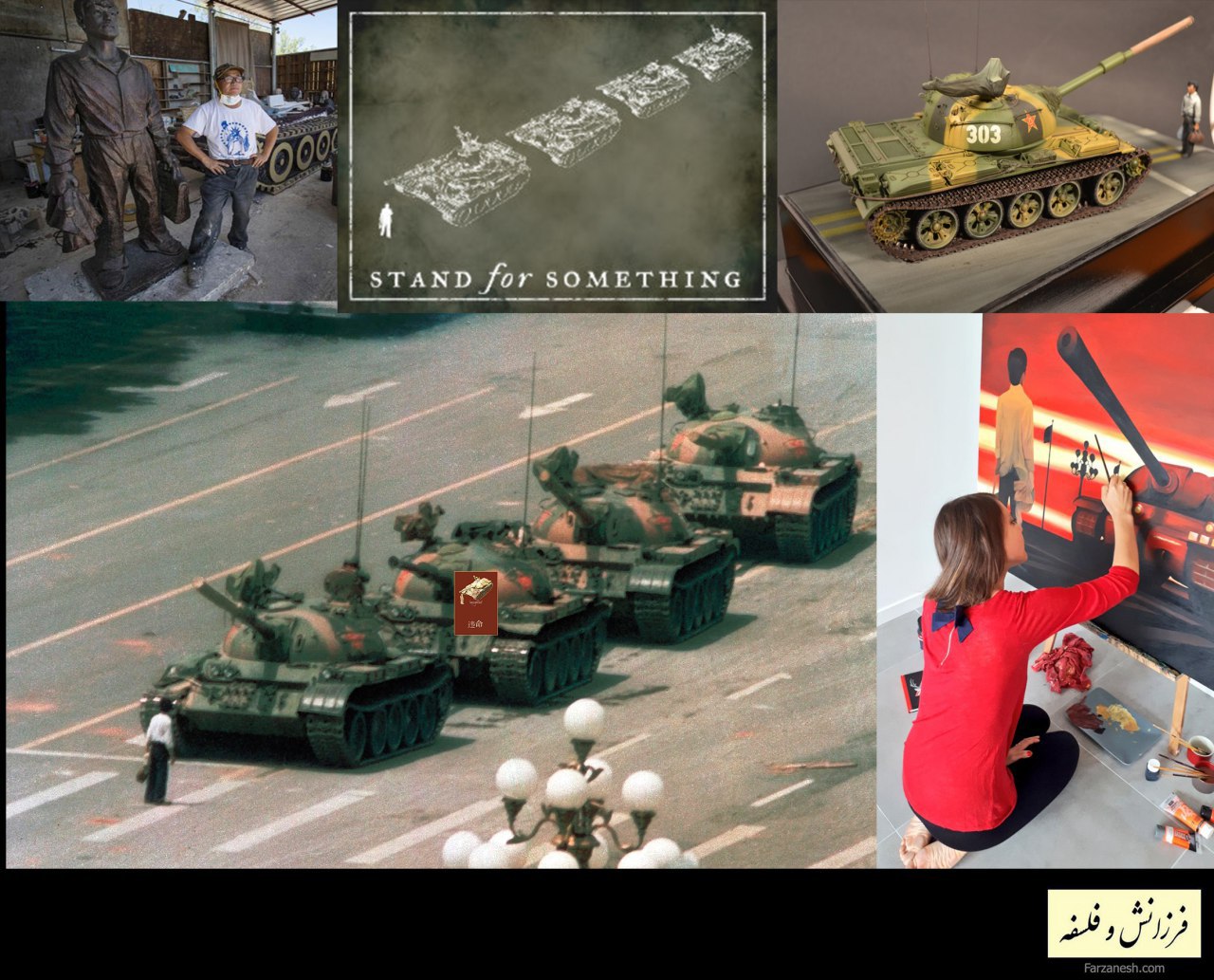
Yet in the midst of this movement, one image fixed the eyes of the world on Tiananmen Square. It was recorded by numerous journalists one day after the massacre and major repression of 4 June and transmitted around the world. The extraordinary image, which became known as Tank Man, showed a lone man who, with almost unimaginable courage only one day after the killing of thousands, stood in front of a column of army tanks and prevented them from moving forward.
The most famous photograph of this scene was taken by Associated Press photographer Jeff Widener. He recounts that on that day, injured and suffering from severe influenza, he had set up his camera on a tripod from the sixth floor of the Beijing Hotel, pointing toward the street to photograph the tanks. A middle-aged man slowly entered the road. At first Widener was irritated because he thought the man had ruined the carefully framed shot by stepping into the composition, without knowing that moments later he would record an image that would become one of the most influential photographs of the twentieth century.
To his astonishment, he watched the man stand directly in front of the lead tank. The tank tried to move around him, but the man moved again and blocked its path. Eventually he was led away from the tanks and removed from the square. To this day, after thirty years, no one knows his name or fate, yet few people have not seen the image or do not recognise Tank Man.
Comments
Loading…
Leave a comment