
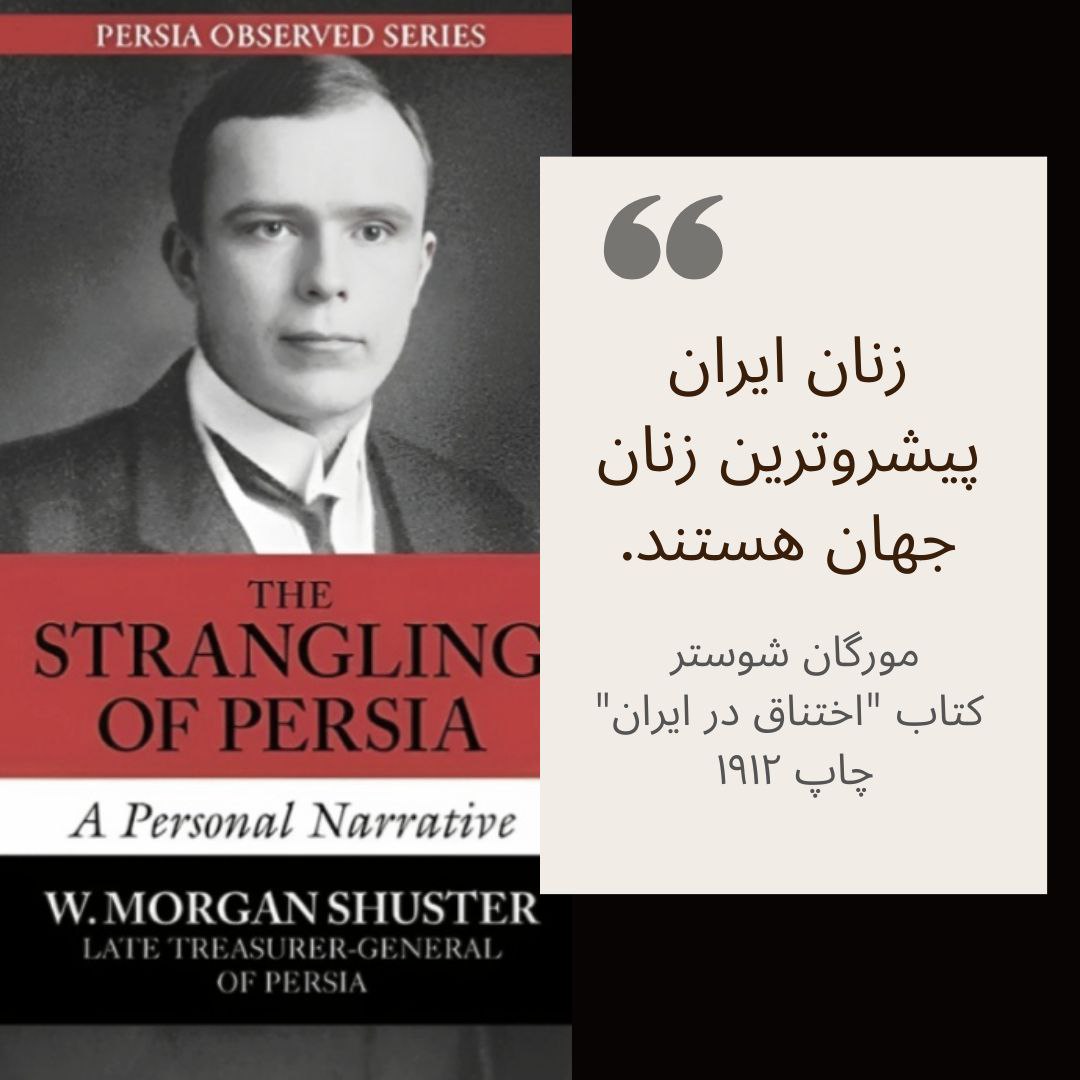
The Most Progressive Women in the World
Aydin Areta
In *The Strangling of Persia*, which Morgan Shuster published in 1912 after leaving Iran under pressure from the Russian and British governments, he wrote:
“The women of Persia are the most progressive women in the world.”
This was during the years of repression after the Constitutional Revolution, less than a decade after Sheikh Fazlollah Nouri had declared the establishment of schools for Iranian girls contrary to religious law. What Shuster was witnessing was the remarkable struggle of Iranian women across two decades to make the supposedly impossible—women’s education—possible.
The first modern girls’ school in Iran, established by Tuba Azmudeh in 1282 SH, survived only four days before it was destroyed by followers of hard-line clerics. Two years later Bibi Khanum Astarabadi’s attempt also met resistance: she herself was attacked and her school was looted. In the same year, Nur al-Hoda Manganeh’s school was burned, while Forough Azarakhshi, founder of the first girls’ school in Mashhad, was the target of an armed attack.
What Shuster saw was how Iranian women, with extraordinary courage and perseverance, without waiting for the support of men and without government support, established more than sixty private schools in less than a decade and continued this struggle until the right of Iranian girls to education was secured.
Shuster writes in the same book, described here as one of the valuable sources on the history of Iran’s Constitutional Revolution:
“It is highly unlikely that anyone could spend even a short time among Iranians, live with them and witness the difficulties they endure with such exemplary dignity, without developing affection for the Iranian people and sympathy for their aspirations for justice.”
During the period in which Shuster was employed by constitutionalist revolutionaries as Treasurer-General of Iran, he is described here as having reformed a taxation system whose treasury was empty. He imposed taxation upon northern and southern customs revenues claimed by the Russian and British governments and seized the property of princes such as Shoa al-Saltaneh in favour of the Constitutional Revolution—actions that angered the Russians to the point of deploying Cossacks in opposition.
What he saw 111 years ago in the raw bricks of the emerging modern Iranian society has today revealed itself in the mirror of history more clearly than ever.
Comments
Loading…
Leave a comment