
Part Two (2):
This way of living is approved and supported by the forces that have defined these duties for us. In this mode we place ourselves in the service of those beliefs and devote our lives to realising them. Yet despite this sense of belonging, Kierkegaard does not regard such belief as equivalent to faith; he sees a profound distance between ethical devotion and faith.
Many self-sacrificing adherents of different ideologies who are prepared to devote themselves entirely to their beliefs belong to this group. If a person devotes an entire life to this mode of living, Kierkegaard calls that person the knight of infinite resignation—someone who gives up everything in existence for the sake of a belief. This way of living involves rationalising and attempting to justify one's conduct on the basis of what has been learned through belief. It is devotion to a belief dictated from outside.
If, up to this point, we map Kierkegaard's thought onto Transactional Analysis and its descriptive personality states of Child, Parent and Adult, the first two domains in Kierkegaard can be understood as living in the Child (felt meanings) and living in the Parent (learned meanings). For Kierkegaard, however, entering the Adult—the domain of thought-out meanings—is not the end, but the beginning of a radical act he calls a Leap.
Act Three:
Kierkegaard believed that thought is always directed towards something. When it is no longer directed towards “me,” it necessarily leaves the first sphere—life for pleasure, psychologically the Child. If it is also no longer directed towards “the other,” it crosses the boundary of the second mode—duty, psychologically the Parent.
Thinking that gives its foundation neither to “me / Child / felt life” nor to “others / Parent / learned life,” and regards only a truth beyond the Ego, society and public opinion as worthy of mature thought, places the thinker at the threshold of the leap of faith.
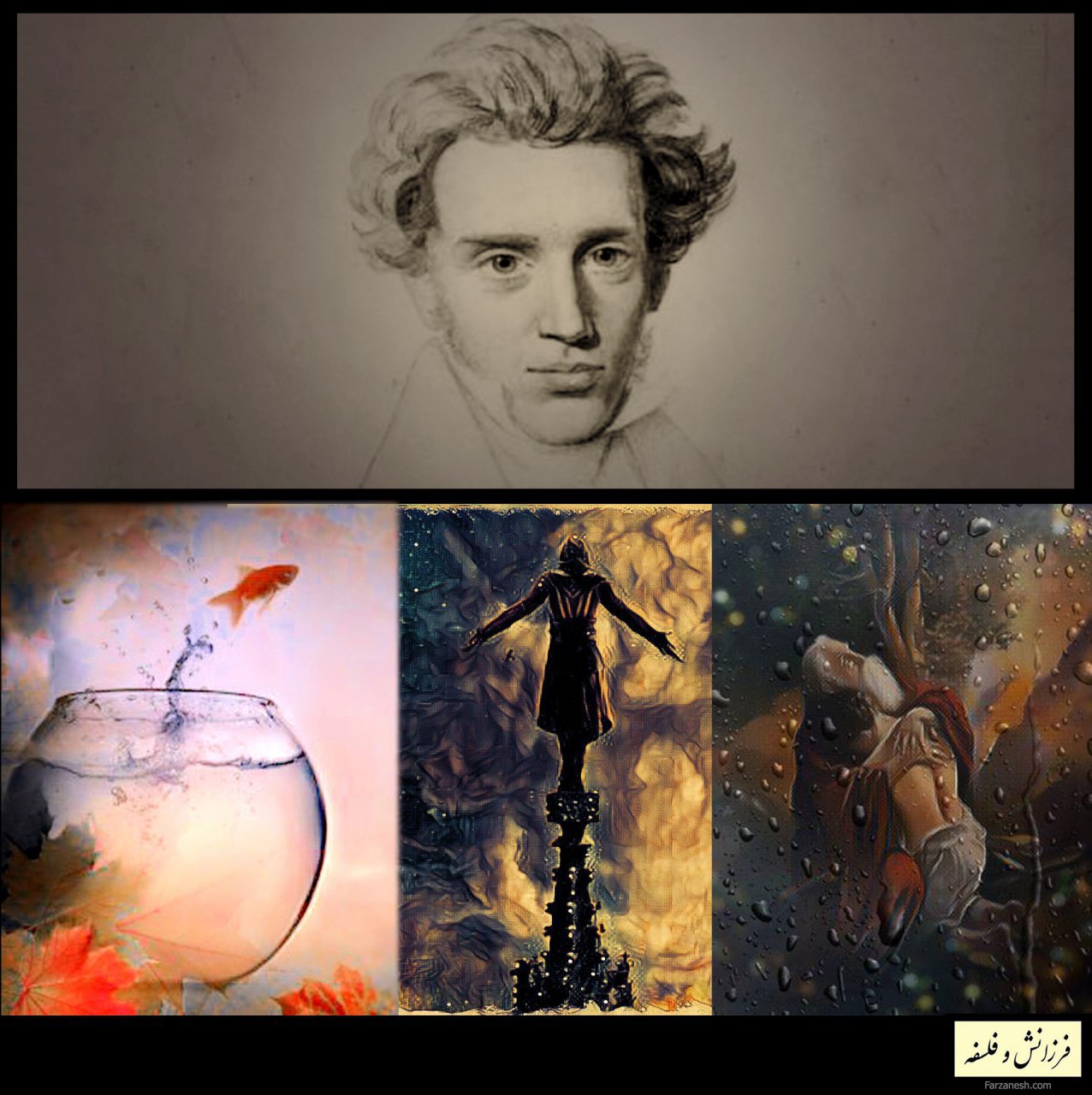
For Kierkegaard this leap is a transcendental act and is irrational in its nature.
The transcendent in Kierkegaard's thought is something beyond the historical thought of humankind. Between Transcendence and the human being lies a chasm whose depth can be crossed only by the leap of faith. To make such a leap one must first be liberated from the tyranny of scientism and rationalism, turning from outwardness towards inwardness and from collective rationality towards personal experience.
In Kierkegaard's philosophy, alongside the truth that exists in the external world—Objective truth—and is studied by science, there is also an inward truth—Subjective truth—which is your own inward truth. Although it cannot be measured by scientific instruments, it is true for you. In Kierkegaard's thought this truth is not of the order of “belief” but of “action,” and for this reason it must be lived within one's individuality. Living this truth requires the Leap of faith.
The leap of faith is the only possible path to a fundamental transformation from one “way of Being” to another “way of Being.” The person who makes such a leap is the Knight of faith.
Comments
Loading…
Leave a comment