
The Error of Templates: Why the Western Analyst Does Not Understand Iran
Aydin Areta
Some time ago I was speaking with a well-known environmental activist in Australia who had become interested in developments in Iran. What confused him most was that, after decades of revolutionary and republican experience, a significant number of Iranians seemed once again to be turning toward Reza Pahlavi. For him this was difficult to reconcile with the familiar analytical templates through which political change is usually interpreted.
This is precisely the problem. Both Western analysts and many Iranian analysts often try to understand Iran through conceptual templates already available to them: classical authoritarianism, theocracy, Middle Eastern populism, the rentier oil state, personal dictatorship, regional Cold War, Shi'a clerical politics, underdevelopment or democratization. Each template reveals something, but each also filters reality through a net whose mesh was woven elsewhere.
The history of politics in Iran is not merely the history of a modern structure of government.
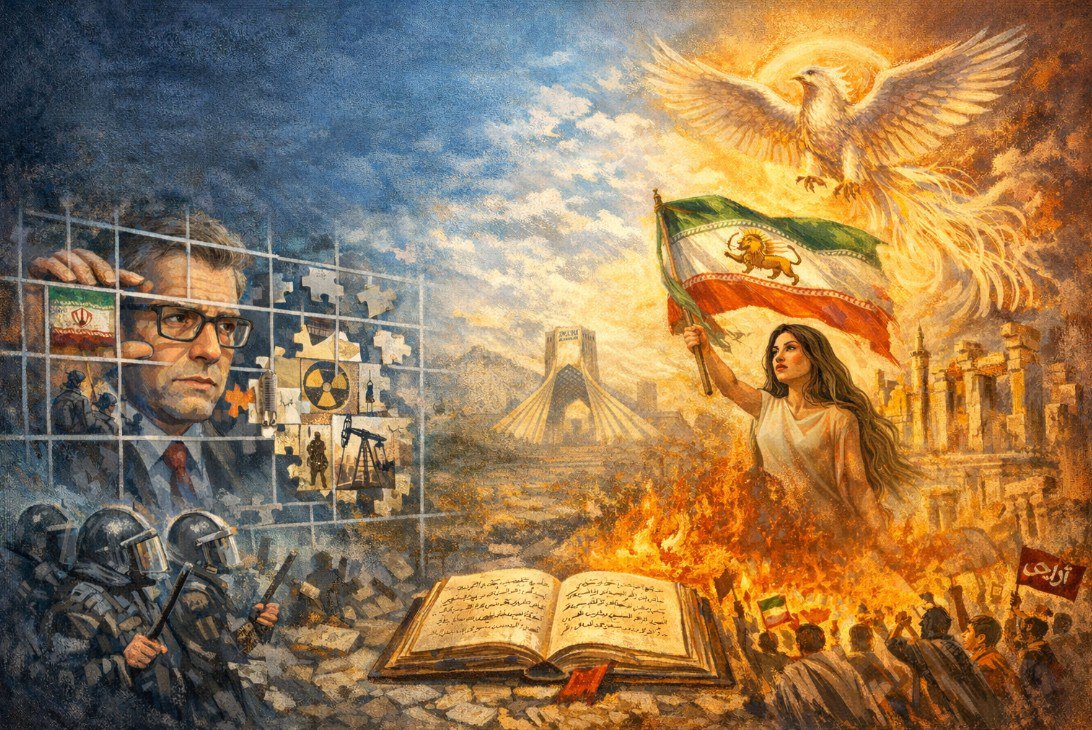
Template-driven analysis reduces Iran to a “political system,” whereas Iran is a civilizational memory that has repeatedly changed form. Analysts see symbols such as a national flag in the hands of Iranians as a “political brand,” without recognizing that symbols such as the Lion and Sun or the Simurgh can function as a compressed constitution of this civilization.
When a Western political analyst approaches Iran through the template of authoritarianism, the search turns toward indicators of repression. Through the template of underdevelopment, attention shifts to GDP and unemployment. Through the template of theocracy, everything is reduced to the Shi'a clergy. Yet none of these frameworks reaches the deeper question: how have Iranians themselves understood politics within their historical unconscious?
This is why, at precisely the moment when an analyst believes the map of Iranian politics is finally in hand, the map slips away. Iran is not merely a “political case.” It is a civilizational field, a memory that has been shattered a thousand times and each time has remembered itself in another form.
Whenever I read an analysis that explains Iran solely through the language of institutions and political templates, I feel that it speaks of the body while forgetting the cultural soul of politics. The point is that soul is not an ornament in Iranian politics; it stands at the centre of the field. Politics in Iran, perhaps more than in many other societies, is a struggle over meaning: a struggle over the narration of history; a dispute over who has the right to say what “good” is, what “evil” is, what “truth” is and what is “sacred.”
For this reason, governments in Iran do not govern bodies alone. They also seek to control language, appropriate symbols, redefine words and reverse the meanings of slogans. Before silencing an opponent, they contaminate meaning. Template-driven analysis fails to grasp this because, within such a framework, language is treated as a marginal aspect of politics rather than as politics itself.
The Western analyst’s most readily available explanation for the reappearance of the Lion and Sun and the return of monarchical thought within the political movement of Iranians is “nostalgia” for the pre-revolutionary period. But for an Iranian this is not merely memory. It is a historical question that never truly disappeared; it merely changed form. Like a turbulent river, it continues to run through the field of Iranian politics: what must power be in order to be legitimate?
It is at this question that the template begins to crack. The historical search of the Iranian spirit has been a sustained attempt to answer it. Even the question of the legitimacy of political rule in Shi'a thought is, at its foundation, an Iranian question rethought in post-Islamic Iran.
Continued in the next post 👇🏼
Comments
Loading…
Leave a comment