
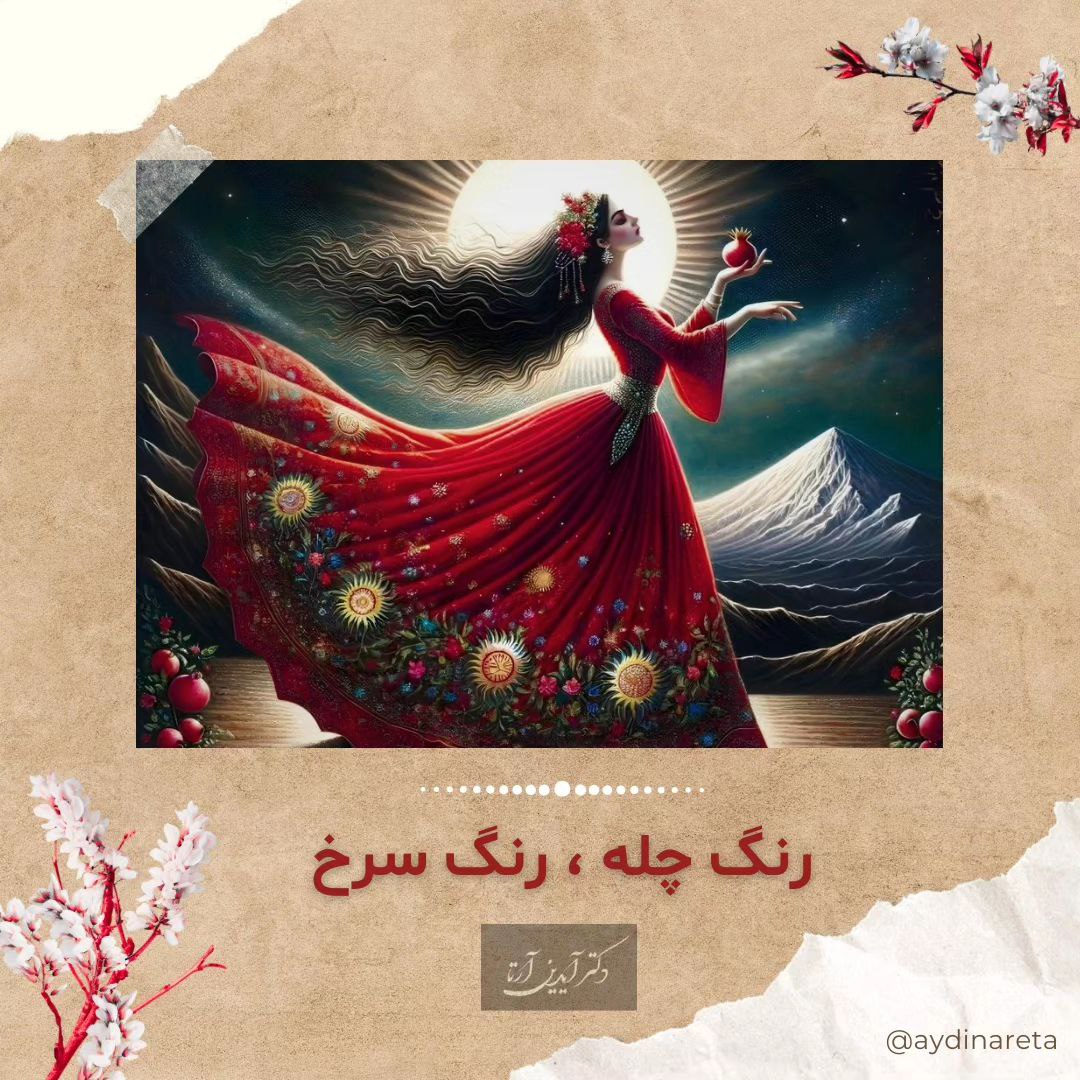
The Colour of Chelleh Is Red
Aydin Areta
Shab-e Chelleh is one of the oldest and most enduring celebrations among peoples across the Iranian plateau. It is a festival rooted in a foundational belief in the victory of light over darkness—a belief seated in the heart of our thought and collective unconscious.
It is the belief that no matter how extensive and overpowering the darkness of night becomes, even after the longest night triumphant Mehr and the exalted sun will eventually rise at dawn on Khur-Ruz, the “Day of the Sun,” and defeat darkness, however dominant and widespread it may be.
It is remarkable that we celebrate the birth of the sun at the moment of night and darkness’s greatest and longest dominion. Our festival of light on the longest night of the year expresses a historical faith in the victory of light, even when we see darkness at the height of its sovereignty and power. At the peak of this darkness we celebrate and sing. The extraordinary symbol of this night is the pomegranate, a symbol of the unity of individuation and union.
Red is the colour of Shab-e Chelleh. Suhrawardi writes in The Red Intellect that red is the colour of the meeting of light and darkness, like sunset or sunrise, or like the darkness and coldness of iron when it is placed in fire. The colour red in the heart of the night’s darkness tells the dominion of night that we ourselves have brought dawn into this night, and that light will arrive after our red-coloured celebration.
Festivals such as Chelleh, Nowruz, Mehregan, and Tirgan have preserved us for millennia against some of the most destructive storms of history—storms that erased the names and memories of many peoples and civilisations from the pages of history—and these festivals still have the power to preserve the seeds of our identity.
They may call this festival whatever they wish, or even remove it from the official calendar, but they will never be able to overcome our thousands-year-old collective unconscious or the archetypes woven into the soul of our history and culture. We will wear red, place a pomegranate at the centre of the Chelleh table, read the enduring poems of the old rose-coloured master, and dance in celebration of light until morning, as we have done throughout history.
At the end of this piece, I opened Hafez at random and found these verses:
Cupbearer, come: the beloved has lifted the veil from the face;
the lamp of those in solitude has been lit again.
...
The tale has filled the seven domes of heaven with sound;
see how the short-sighted one has made the story brief.
Comments
Loading…
Leave a comment