
-
Collective Trauma and Its Treatment
Aydin Areta
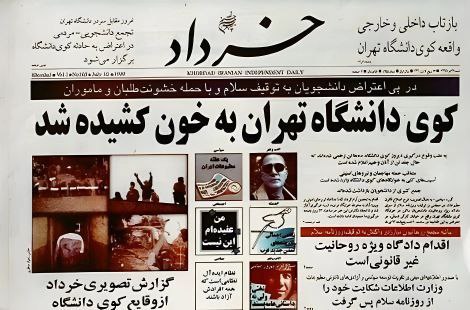
Many memories fade in our minds with the passing of years, but time stopped somewhere in my memory on the morning of 9 July 1999, in front of a newspaper kiosk near Valiasr Square.
That morning I woke exhilarated by the thought that I was turning twenty-two. I left home earlier than usual because I was due to meet a friend at a publishing centre on Enghelab Street. When I reached Valiasr Square, at the beginning of Keshavarz Boulevard, I stopped in front of a newspaper kiosk. I saw the headline of *Khordad*, but I could not properly understand what had happened. I bought the newspaper and began reading it there by the side of the street.
Without realising what I was doing, I sat down on the ground. I could not control my tears. All the dizziness, anger and indescribable pain that poured into me as I read that news ended in uncontrollable crying that I could not stop. I sat beside that same newspaper kiosk and fell apart. The pleasant sunshine of that morning, and the good feeling of unknowing that I had possessed only moments before seeing the headline, stood in a strange contradiction with the pain and anger that suddenly engulfed me like a storm. That afternoon I joined the hundreds of students who had gathered in Enghelab Square.
In those student years I wrote for several newspapers. I had a regular page in *Iran-e Javan*, and I also sent my writings to *Bayan* and several other newspapers. The relatively open newspaper environment in the early years after Khatami’s government, and the growing number of newspapers, created a unique opportunity for young people like me who had a passion for writing and social participation. Only one day before the newspaper *Salam* was closed, it had published something of mine for the first time. A friend who had helped arrange its publication joked that my contribution had brought the paper bad luck. From the closure of *Salam*, a few days before the university-dormitory incident, until that morning, everything was tense. That event did not occur in a vacuum. Everything was charged, much like the days before the nationwide Woman, Life, Freedom uprising.
When Mahsa lay in hospital between life and death, I felt again within myself that same pain and anger at injustice. It was as though that morning, with all its restlessness, had returned. I knew that this time too the feeling was not only my experience; it was our experience of collective trauma returning in another generation.
In the experience of collective injury and trauma there is always silence, distance, a profound sense of anger and injustice, and a terror that remains unspoken and haunts each of us for years in our solitude. Speaking about what we have personally experienced is part of the process through which the social psyche heals collectively, because the waves of the grief we have watched in one another’s arms pass from one generation to the next.
No government will be at peace with its society as long as a distance like collective trauma stands between that government and its people. Such a distance is not healed across generations. It remains and deepens because the injustice felt within it has never received an answer.
To be continued ... 👇
Comments
Loading…
Leave a comment