
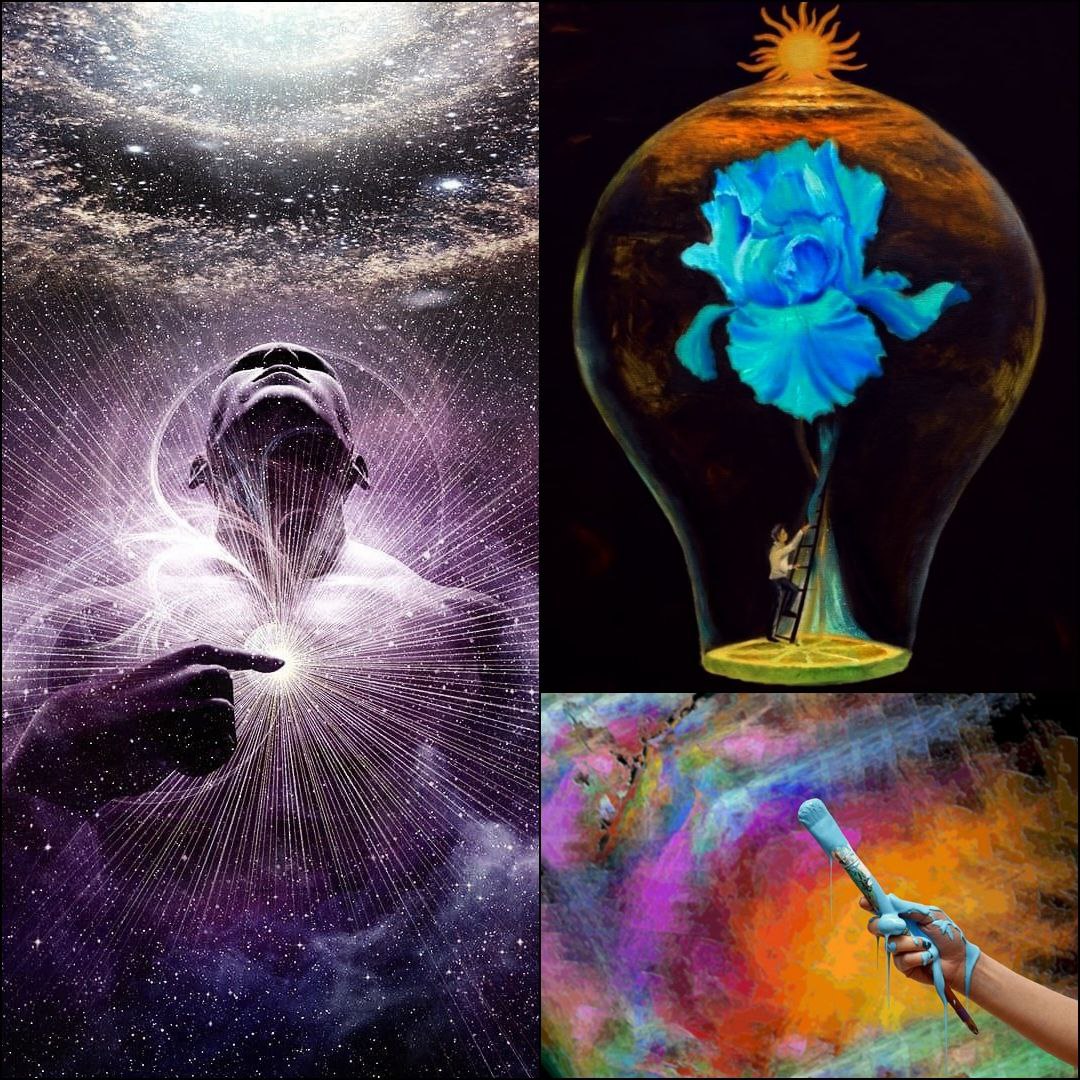
It seems that something within us perceives the world not merely as “what it is” but as “what it can be.” We are moved by the sight of the ocean and captivated by flowers, birds and precious stones even when they offer us no obvious evolutionary advantage. But why is this so?
At least as far as we know the world, human beings appear to be the only creatures capable of seeing “possibilities” within it. A flower is profoundly beautiful to us because it is a symbol of blossoming and of the plant realising itself: a point of final flowering and the fulfilment of life’s potential in this world. We do not consciously think of these images as representations of transcendence. Rather, they seem to be inscribed in us as fundamental archetypal images, at the point where the boundaries of an ideal world—of things as they might become—touch our world.
In the flight of birds we can see the enchantment of transcendence: a creature rising from the earth. Many people imagine that gold or diamonds are valuable merely because they are rare, yet it seems that even in stone we search for transcendence: the point at which stone can become diamond. This is part of what gives the diamond its value for us.
If there is no possibility in the world beyond “what is”, and if we ourselves see nothing beyond that limited actuality, then from where does our capacity to be moved by the idea of transcendence arise? Perhaps it arises because we can see such a possibility in everything and can perceive things not only as they are but as they might become. Deep within ourselves we know that we possess a remarkable capacity to transform ourselves and the world into something higher. Throughout our history we have struggled along this path.
The modern world has an obsessive tendency to master everything: to reduce truth into smaller particles so that it may be made more comprehensible, scientifically understood and measured, and brought under technological control. In a philosophy of transcendence, however, we do not conquer. We voluntarily allow ourselves to be overcome. We know that we must bend in order to pass through the door of the temple of truth. Yet once we enter that temple, being overcome by the grandeur of truth gives us a sense of magnitude and liberation.
In The Perennial Philosophy—which I have translated into Persian as “eternal wisdom”—Aldous Huxley writes, in the rendering used here, that philosophy is not an abstract theoretical system based on theoretical reason and logic, but a form of life in which love of truth and wisdom is the highest value; and that any philosophy placing this love of truth at its centre is fundamentally Platonic. Such a philosophy is not a closed theoretical system but a way of living.
Whenever philosophy speaks of, or evokes in us, the passion for transcendence, we enter the Platonic world, the transcendent realm, and the eternal land of perennial wisdom. It is a truth that exists not only in the world but also within us. Our own Self, and what we can become, is the seed of our transcendence. It is a light that every human being can sense within. This is the divinity of human individuation: the individuation that we must bring into being.
We are free to walk this path, to accept our responsibility in the world, and to transform our existence into that light. This is my understanding of the philosophy I call “transcendent existentialism.” For me, philosophy is love of a world that can be realised but has not yet been realised—a world we can see in imagination and, by bringing it into being, also realise ourselves.
Aydin Areta
Comments
Loading…
Leave a comment