
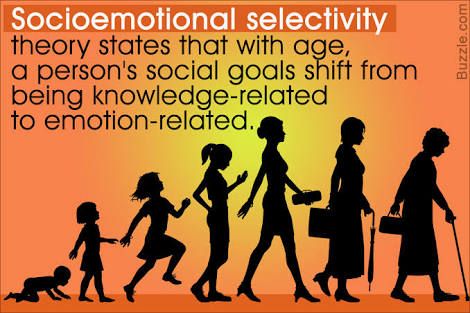
Socioemotional selectivity theory in social psychology explains that when we are young, and when the main motivation behind our activity is future development, many of our activities are likewise future-oriented: gaining more knowledge, for example, or tolerating an emotionally unbalanced situation in the hope of reaching better conditions later. But as time passes and we grow older, a point may come when we feel that we no longer have much time. At that point, instead of investing in activities whose rewards lie in the future, a shift in our motivations leads us towards activities with faster and more reliably satisfying emotional returns.
As time passes and ageing begins, we may invest less in knowledge and the growth of personality and more in emotions that offer an immediate return.
By choosing short-term investments of time and emotion, we narrow our lives to a small circle of friends whose behaviour is predictable and from whom we receive positive feedback. We increasingly choose activities that we know will offer pleasant and positive short-term emotional rewards: a picnic with friends, more time on social media, social gatherings, or simply watching a film after coming home from work.
The future gradually loses its colour, and small pleasurable activities take the place of long-term plans, under the influence of a belief that time for long-range planning is running out. Changes in motivation eventually alter our cognitive activity and may draw us towards cognitive stagnation, because learning is almost always a long-term investment.
How much each of us still thinks about the future, and how young we still consider ourselves in relation to long-term investment in the projects of life, can be assessed partly through our capacity to forego short-term daily emotional satisfactions for the sake of better outcomes in the future.
Some of us decide very early that the future is already lost and become concentrated on rapidly rewarding emotional activities. Others retain their orientation towards the future well into old age. This is a choice that, to some degree, remains open to us.
Aydin Areta
Comments
Loading…
Leave a comment