
Questions on Platonic Transcendentalism
Response to Question Three (2–3):
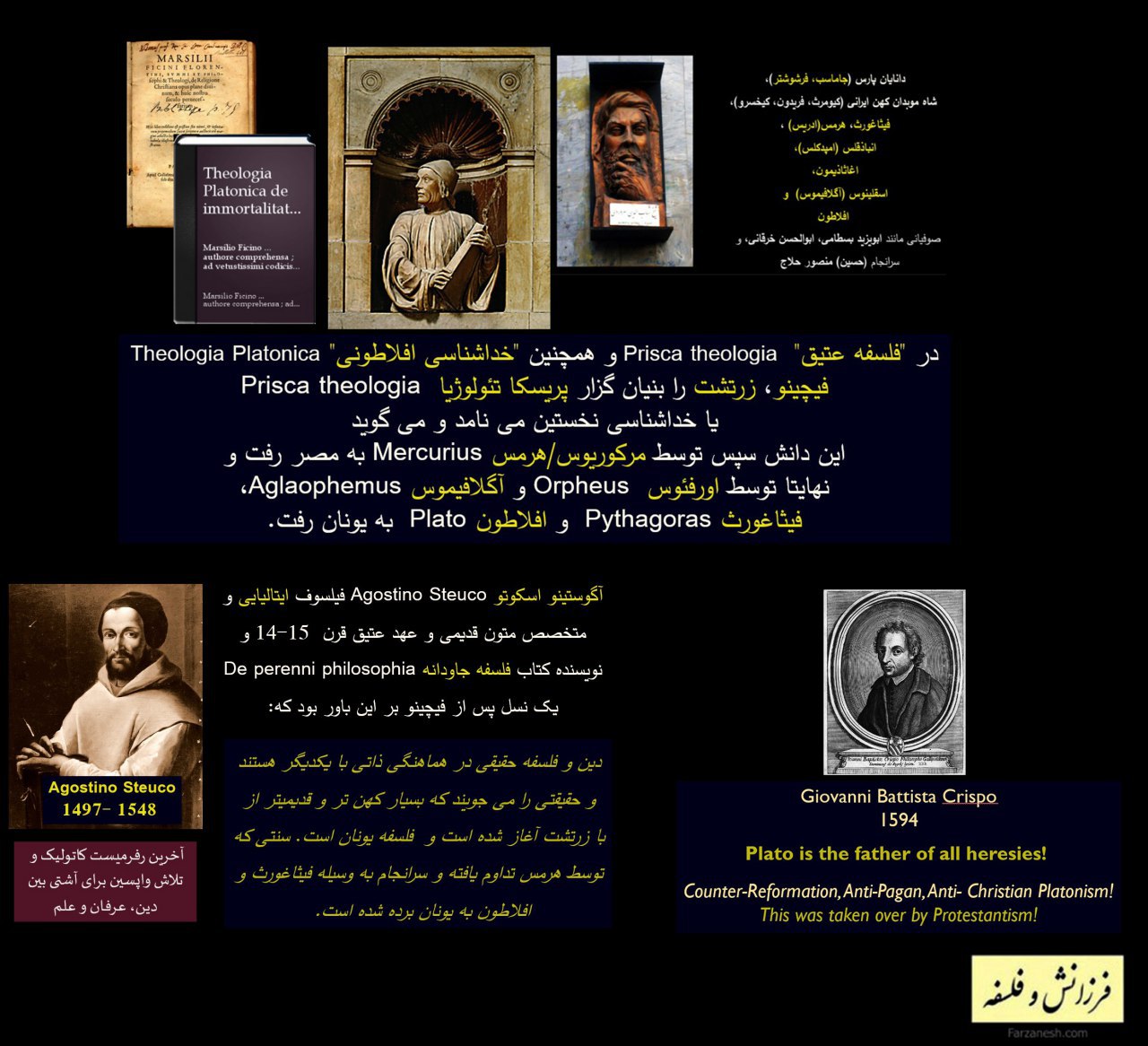
Giovanni Battista Crispo, a powerful figure in the Church and a leader of the anti-Platonic movement in the late sixteenth century, is quoted as saying: “Plato is the father of all heresies!” He believed that until Platonic thought was destroyed the Church could not return to its truth. Elsewhere he is said to have argued that when the Church was at the height of its power it had Plato captive and should have killed him, but the Church’s negligence allowed this poisonous serpent to escape.
We in Iran have encountered a closely analogous phenomenon. If we understand the deep continuity between Iranian mystical thought and Platonic philosophy, and recognize that a substantial part of our own philosophical movement was profoundly Platonic—to the point that Suhrawardi has been called “the Imam of the Platonists of the East” (and even in relation to the Peripatetic/Aristotelian Ibn Sina and the transformation of his thought in his final years, reflected in the lost work Hikmat al-Mashriqiyyin, there is room for reflection and investigation)—we can see how one group calls our mystical movement the essence and truth of religion, while another calls it a deviation from religion. There have been many jurists of the same kind as those who issued the decree for Suhrawardi’s death, who, like Crispo, believe that whatever deviation entered religion came through the mystics.
Now let us return to your question.
If we replace Platonic truth with God, in any religion, what fundamental difference remains between Platonic transcendentalism and a religion, whatever its creed may be?
The issue depends on how one understands religion. This is the fundamental difference between Mazdayasnian thought, or a large part of the mystical movement after Islam, or Christian Neoplatonic thought on the one hand, and, for example, the literalist religion of some Zoroastrian priests, the dominant thought of the Catholic Church, or Sunni Wahhabi thought on the other. Both can be called religion, yet in one Platonic thought forms the essence of religious thinking, while in the other it is the root of heresy.
If religion is defined as a belief system with a set of culturally prescribed practices, structured to determine how human beings should act and behave, then Platonic thought either is not religious thought at all or does not correspond to the common and classical understanding of religion. It not only recognizes the light of truth and the Logos within every human being, but asks people not to be satisfied with the shadows that puppeteers display on the wall of the cave in the name of truth. It asks them to break their chains and seek the light of the sun, which, because it also exists within them, can lead them out of the cave if they search for it honestly. This is not an accepted mode of thought in the official reading of many religions. The difference between this kind of religious life and its opposite is the difference between Suhrawardi and the person who ordered his death, though both understood God to be watching their actions.
Comments
Loading…
Leave a comment