
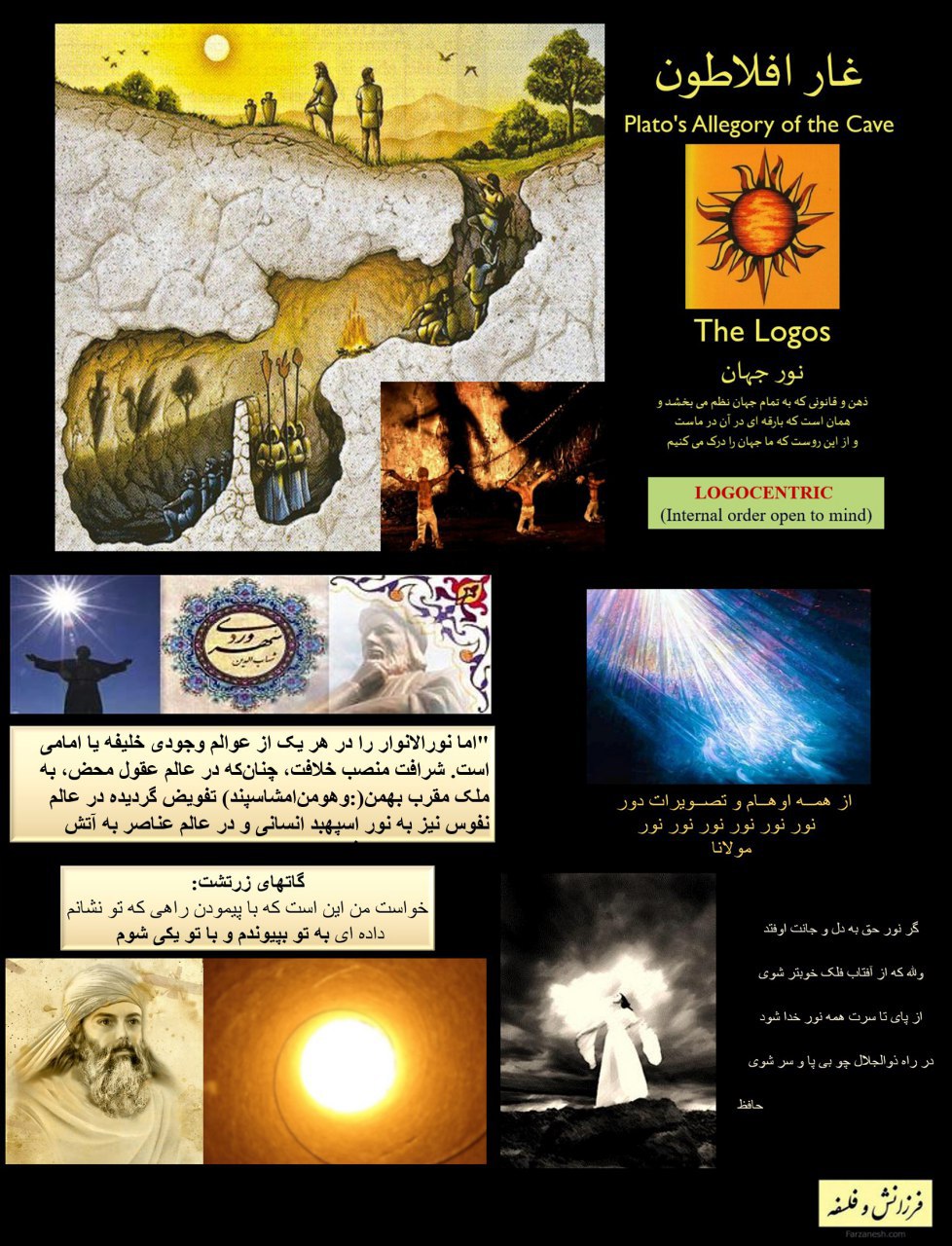
Questions on Platonic Transcendentalism
Question Two (Hanieh): Why do we need Plato's theory of the world of Forms in order to understand the theory of transcendence?
Accepting Plato's theory, especially when Forms and Ideas are understood as existing outside our minds and in a world beyond this world, is not easy. It seems imaginary. If there were no mind to apprehend Ideas, the Ideas would not exist.
It is understandable that we are always trying to move towards transcendence and to give Ideas a more complete reality.
I can imagine, for example, that love might be an Idea far broader and deeper than what my mind can understand today.
I try, by moving towards growth and transcendence, to understand this Idea more deeply and realise it in practice. Could we perhaps say that this Idea of love exists in the human collective unconscious?
Response to Question Two (1–2)
Theories do not create truths. They merely attempt to express a systematic understanding of one aspect of those truths.
Truth in itself has no need of theories, and certainly there is no single theoretical path through which one must enter it.
What makes Plato's theory important for transcendental thought is not simply that it describes the world of Ideas and Forms as a complete realm that can stand before our present world as the goal of its transcendence. Two further points in Platonic thought also establish an important philosophical paradigm:
1) Platonic thought is Logocentric. By this I mean that Plato believes that outside the cave of the world's shadows there is a sun—the absolute truth—from which all Forms and ideals receive their light and truth.
The light of this sun gives Being to all these Forms. Leaving the cave therefore means not merely leaving to discover Ideas and Forms, but moving towards this highest truth.
This thought has a deep affinity with Mazdayasnian ideas, and we can see it repeatedly reborn in Iranian philosophy and mysticism: the belief that Ahura Mazda—described through images such as the giver of light, all-light, the radiant one of radiants, Light of Lights, Nur al-Anwar—
“beyond all illusions and images ... light of light of light of light of light of light”
conceived a perfect world, Spenta Mainyu, and then, in the path of realising it and preserving it from Ahriman, created the material world and finally the human being, with free will, as the greatest weapon in the struggle against Ahriman.
In the history of thought, “logocentric” is used here for a way of thinking that believes in the existence of a transcendent truth. If you think logocentrically, truths and values will have a hierarchy within your mind.
Comments
Loading…
Leave a comment