
Questions on Platonic Transcendentalism
Question Three (Arshia): If I have understood correctly, Plato says there is a sun—Truth—outside the cave, and this truth does not depend upon our minds. Even if the earth were completely emptied of human beings, truth would remain what it is. My question is: if we replace “truth” in the sentence above with “God” (in any religion), what fundamental difference remains between Platonic transcendentalism and a religion, whatever its beliefs?
Response to Question Three (1–3):
This is one of the most important, and at the same time one of the most difficult, questions one can ask about Plato.
The relationship between Platonic thought and religions has always been one of the most controversial relationships in the history of ideas.
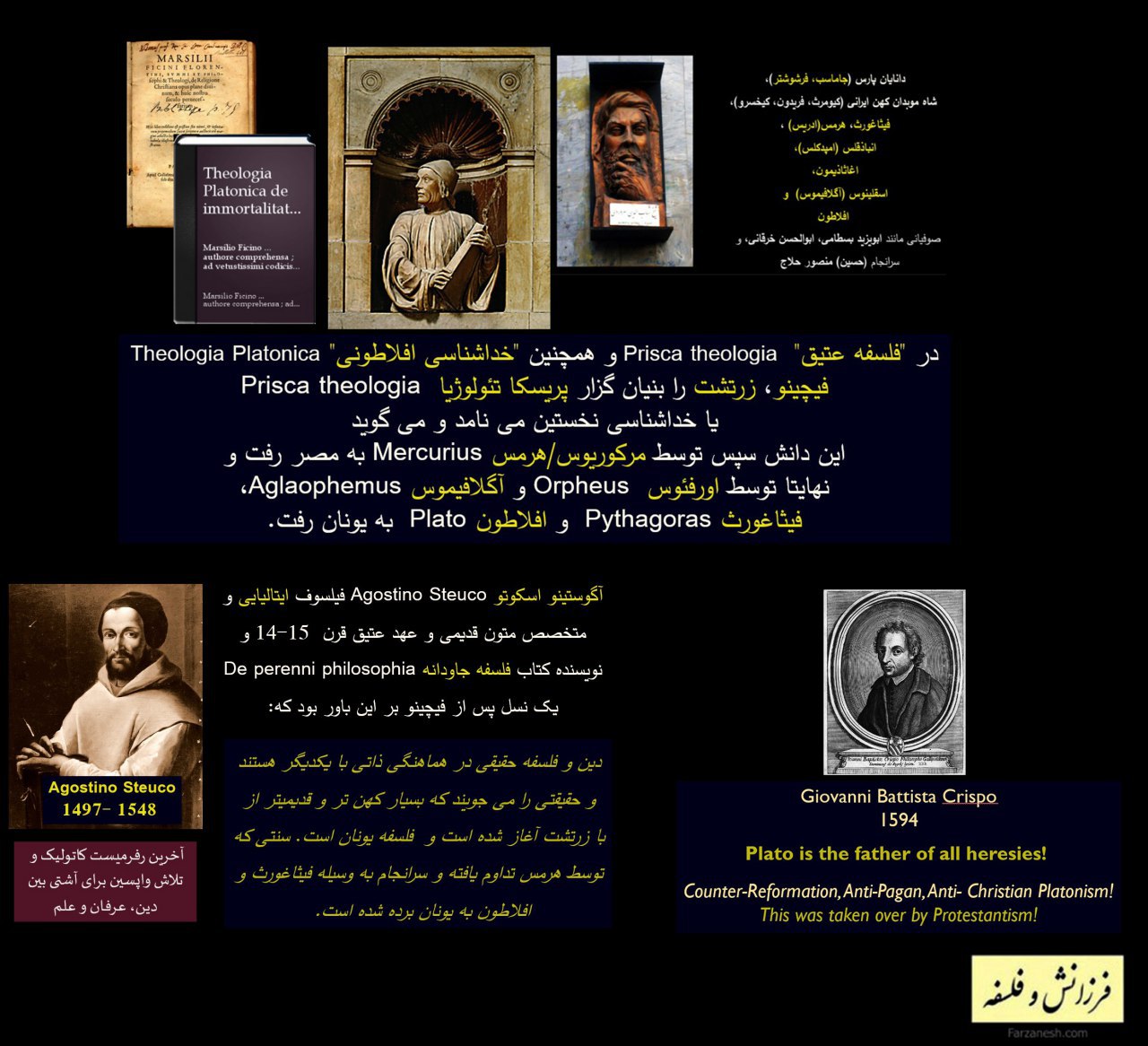
Many of the early Church Fathers considered themselves Platonists. Augustine of Hippo, for example, believed that no one had come as close as the Platonists to what he regarded as the heart and truth of Christianity. This view was strongly affirmed again by the Neoplatonic movement within the Church in the fifteenth and sixteenth centuries, from Ficino to Agostino Steuco, who saw their aim as a kind of Platonic reform of the Church.
The following statement is attributed to Steuco, who was head of the Vatican Library in the early sixteenth century, one of the major scholars of his time, and has been described here as the last Catholic reformer of this type:
“True religion and true philosophy are in intrinsic harmony with one another and seek a truth far older and more ancient than Greek philosophy: a tradition that began with Zoroaster, was continued by Hermes, and was eventually carried into Greece by Pythagoras and Plato.”
They called this philosophy the Perennial Philosophy—De perenni philosophia—or, in Ficino's terminology, Prisca theologia or Theologia Platonica.
By contrast, especially after the defeat of the last powerful Neoplatonic group within the Catholic Church, an opposing idea gained strength—although it had existed from the beginning—that Platonic philosophy lay at the root of every heresy and deviation within Christianity.
Comments
Loading…
Leave a comment