
Response to Question One (2–1):
Aristotle, by contrast, although he too accepts Forms, rejects Plato's way of understanding them. For Aristotle, everything is made from Matter / Material; this is Substance, and whatever that thing or matter becomes is its “form.” The Being of anything therefore consists in the combination of matter + form.
A piece of wood can become a statue, a door, a window or a table; becoming a statue, door or table is the form of this matter. A wooden chair, for example, acquires meaning only through the combination matter + form. “Chairness” has no independent meaning in itself, and there is no separate world outside the material world containing an “Idea of the chair.”
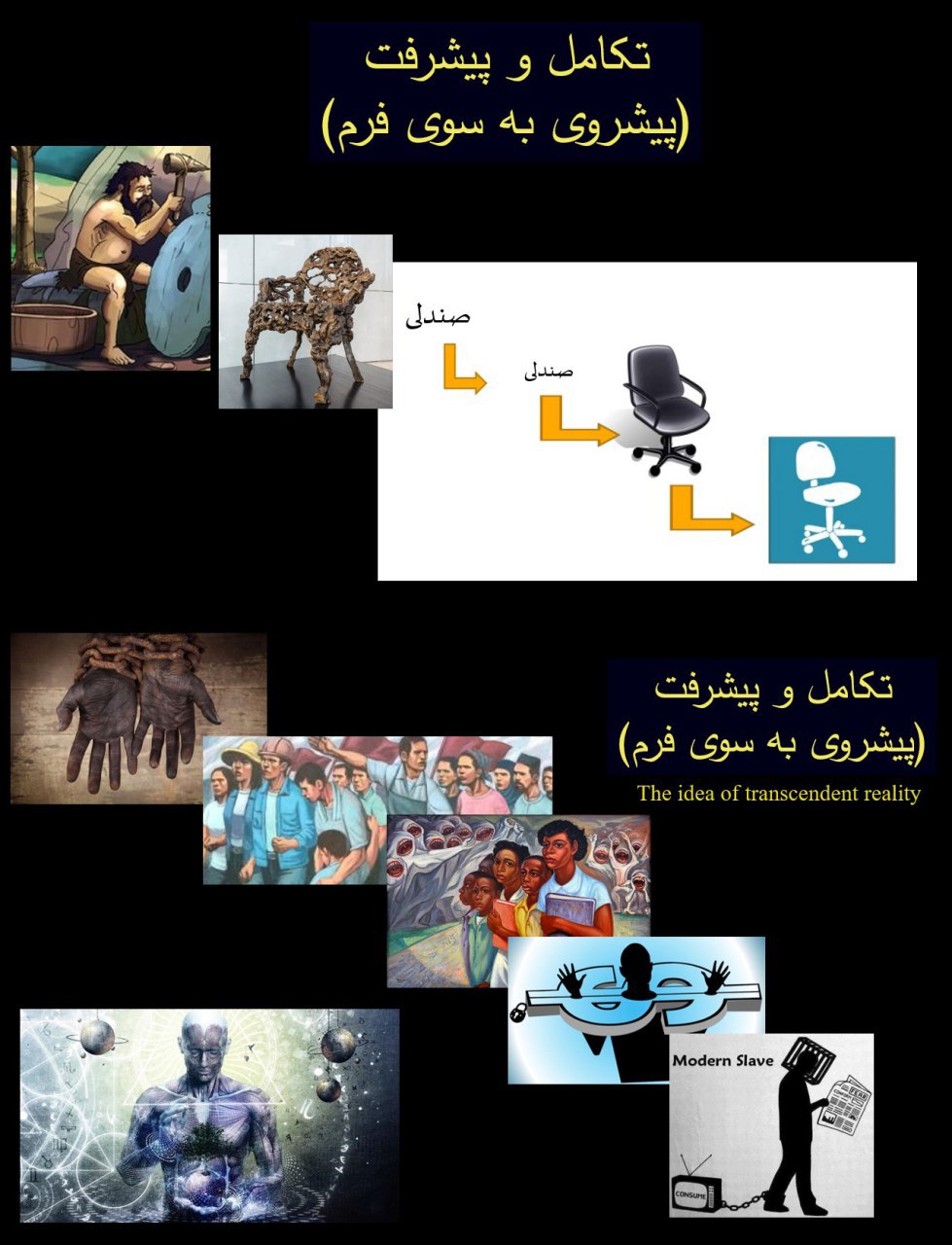
In Plato's view, by contrast, the “Idea of the chair”—or, to make the point clearer, the ideal chair—exists in the world of Ideas. Ten thousand years ago we may have sat on a flattened stone; gradually the chair develops because mind continually passes beyond the material world towards the world of Ideas, bringing the material world closer to the ideal realm. Along this path the chair gradually becomes more complete: it acquires wheels, begins to move, and perhaps one day we will sit on a surface that takes the form of our body, rises from the ground and flies. Through transcendence towards the world of Ideas, we apprehend more complete patterns of life and things—from a chair to our understanding of justice and beauty—and develop them in the material world.
For Aristotle, the question is how to understand the world as it is. He therefore asks sceptically: when we say “wooden chair,” does anything called a chair possess an independent, non-material existence? His answer is no. This Aristotelian idea is called Hylomorphism. Aristotle understands even phenomena such as life, knowledge, justice and beauty in this way. A human being is an earthly/material entity and the soul is a form; the combination of the two gives the human being life. Socrates is wise: “wise Socrates” is Socrates combined with the form of wisdom.
Some forms are Accidental and some are Essential. If Socrates is overweight, for example, that is accidental and not necessarily a stable form. In a wooden table, by contrast, being-a-table is the form that defines the identity of its Substance and is Essential; if the table is painted red, redness is an accidental form.
In my view, if we do not imagine Plato's theory of Forms as describing a parallel world, but instead understand it as describing a mental world, or the world of the human transcendental imagination, then there is fundamentally no contradiction between these two perspectives. My personal view is that Aristotle had a limited understanding of Plato's theory of Forms because the questions occupying his mind and the object of his search were different. He was more concerned with understanding what the material world is and with classifying things than with the mental world of which Plato spoke.
For Aristotle, philosophy was the understanding of what the world is. For Plato, it was understanding the best way to live in the world and transform it. These two approaches to philosophy have existed throughout its history.
Comments
Loading…
Leave a comment