
Part Two
In the Freudian view, the human being is a social animal in conflict with the animality within. The only real forces in the understanding of the human being are sex and aggression, while morality means little more than the will to power of social forces seeking to repress the two.
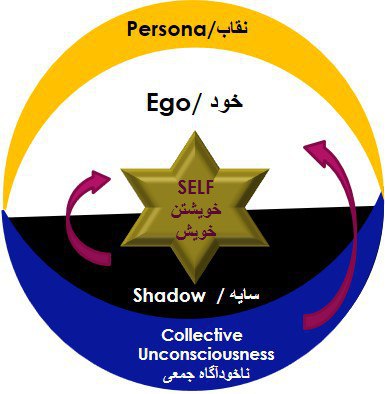
In Jung’s perspective, the human being is depicted as a more complex being than in Freud’s conception. The unconscious contains not only basic instincts but also repressed and undiscovered beliefs and talents, and beyond them the vast world of humanity’s collective unconscious and the history of the evolution of consciousness present within every human being.
Freudian psychology portrays the human being as a puppet of instincts and social laws, whose ultimate psychological health consists in establishing a balance between these forces: a puppet whose movements are smoother and less conflicted and who is therefore more satisfied with life. In the Jungian view, the human being is on a journey towards the development of individuation. Along this path, one must enter the darkness of the unconscious, become aware of it, and illuminate it with the light of consciousness in order to complete the continuity of personality and the process of individuation. On this journey, our beliefs, religion, collective unconscious, symbols and unconscious convictions are all brought before the test of consciousness.
The ultimate aim in Jungian psychology is what Jung calls individuation. Individuation means the final union of conscious and unconscious and the attainment of what Jung calls the Self. This Self is fundamentally different from the “I,” or ego. The Self can be understood as an “I” that is not limited in space and time; it contains not only what we are, but also all that we can be and are not yet. In Jung’s view, this Self sits at the heart of our being, much like the light or the Buddha at the centre of a mandala.
Where Should We Look for Our Shadow?
Each of us likes to think of ourselves as possessing valuable virtues. What are the values you respect and hold as great? Now imagine their opposites. Is it possible that somewhere in your life you have expressed those opposites, or acted under their control?
Do you admire honesty, courage and freedom? Can you remember places where you were dishonest, fearful or cowardly, or behaved like a slave? Where has this happened to you, and how many times? Where have you acted against your own values?
The shadow can be found in our evasions and avoidances, in fixed and similar events that repeat themselves in our relationships and behaviour, in our repetitive actions, and in moments of anger.
More precisely, our core anxieties; our anger, especially when it tends towards violence; our feelings of shame and inner humiliation; our apparently inexplicable resistance to change and to other people; self-harming behaviour directed towards either body or psyche; places where even we do not know why we are so easily provoked and inflexible; and, conversely, moments of inexplicable softness and flexibility—all can reveal a shadow within us of which we are unaware.
Do we end our friendships in the same way? Do our relationships repeatedly run into difficulty through the same pattern? Do we encounter the same problems at work? Do we repeatedly disrupt the balance of our lives? By thinking about and honestly facing these recurring events, we can see the footprints of our shadow.
Another place requiring reflection is wherever we insist intensely that we are right and where being right assumes vital importance for us. At such moments and in such situations, we should look for the shadow.
Another important area is where we behave in conditioned ways—what is called conditioning. Our ordinary, spontaneous, everyday behaviours, which we perform throughout the day without thinking about them, also lie in the darkness of the shadow. Likewise, wherever we live life unexamined and unthought, we can find traces of our shadow. We do not want to repeat ourselves every day, yet we do so; this is one of the places where the shadow makes its nest.
Jung believes this darkness is precisely where self-knowledge must begin, because the darkness concealed in the unconscious directs a large part of our behaviour throughout life without our being conscious of the source of those behaviours.
Comments
Loading…
Leave a comment