
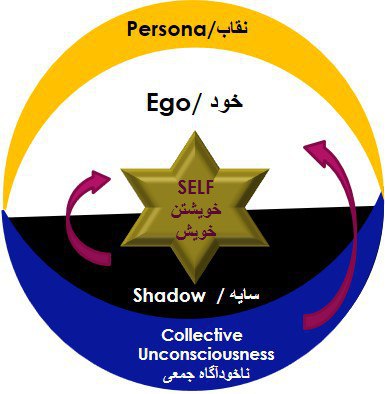
Part Three
In truth, our story and this hidden, dark part of our unconscious closely resemble the famous tale of Mulla Nasruddin searching the ground beneath a street lamp. A passer-by asked what he was looking for. Mulla replied that he had lost the key to his house. The passer-by asked where he had lost it. Mulla said: in the darkness—but I am searching here because this is the only place with light!
We, too, have lost the key to our individuation and the development of our personality in the darkness of our unconscious, yet most often we search for it in the light of consciousness, where we will never find it.
The key lies in our shadow and unconscious, where we must find the courage to confront and search for it. It is hidden somewhere in our darkest darkness.
Confronting the Shadow
Jung believed that all of us can, to some degree, understand that there are bad aspects within us; but an unmediated and naked encounter with the depth of the unconscious shadow is a crushing experience for any human being, one for which not everyone will find the courage or be able to withstand the fear. The experience is something like staring into the eyes of Ahriman and then realising, in terror, that we are looking at ourselves in a mirror.
This does not mean that there is a devil within us. It means that in each of us there is a shadow darker than we have the courage to accept, a shadow cast over the light that is our inner truth. Until we stand before it and overcome it, we will not reach our inner light either. The shadow continually tries to take control of our thoughts, feelings, actions and choices. Shadow can be another name for everything that lies behind our mind yet of which we are not directly aware. It is often filled with what we wish we were not, but unconsciously are.
In a lecture at Yale University in 1937, Jung said in substance:
We are often certain that we know what other people think and what their true character is. We judge others constantly on that basis. We are certain that we know bad people whose negative qualities are absent in us. In my view, we must be extremely careful about unconsciously projecting our shadow onto others. If someone were courageous enough to stop all his projections, he could no longer say: they did this or that, others are wrong and I am right. Such a person knows that whatever darkness and difficulty exists in the world also exists within himself; and if he learns how to deal with the darkness and unconscious errors within himself and bring them into consciousness, he will then have succeeded in resolving an essential part of the world’s immense and apparently insoluble problem.
We all have weaknesses. There are aspects in each of us much darker than we can even imagine. We all like to imagine that we are good people with good motives. At the very least, we assume that we are harmless. For that reason, accepting that part of our being is so dark that, in the words attributed to Jung, its roots reach all the way into hell is frightening.
Accepting the concept of the shadow means believing and then admitting the bitter truth that we human beings are less good than we imagine ourselves to be, and that in each of us there is a hellish darkness. Remaining unconscious of its existence and depth can not only prevent us from reaching the light within, but can allow that darkness to govern the lives of other people—even those we love—and ultimately the world outside us, perpetuating its dominance from generation to generation.
Believing that we are harmless and underestimating the depth of our own shadow is extremely dangerous. Consider how mothers and fathers, despite all their love for their children, can underestimate the importance of their own negative characteristics and pass them on to the next generation.
Ordinary Men tells the story of a group of ordinary policemen in Nazi Germany who, before the war, were good fathers and husbands within their families and harmless men in society. All of them were already adults when the war began. This is important because becoming deeply ideological and being thoroughly indoctrinated usually requires that one be younger than thirty. This is why soldiers are trained from a very young age and why influence over the mind must begin early if one is to bring another person’s beliefs deeply under control. During the war, these ordinary and, under normal circumstances, harmless men were sent to Poland. The book tells how we harmless human beings can become the most hard-hearted killers, and how an ordinary person can move step by step to the point where he is able to drag a pregnant woman across the snow and shoot her in the back of the head.
Comments
Loading…
Leave a comment