
Part One
Carl Jung, the distinguished Swiss psychologist whose school of psychoanalysis took a different path from the dominant Freudian psychology of the twentieth century, divided the structure of the mind into several fundamental parts.
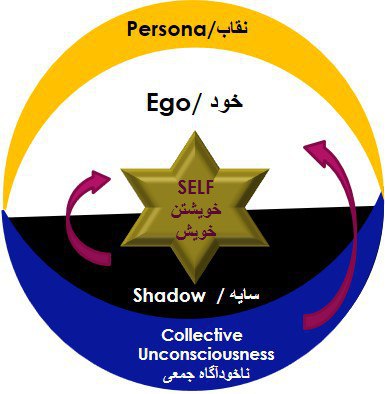
At the first level of Jung’s division of personality structure, we have the conscious and the unconscious. The conscious is the aware part of our mind and is itself divided into two parts: the persona, or mask, and the ego. The unconscious is likewise divided into the personal unconscious, or shadow, and the collective unconscious.
The persona is the most superficial layer of personality and, in fact, the mask each of us wears in our encounters with the outside world. This mask or persona is shaped by two forces. The first is internal, formed according to our ideal image of ourselves in society and the way we would like and want to appear to others. The second rests on external forces such as culture and social rules, with which we are compelled to bring our mask into alignment. The persona is therefore the product of the interaction between inner and outer forces, presenting to the world the visible shell of who we are.
The ego is a mediator between the personal unconscious or shadow, the collective unconscious, and the outer shell of personality—the persona. The ego is what we experience as the “I.” It is an inner organising force that coordinates thoughts and feelings and is an embodiment of conscious awareness.
The personal unconscious, which in this account is the shadow, is a part of our personality that the ego, or “I,” does not see or accept as part of itself. Everything that we are at a semi-conscious or unconscious level without being aware of it belongs to the shadow: a dark part of our being that we are unable to comprehend consciously.
Because our conscious mind does not like to become aware of negative aspects of personality, or aspects that conflict with it, these dimensions remain important parts of our personality yet are not consciously recognised. Awareness of them may damage our self-confidence, our sense of self-acceptance, or the way we face the outside world.
Jung believed that everyone has a shadow, and that the less conscious we are of that shadow, the denser and darker it becomes.
By Jung’s definition, the shadow consists primarily of the darkest and most negative aspects of our personality of which we are unaware. These lower aspects of personality are shaped in our unconscious by our repressed wishes, our interactions with the outer environment, our childhood upbringing, society and the traditions in which we live, working on us from both outside and within. It is like a monster that slowly begins to grow inside us in childhood and makes its home somewhere in the dark dungeons of the psyche; at times flashes of its fire burst out of us and engulf others. Yet this is not the whole shadow. Part of it also contains our repressed talents and capacities, and part of the individuality that society has suppressed.
The shadow is repressed by consciousness as far as possible, but we are never conscious of it in its entirety. What is remarkable is that other people sometimes see our shadow and even try to show it to us while we ourselves remain unaware of it. The truth is that most of us are able to see other people’s shadows while they themselves cannot, just as we are unable to see our own.
In a brief comparison between Jung and Freud up to this point, one of the very important differences between their perspectives can first be seen in the fact that Freud divides the conscious mind into the ego and the superego, and regards the entire domain of the unconscious as the id; from this perspective, unlike Jung, he does not believe in the existence of a collective unconscious.
In Freud’s thought, the id is with us from birth and contains all our sexual instincts, aggression, drive towards pleasure, and flight from pain and suffering, with which we struggle throughout life. The superego—morality and supra-individual social rules—compels us to repress these instincts, while the ego attempts to satisfy the id rationally and within the framework accepted by the superego.
Comments
Loading…
Leave a comment