
Our Relationship as Iranians with Our Cultural Past and Historical Civilization — Part Two
(Through the myth of Osiris and Horus in ancient Egypt)
As time passes, Osiris grows old and his sight declines. His brother Seth impatiently looks for an opportunity to remove the old and blind king of the world. Because Osiris has no child and successor, Seth, as the second-born of the world, can become king and bring chaos and darkness to rule over it.
Isis, who knows Seth’s plan, continually protects and cares for her husband Osiris. Eventually, however, Seth finds Osiris alone and kills him, places his body in a coffin, and casts it into the Nile. After a long search, Isis finds Osiris and, through her healing power, restores him to life.
At another opportune moment Seth kills his elderly brother again. This time he cuts Osiris into pieces and hides each part in a different corner of Egypt so that Isis cannot restore him to life.
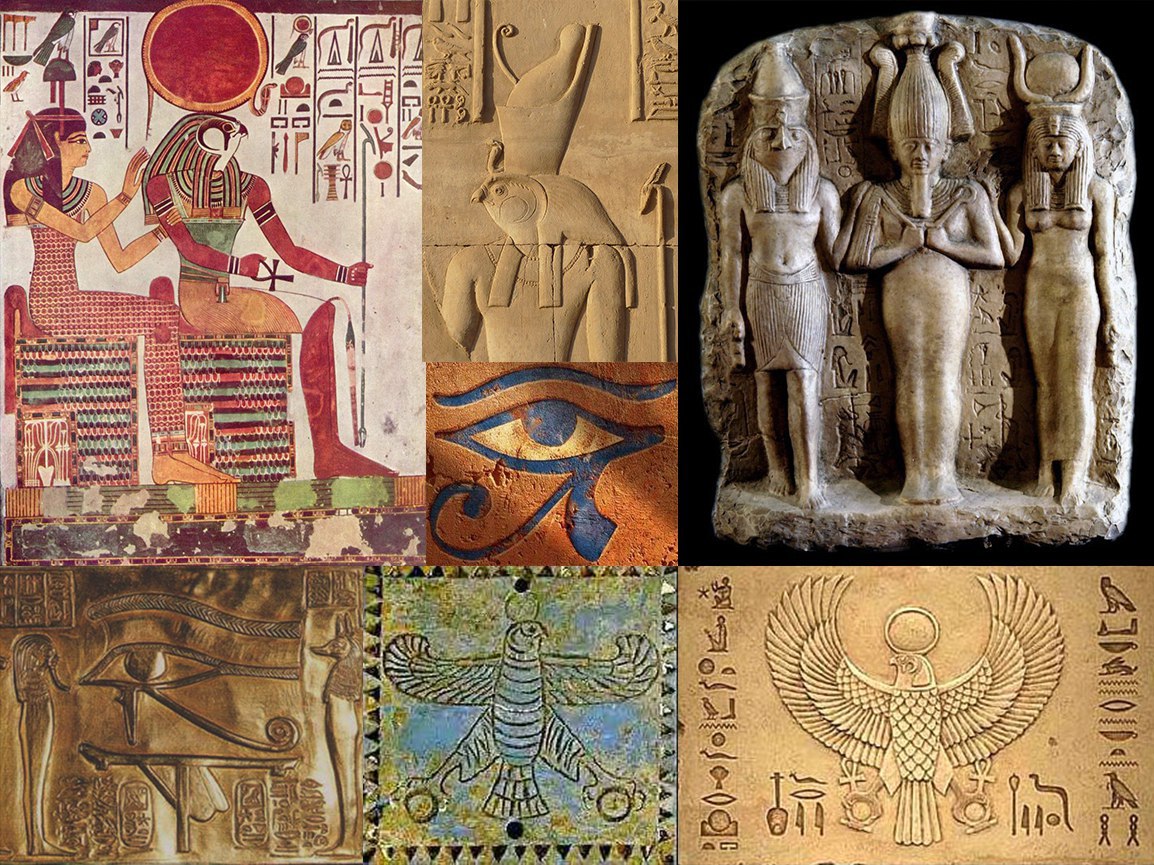
When Isis learns of her husband’s death, she first weeps for him, but ultimately, in a tireless search, gathers the pieces of his body from across Egypt. She then takes the form of a bird and, using her magical power, draws the essence of Osiris from his body and becomes pregnant by it. Thus, from Isis—the goddess of magical knowledge and healing—conceiving from the reassembled remains of Osiris—the guardian of human beings in life and death and king of the world, murdered by his destructive brother—a child is born with the head of a falcon. His name is Horus, and his eyes carry the radiance of the sun and moon. In this way, nothing by day or night can remain hidden from the keen sight of Horus.
The Eye of Horus is a well-known symbol in the history of religious mysticisms around the world. In many images Horus bears the sun above his head and is himself an embodiment of the sun. Regarding the etymology of the word Horus, reference has also been made to the Indo-European root hor, meaning sun, creating the possibility that this very ancient myth may fundamentally have an Indo-European origin. What is striking is the remarkable similarity between the falcon depicted on the standard of Cyrus the Great, the Achaemenid king, and the image of Horus visible in the illustration used above for this piece. (The royal emblem of Cyrus, dating to a time before the Iranian conquest of Egypt, can be seen in the centre of the image above, at the bottom.)
Perhaps, if an appropriate opportunity arises later, I will write about this resemblance, its importance, and some more recent archaeological findings concerning the ancient roots of the Horus myth. Here I will say only that if we understand Horus and the falcon depicted on the Achaemenid standard as connected to a shared source, this story and myth is no longer wholly foreign to us.
In older versions of this story, Thoth, god of ancient knowledge and wisdom and creator of writing, science, and the earliest inscriptions in the world, is the one whose magical knowledge makes possible Isis’s conception from the lifeless body of Osiris.
Ultimately Horus goes to war against Seth, god of darkness, both to avenge his father Osiris and to save the world. He triumphs in a decisive battle, although in that battle he loses his left eye, the eye that gives him the ability to see in darkness. At the end of the battle, however, Thoth—the god of knowledge who, among his many other qualities, is also god of the moon—appears on the battlefield and restores Horus’s left eye.
The most astonishing and meaningful moment of the story comes after Horus regains his eye. At this point he makes an unexpected choice.
Having recovered his eye, he could become the young and powerful king of the world. Instead, he does something unforeseen. He takes his left eye, which possesses the power to see into the world’s darkness, descends into the underworld of the dead, finds his old and blind father Osiris, and gives the eye to him. In this way Osiris is reborn and recovers his sight. Horus returns him to the world and asks that they rule it together.
Osiris entrusts kingship of the world to Horus and ascends to the heavens, becoming lord of the world after death and judge of the purity of the souls of human beings who have departed from this world.
Aydin Areta
Comments
Loading…
Leave a comment