
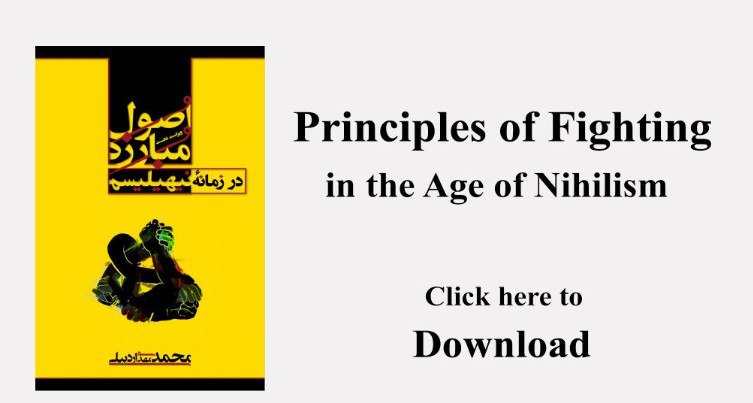
Individuation, Meaning, and the Underworld of the Soul
A Reading of Principles of Struggle in an Age of Nihilism
by Dr Mohammad-Mehdi Ardabili
Aydin Areta
Among the names you have suggested over the past few days for the conversation project, one name was repeated more than any other: Dr Mohammad-Mehdi Ardabili.
The truth is that my familiarity with his thought was limited and brief, so on your recommendation I decided to read his book Principles of Struggle in an Age of Nihilism. I have begun, and so far I must say I have enjoyed it greatly. Following your suggestion, once I have finished the book and reflected more deeply on his thought and work, I intend to invite him for one, or perhaps several, conversations.
Having read roughly half the book so far, I can share my personal response and say that I found several of the central axes of his thought particularly compelling. I will share these foundational themes as I understand them, along with aspects of his philosophy where I see differences between our approaches to nihilism, meaning, and freedom, so that, if an opportunity for conversation arises, we can later explore both the similarities and the differences more deeply.
In my reading of the book, the centre and locus of responsibility and freedom is the “individual/subject,” not the collective. In his view, too, a philosophy that is abstract and severed from the fabric of life is a philosophy already dead and without value. Knowledge that never leads to action will never lead to awakening or liberation.
Ardabili’s account of nihilism is not an evaluation of one belief against alternative beliefs. Nihilism is, rather, the atmosphere and air we breathe; it is a paradigm within which our entire individual and social existence is situated. Politics, in this framework, becomes the centre of our radical struggle against such pervasive and profound nihilism.
Another point is that the theoretical core of the book, as I am reading it, rests on a theory of a “system of narratives and figurations”: that all religious, philosophical, political, and scientific systems are ultimately networks of metaphors, figures, and narratives. The power of narrative, and its role in the story we tell ourselves and the world we create through these stories and myths, is also beautifully drawn within his project. What deserves admiration is that he lives within the myth to which he is trying to give renewed life and power.
All three of these convictions play a central and foundational role in my own philosophy of individuation, and this is where I find a personal, meaningful, and pleasurable connection with his philosophical vision.
Dr Ardabili also, on the one hand, criticizes irresponsible Romantic ideas and a form of Eastern spirituality based on escape from life, thereby distinguishing his practical philosophy from such beliefs. On the other hand, he simultaneously accepts a constructive role for Eastern wisdom in increasing the subject’s preparedness and awareness for struggle. I am aligned with him in both the rejection and the affirmation.
Dr Ardabili’s deeply honest book courageously avoids hope-therapy and quick answers. Although it begins from a point of desperation, it does not flee from the long suspension within the vertigo of nihilism. It explores a wide range of inadequate responses to the problem of nihilism, yet ultimately acknowledges that his own intellectual system is not only a theoretical and practical response to nihilism, but another story: one formed around the archetype of the “warrior-hero” within a society historically enchanted by nihilism, seeking meaning through the choice to struggle—not “against nihilism,” but “from within the condition of nihilism.”
Despite the profound affinity I feel with these foundational principles in his thought, at least at this stage I think there may be a difference in the foundational myth and narrative that each of us inhabits, and I will turn to that in the continuation of this text.
Dr Ardabili beautifully and accurately portrays nihilism as home, father, and enemy. He carefully avoids the trap of recommending struggle with nihilism in the sense of defeating or overcoming nihilism, because he knows that such a struggle would only strengthen the myth of nihilism and allow us to be possessed by this archetype of the underworld.
He repeatedly emphasizes that this enemy cannot be fought from outside or simply opposed, because every blind confrontation and struggle only makes the enemy more powerful. And yet the book remains centred on “struggle,” creating the sense that, amid the destruction of systems of value, “struggle” itself risks becoming a value. It is as though, after overthrowing the other gods, we secretly raise the myth of a new god in the form of Mars and Saturn in order to impose order on the metaphysics concealed in this work under the name of “method.”
Continue in the next post...
Comments
Loading…
Leave a comment