
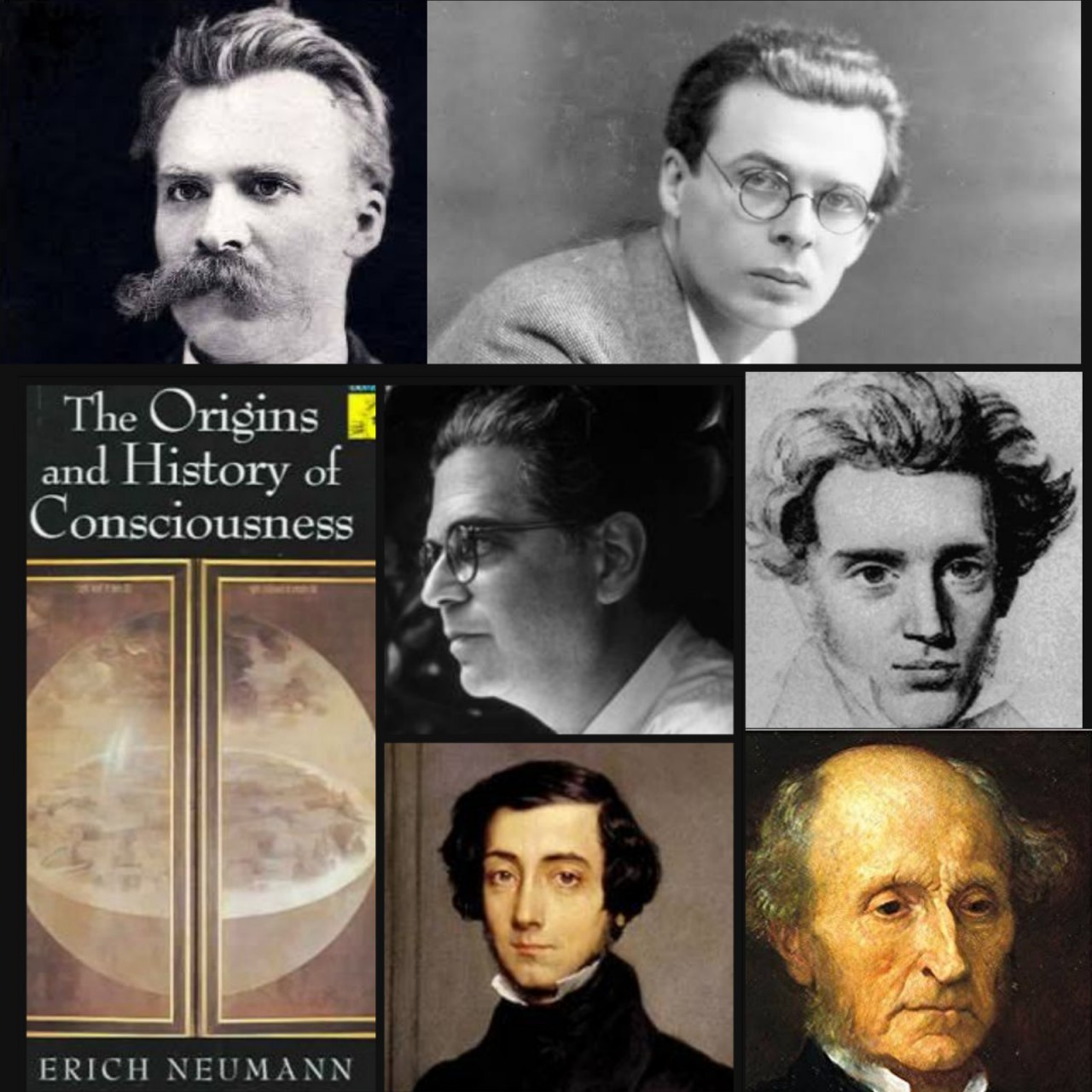
How is the freedom of modern human beings threatened simultaneously from “within” and “without”?
A look at Erich Neumann’s ideas in The Origins and History of Consciousness
(Part Two)
In a new form, a modern aristocracy may be reconstructed within industrial and economic structures under the deceptive name of democracy. This new domination does not destroy citizens’ lives in the old manner, nor does it usually oppress through chains, executioners and naked violence. Instead, modern state power perfects and civilises its techniques of control and therefore appears less hateful and humiliating in the eyes of those subjected to it.
Peacefully, and through laws formulated and administered democratically, this domination can turn citizens into passive subjects expected to trust the benevolent power of the state while devoting themselves to family life, work and material consumption.
Freedom is placed in chains once again in history, this time under a new justification: security. Opponents of government are recast as “opponents of security”, and freedom is restricted through the weapon of security. In this way, with the return of a modernised form of domination, freedom—once the first aspiration of democracy and of the modern human being—becomes one of the first casualties of the democratic state.
If Tocqueville’s warning can be understood as one of the early warnings to modern humanity about the quiet restriction of freedom “from outside” by political power, other thinkers—long before Neumann and roughly in Tocqueville’s time or shortly after him—pointed to another painful process occurring “inside” modern human beings. This inner process may be an even greater threat to modern humanity and its struggle for freedom.
John Stuart Mill, often regarded as one of the architects of modern liberalism, warned in his historically important On Liberty, written about two decades after Tocqueville’s Democracy in America, that as political and social freedoms expanded a new slavery was taking shape without clear historical precedent: the “slavery of public opinion”. Mill’s concern, as presented here, was that people would not merely become blind followers of whatever was fashionable and publicly approved, but more troublingly would come to desire, even in the depths of their hearts, nothing beyond what the majority regarded as acceptable.
Søren Kierkegaard, the Danish philosopher and precursor of existentialism, warned at roughly the same period that modern society’s excessive concentration on freedom of speech might be a compensatory reaction to the loss of something deeper: freedom of opinion and freedom of thought. In the formulation used here, Kierkegaard suggests that we can lose independence of thought so silently that the loss of a low-value banknote troubles us more than the loss of intellectual freedom.
Only a few decades later, Aldous Huxley, in his literary and philosophical work Brave New World, imagined a dark future in which pleasure-seeking and consumerism dominate human life and thinking—and consequently philosophy, art and literature—are displaced. If George Orwell, in works such as Animal Farm and Nineteen Eighty-Four, fears the return of overt tyranny and the chaining of modern humanity, Huxley imagines that modern societies may no longer require such naked oppression at all: no one needs to steal freedom or hide truth if truth itself becomes irrelevant and freedom of thought becomes unnecessary.
Many philosophers, including Friedrich Nietzsche in the late nineteenth century, warned about collectivism and the dangers of forgetting individuality. Nietzsche sees collectivism as connected with the herd instinct and as an unconscious force hostile to thought and individuation. Liberation from domination by the collective and freedom from the herd become, in this reading, primary conditions of modern freedom at a time when individuality is increasingly crushed beneath the wheels of mass society.
The experiences of the twentieth century—from the Soviet Union and China to forms of consumer capitalism in which public opinion and widespread material desires can flatten individual distinctiveness—are presented here as reasons for taking seriously the concerns voiced by Nietzsche, Mill, Tocqueville and Huxley.
Aydin Areta
Comments
Loading…
Leave a comment