
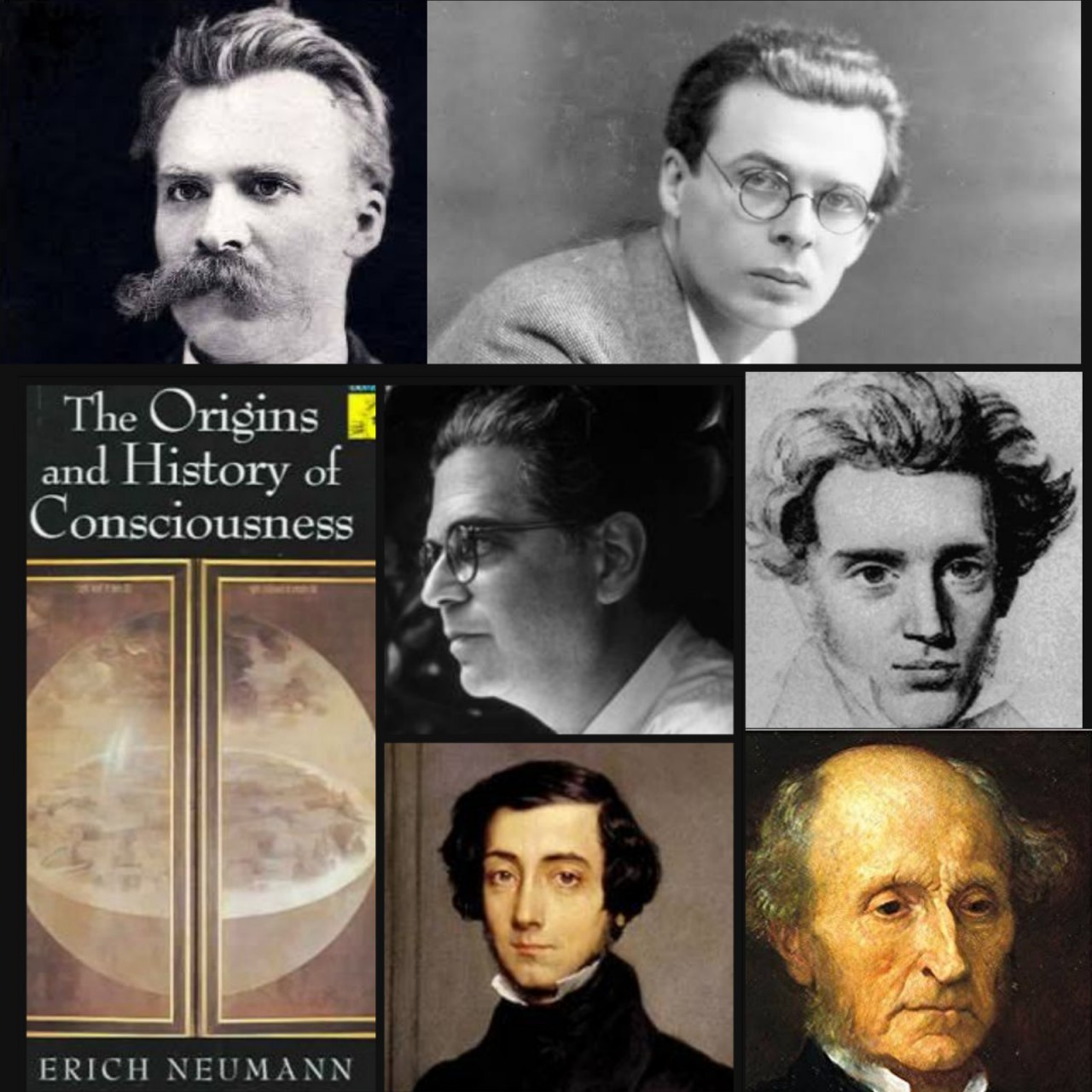
How is the freedom of modern human beings threatened simultaneously from “within” and “without”?
A look at Erich Neumann’s ideas in The Origins and History of Consciousness
(Part One)
Erich Neumann, the German psychologist and philosopher and one of Jung’s most prominent students, warns us in the final chapter of his important work The Origins and History of Consciousness—under the title “Mass Man and the Phenomena of Recollectivization”—that although modern human beings appear to be freer than at any previous point in history, and although greater value seems to be placed on individuality, a new form of tyranny is taking shape through the enslavement of consciousness by our unconscious mind.
Before considering Neumann’s warning about the destruction of modern freedom from within, I want to broaden the discussion and consider how modern freedom is being restricted from both “outside” and “inside”.
Throughout history, it seems, we have struggled continuously and tirelessly against forces outside the sphere of our individuality that have sought to enslave us.
There was a time when slavery, racial superiority, and political and social inequality between men and women were treated across much of the world as self-evident and acceptable, while children’s rights, universal education and the political participation of all citizens were scarcely imaginable. Today we live in a world in which tyranny and the ugly face of such inequalities certainly remain in many places, yet their former absolute domination over human consciousness has gradually weakened, and their influence upon our collective awareness has diminished.
It is now more difficult than at almost any previous point in history openly to defend naked tyranny that enslaves human beings and promotes inequality, because a new consciousness of freedom has been taking shape within the modern mind.
Readers of my earlier writings will probably have seen me repeatedly return to Hegel’s description of human history: “The history of the world is nothing other than the progress of the consciousness of freedom.” To accept this description is to believe that human beings continually expand their awareness over time and, as that awareness develops, not only become freer but also understand more deeply the purpose and meaning of freedom itself.
While many thinkers and people around the world, intoxicated by the modern understanding of freedom, imagine that we now stand at freedom’s summit, other thinkers warn that alongside these significant and valuable developments a new tyranny is forming in both our “outer” and “inner” worlds.
With regard to the new tyranny emerging externally, Alexis de Tocqueville—the nineteenth-century French thinker best known for Democracy in America—argued, long before the great expansion of democracy in the second half of the twentieth century, that after the French and American revolutions the democratisation of societies in the following century would become an irresistible and unstoppable historical force.
He also warned that as democracy accelerated, social equalisation would accelerate with it; yet the ideal of freedom from domination might gradually be displaced by a demand for rights and equality guaranteed by the state. Tyranny could then return in the form of the democratic state, entering the details of everyday life more deeply than before and, in the name of democratic equality, reproducing its authoritarian life as regulator, inspector, adviser, educator and punisher.
Although Tocqueville admired democracy and regarded movement towards it as a powerful historical tendency, he believed that democracies retained a capacity to become centralised forms of domination and that democratic culture itself could become vulnerable to manipulative propaganda and demagoguery. He anticipated the possibility that tyranny might return in a tolerant and populist appearance, difficult even to recognise: a tyranny that would not necessarily torture human beings, but could instead reduce, diminish and degrade them.
Comments
Loading…
Leave a comment