
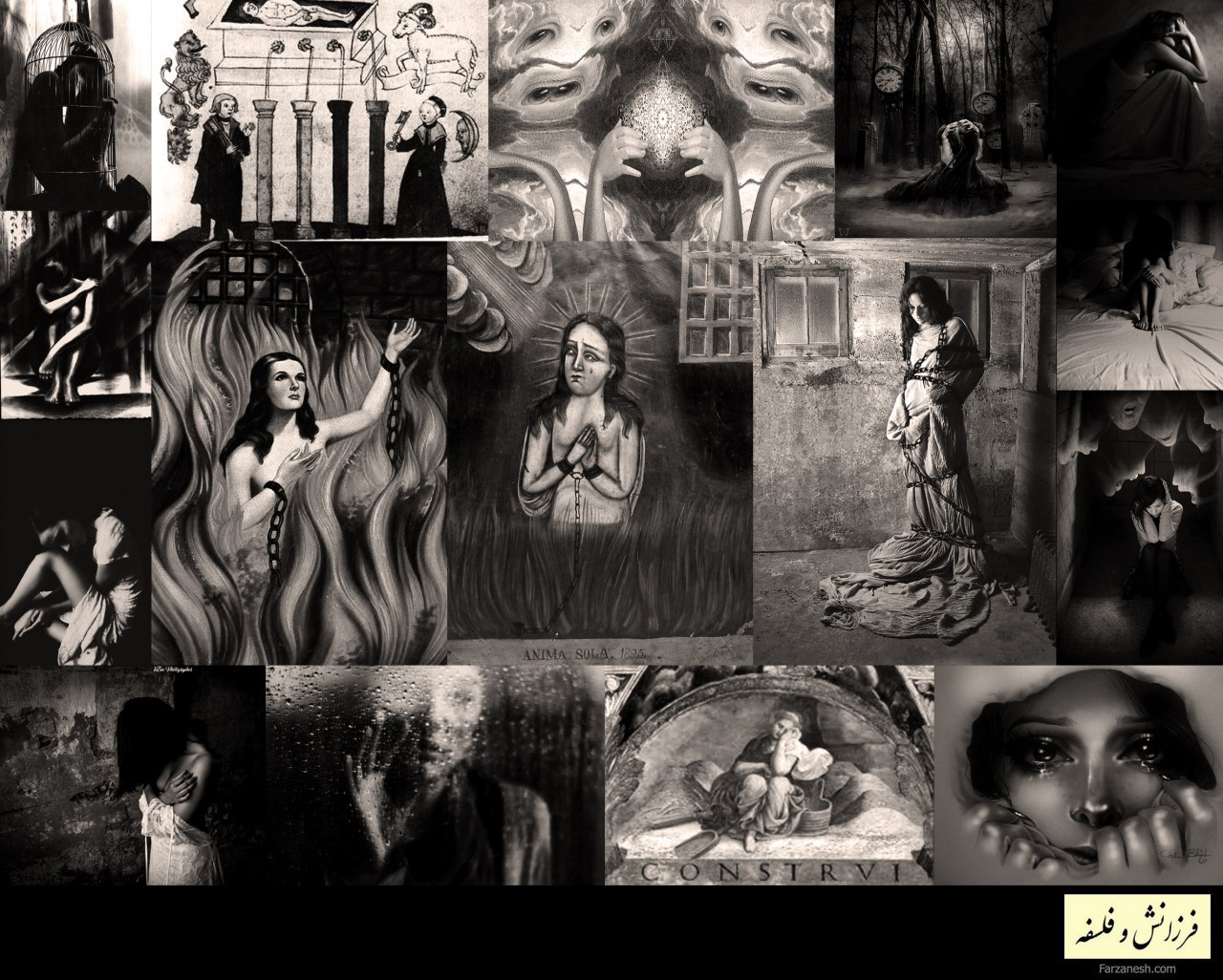
This initial confused and chaotic matter can have different degrees and forms, varying from one person to another. It may, for example, be ash (a desire that has burned out and come to an end); what is called Virgin Milk (an unexamined life and a mind nourished by only one ideology); the Black Mountain (the immense problems of life that lie before us); Smoke Fume Nebula (ambiguity, confusion and an inability to see clearly); or the guiding star, Stella Signata (the light of an inner guiding star that makes a particular path familiar but tells us nothing about the journey or how to travel it). Alchemists have referred to many other such examples.
Whatever this primary matter may be, and whatever form the process takes, the final aim is always the same: the liberation of the soul from its chains and freedom after attaining the philosopher’s stone.
One of the famous images in alchemy is Anima Solo—the anima alone and in chains. In Jungian psychology, anima refers to the feminine dimension of each person, while in alchemy more broadly the anima is regarded as equivalent to the soul. Even in Jungian psychology, a man who is incapable of relating to the anima within himself in effect becomes a soulless, mechanical human being. To become trapped in the animus is to turn life into the corpse of life.
In both depth psychology and alchemy, soul has a feminine quality and is therefore life-giving. Each of us, bound to the body, has an anima in chains. The alchemical process unfolds throughout our lives as the work of freeing the soul from its chains. At the same time, we perform smaller acts of alchemy every day along this path whenever we become trapped in a relationship, a job, a way of living or a way of thinking and cannot find a way out—whenever we feel that our soul is caught and is not free. The work of alchemy is to release the soul from these places: to free our Anima Solo, our solitary anima chained in limbo.
Aydin Areta
@AydinAreta
(1) 1st century author, Pliny the Elder (23-79 CE), names Zoroaster as the inventor of magic (in Natural History 30.2.3).
K. Preisendanz, “Ostanes (8),” in Pauly-Wissowa XVIII, 1942, col. 1610-1642, is credulous and apologetic, but valuable for the author’s great knowledge of the literature. Little better is J. Bidez and F. Cumont, Les Mages hellénisés, Paris, 1938, I, pp. 165-212; II, pp. 265-356 (the essential collection of data). (Morton Smith)
(2) Augustine City of God 7.35, citing Varro
Comments
Loading…
Leave a comment