
Examining the Historical Evidence
The Relationship of Zarathustra and Mazdayasnian Thought
with Plato and Plato’s Academy
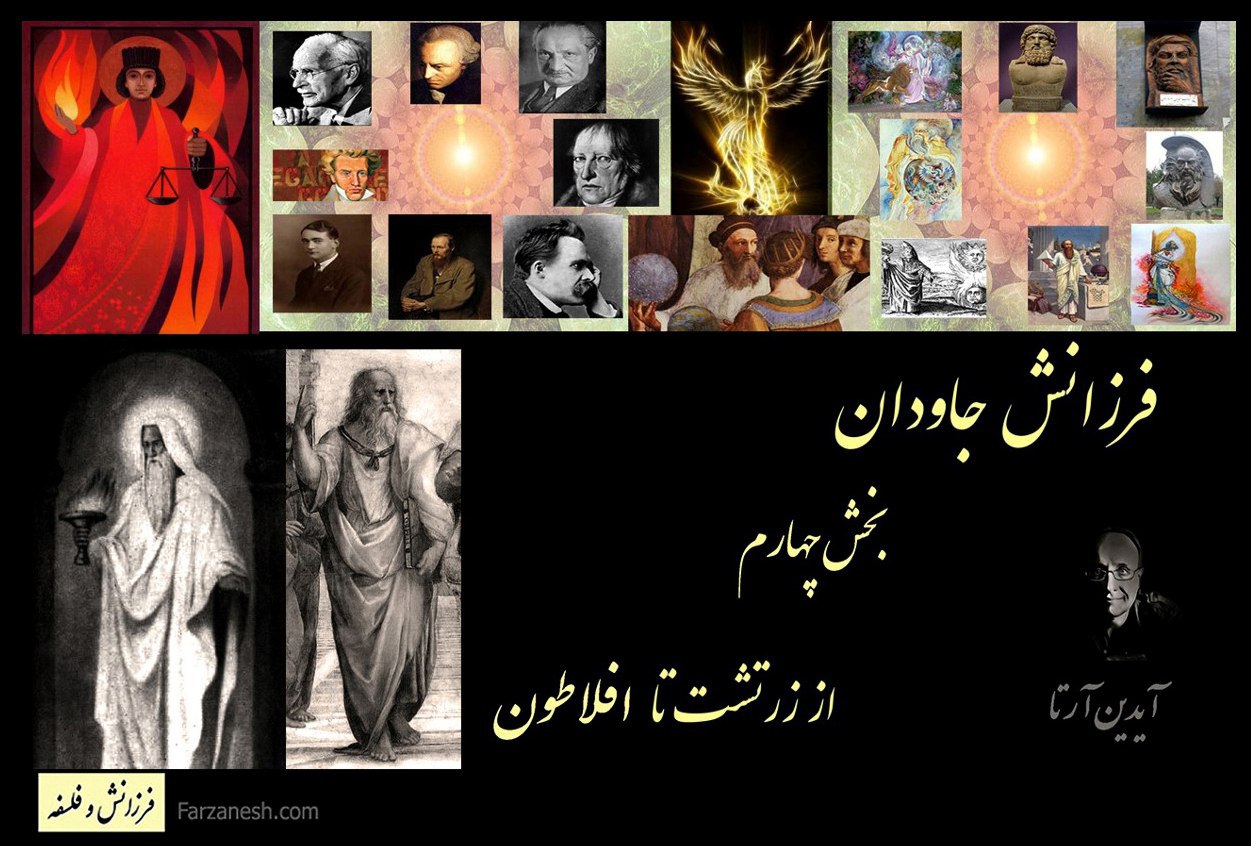
In Part Four of A Genealogy of Perennial Wisdom, which examines historical evidence concerning the relationship of Zarathustra and Mazdayasnian thought with Plato and Plato’s Academy, the following subjects are discussed:
— Raphael’s famous Renaissance fresco The School of Athens; the place of Zarathustra in this painting, located in the Apostolic Palace in the Vatican; and the question of why Raphael painted himself in the fresco beside Zarathustra.
— The influence upon Raphael of the Neoplatonic Academy led by Marsilio Ficino, as described by Paul Oskar Kristeller in Studies in Renaissance Thought and Letters.
— A brief review of the Neoplatonic movement from Georgius Gemistus Plethon to Ficino, and this movement’s belief in the existence of perennial philosophy / prisca theologia, beginning with Zarathustra and reborn through Plato. (The historical period in question was examined in greater detail earlier, in Part Three of A Genealogy of Perennial Wisdom.)
— A return to the early centuries CE and an examination of surviving historical writings by Lucius Annaeus Seneca, the famous Roman Stoic philosopher of the first century CE; Pliny the Elder, the Roman historian and near contemporary of Christ (23–79 CE); Plutarch, the Greek historian and near contemporary of Pliny; Favorinus of Arelate (c. 80–160 CE), the Roman philosopher; and Eudoxus of Chaldea. These sources are presented as referring to a direct relationship between Plato’s Academy and the Iranian Magi, and even to followers of Zarathustra among Plato’s most prominent pupils, including Hermodorus of Syracuse, Eudoxus of Cnidus, and Heraclides Ponticus. The presentation also looks more closely at these three pupils of Plato and their ideas.
— An examination of complementary evidence discussed in the famous third-century work of Diogenes Laertius, Lives of the Eminent Philosophers, as well as Colotes of Lampsacus (320–260 BCE), a Greek philosopher and prominent pupil of Epicurus who is presented as having accused Plato of intellectual theft from Zarathustra. This issue is connected to similarities in the structures of their thought that are said to have been noted by many others, including the fifth-century Neoplatonic philosopher Proclus Lycaeus Diadochus (412–485 CE) and Clement of Alexandria, the Christian philosopher of the second and third centuries CE.
— Who the Magi were, and what historians and philosophers of the early centuries CE understood to be their fundamental ideas.
— Another subject concerns the loss of a large part of written Iranian thought in the course of three burnings: the library of Persepolis, the Library of Alexandria, and the Arab invasion. According to Pliny, Hermippus, a Greek philosopher from Smyrna in the third century BCE (c. 250 BCE), conducted a detailed study of Zoroastrian texts that amounted, in the account cited, to more than two million lines or the equivalent of 800 rolls, attributed to Zarathustra himself and kept as numerous separate books in the Library of Alexandria. Hermippus believed that Greek philosophy and thought had roots in the knowledge and rites of the Magi. Pliny is also presented as saying that Hermippus’s pupil Callimachus compiled an exact list of these books and placed it in the Library of Alexandria, where it too was lost when the library burned.
— The final part of Part Four of this historiography of perennial wisdom addresses the closure of Plato’s Academy by order of the emperor Justinian, and the flight of Damascius, head of the Academy, together with six other Neoplatonic philosophers, to the court of Khosrow I of Iran, as well as the events that occurred during those years.
Aydin Areta
Comments
Loading…
Leave a comment