
Continued (2) — The Tantric Vision: Living Without Condemning Life
Part Two — The Songs of Saraha
The story of Saraha continues in this way. When Saraha abandons his status and position as a distinguished Brahmin monk and goes to Śrīkīrti, Śrīkīrti asks him to relinquish everything he knows of the Brahmanical tradition and become empty, so that he may learn the message of the Buddha anew.
Over the years Saraha once again attains an elevated position, now as a Buddhist teacher, and again becomes renowned for his wisdom and methods of meditation. People come from all directions to learn from him. It is at the height of this fame that Saraha dreams of a woman in the marketplace who is destined to become his true and final teacher.
Tantra is the only tradition whose founder, according to this story, receives his final message of wisdom from a woman, and feminine vision and energy occupy a special place in the Tantric vision. Even the expression of Tantric wisdom through the Songs of Saraha and in the language of poetry is deeply consonant with what this vision seeks, because the language of masculine logic and philosophy seeks to master meaning and explain it, whereas the language of poetry, filled with a feminine spirit, seeks to understand and receive meaning. Tantra is a path of understanding, acceptance and openness toward the world through the expansion of the anima of the human spirit.
Another notable point, as Osho observes, is that the birth of the Tantric vision, and Saraha’s meeting with his final teacher, takes place in the marketplace. The marketplace symbolises everyday life and the heart of our social existence in its simplest form. Tantra beginning with a woman and in the marketplace expresses the depth of a vision grounded in refusing to condemn life and in bringing mystical insight into the heart of ordinary existence.
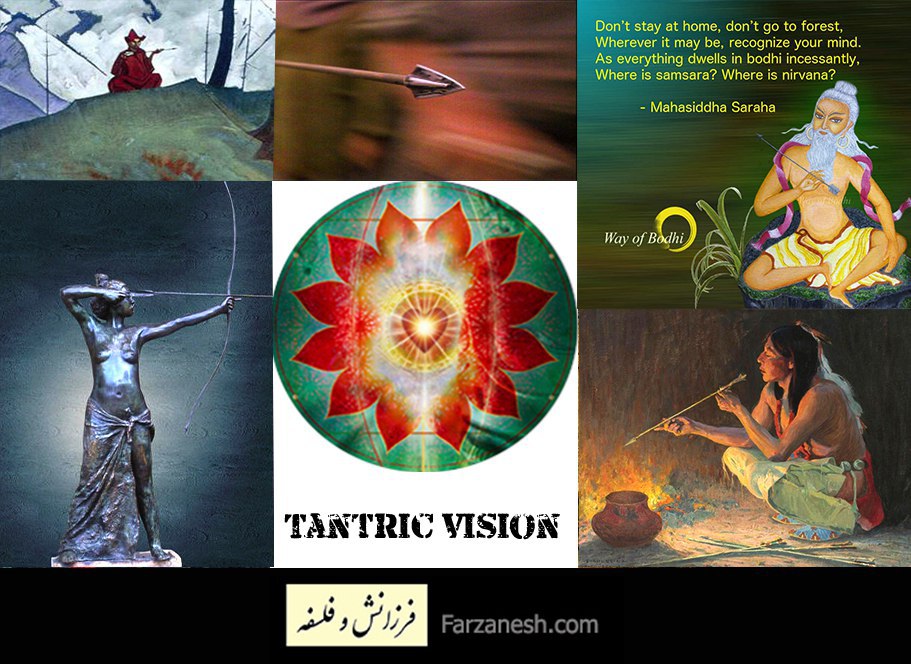
After this dream Saraha goes to Śrīkīrti, apologises for leaving him, and follows his dream to the marketplace in search of his final teacher. There Saraha sees the woman he had dreamed of, making arrows. He encounters a woman whose craft is making arrows for bows, and it is this woman who eventually gives him—whose original name was Rāhula—the name Saraha, meaning the one who has released the arrow from the bow.
In this woman Saraha saw the abundant current of life. She was visibly full of the energy of living, something animated by the freshness of life, something belonging not to the realm of mind but to action. Looking neither to the left nor to the right, she was wholly concentrated on making the arrow. She was so completely absorbed in this act that Saraha understood for the first time the true meaning of meditation. Meditation is not sitting in a corner repeating a mantra until the mind becomes empty. Meditation is acting in life with such wholeness, concentration and love that living is focused neither on the left nor on the right, but upon the path of transcendence. Whatever is done with this quality is nothing other than meditation.
Saraha eventually begins a conversation with the woman. After a short exchange she says to him: You abandoned Hinduism and became a Buddhist. You exchanged one set of ideas for another, one book for another, but you are still the same person you were. When are you going to begin living? Today you imagine yourself to be a Buddhist? Are the words of the Buddha not understandable only through action rather than through words and books? Have you not grown tired of so much wandering in the world of books and words? Leave this world of words and follow me into the heart of life.
For a long time Saraha had reflected upon the Buddha’s statement that the path of transcendence is the Middle Way, and had debated its meaning with others. Suddenly the original meaning of the idea became clear to him. On one side is the sky and on the other the earth; one side above and one below; one side mind and one action. Only in the middle between them does transcendence occur. Thus one cannot condemn the earth in the name of heaven, nor the body in the name of spirit; one cannot become so absorbed in thought that one becomes incapable of action, or look upward so continuously that one fails to see and loses the life that is here below.
Comments
Loading…
Leave a comment