
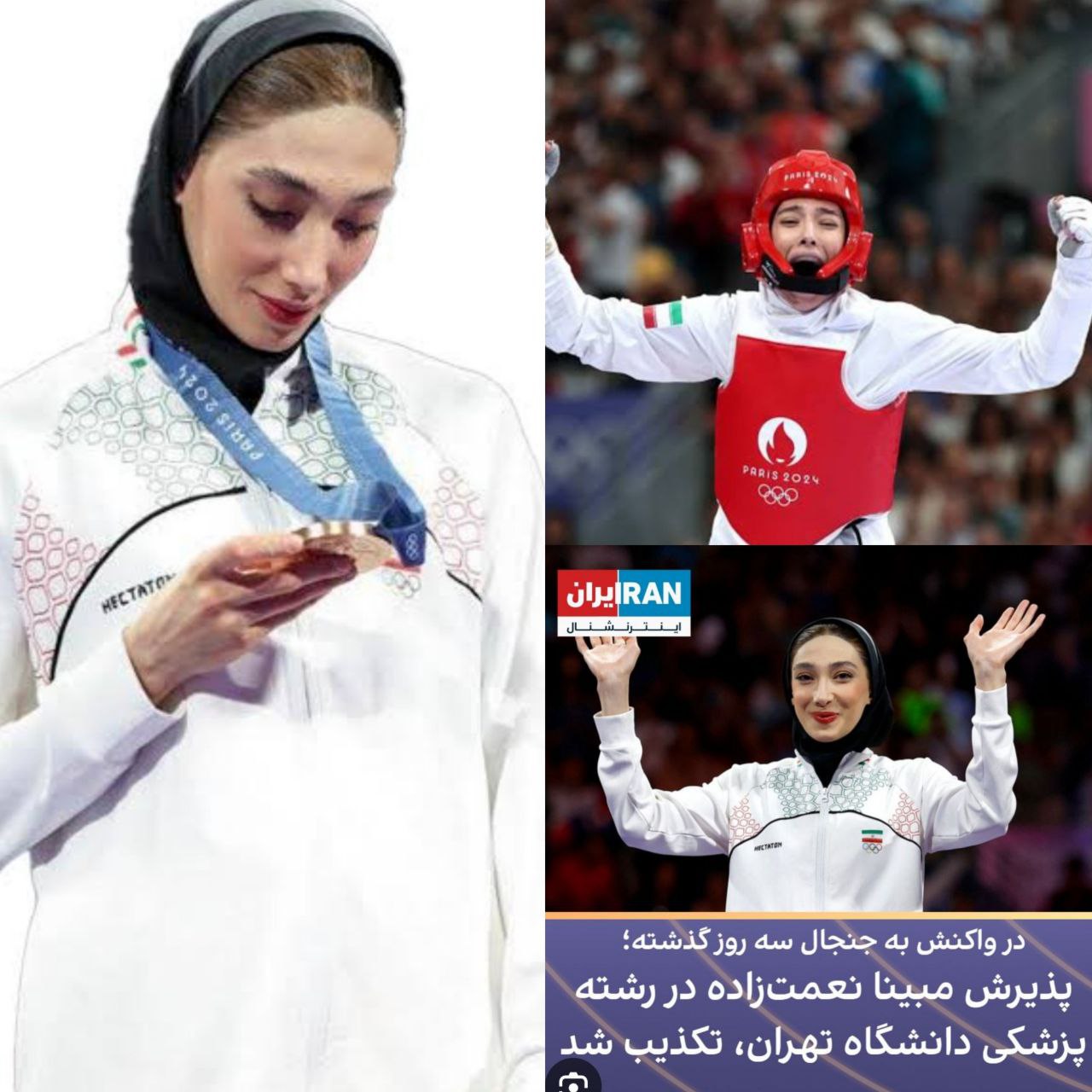
A Reflection on Mobina’s Request
Aydin Areta
For several days I have wanted to write a few lines about Mobina Nematzadeh’s request and share an experience with you.
Our nineteen-year-old national champion’s request to study medicine has been met with a great deal of predominantly negative reaction. Over the past few days many people have written in opposition to Mobina’s request, and several campaigns have even been created against it, which perhaps you, like me, have seen.
I do not know whether Mobina will read this piece, but I hope it reaches her and that she reads it, because her story is an important story for our society and, for reasons I will explain, it connects for me with a set of personal experiences across my life. Those experiences arise from the fact that I am a physician, that I have served on a medical-school student assessment and admissions committee, and that I also love taekwondo. Although the other demands of life did not allow me to pursue this interest professionally in my youth, despite all the difficulties I progressed through black belt to complete first international dan, and before emigrating from Iran I served for two years on the strategic and planning committee of the Taekwondo Federation. Even after emigrating, my intention was to continue cooperating with the Australian Taekwondo Federation, and this was initially possible, but the federation’s split into two organisations with severe internal disputes prevented that brief cooperation from continuing. That itself is another story.
The experience I want to share with you dates from around ten years ago, when for three years I served on the medical-student admissions committee at the University of Notre Dame Australia, assessed applicants’ files as one of the academic reviewers, and also participated in their interviews.
At many Australian universities—in fact, at most of them—medicine is studied as a postgraduate degree. This means that you may first complete a bachelor’s or master’s degree in another field and then apply for admission to medicine.
The admissions process is not like Iran’s, where eligibility for medicine is determined solely by a single nationwide examination. There is an examination called GAMSAT, and its result matters, but it is not the only determinant of admission, and each university has a different admissions process. At the university where I worked, applicants were asked to submit a portfolio comprising a range of life achievements, including non-academic achievements. These could include experience in management and team leadership, sporting achievements, the number of languages you knew, and even musical, literary, poetic or acting abilities. The underlying idea was that outstanding capacity in one area of life could indicate broader personal capacities in other areas as well.
I know that for many of us in Iran this idea is difficult to accept, but the reason it seems unacceptable lies in the content-centred form of education and study in our country. What matters is not the person and the capacities developed throughout life, but only an examination result based predominantly on memorised material.
In the selection process, we scored applicants across a list of abilities ranging, for example, from having been captain of a school debating team to managing other workers in a McDonald’s branch. Those who achieved higher combined scores from their academic results and this broader assessment were invited to interview. The interview involved several stations. At one of them, where for two years I interviewed young candidates, we assessed emotional intelligence and ethical judgement. Students were shown photographs depicting different situations and facial emotions and were asked to identify the emotion and explain what they would do if they were present in that scene. I encountered many applicants who, despite very high academic scores, clearly had little of the emotional intelligence, compassion and communicative capacity required in medicine.
One of the best students I saw during those years was a young musician who was a gifted violinist and had decided to study medicine. Over the past few days I have seen many compatriots comment, for example, that if Dr Mobina Nematzadeh one day leaves a surgical knife inside a patient’s abdomen, who will be responsible? This assumption arises from the belief that the result of a university entrance examination—based on testing memorisation that has no relationship to the capacities required of a physician—determines the quality of a doctor’s performance. The truth is that neither that result nor the results of other memory-based subjects such as histology and biochemistry during medical school determine the quality of a doctor’s work.
End of Part One ...
Comments
Loading…
Leave a comment