
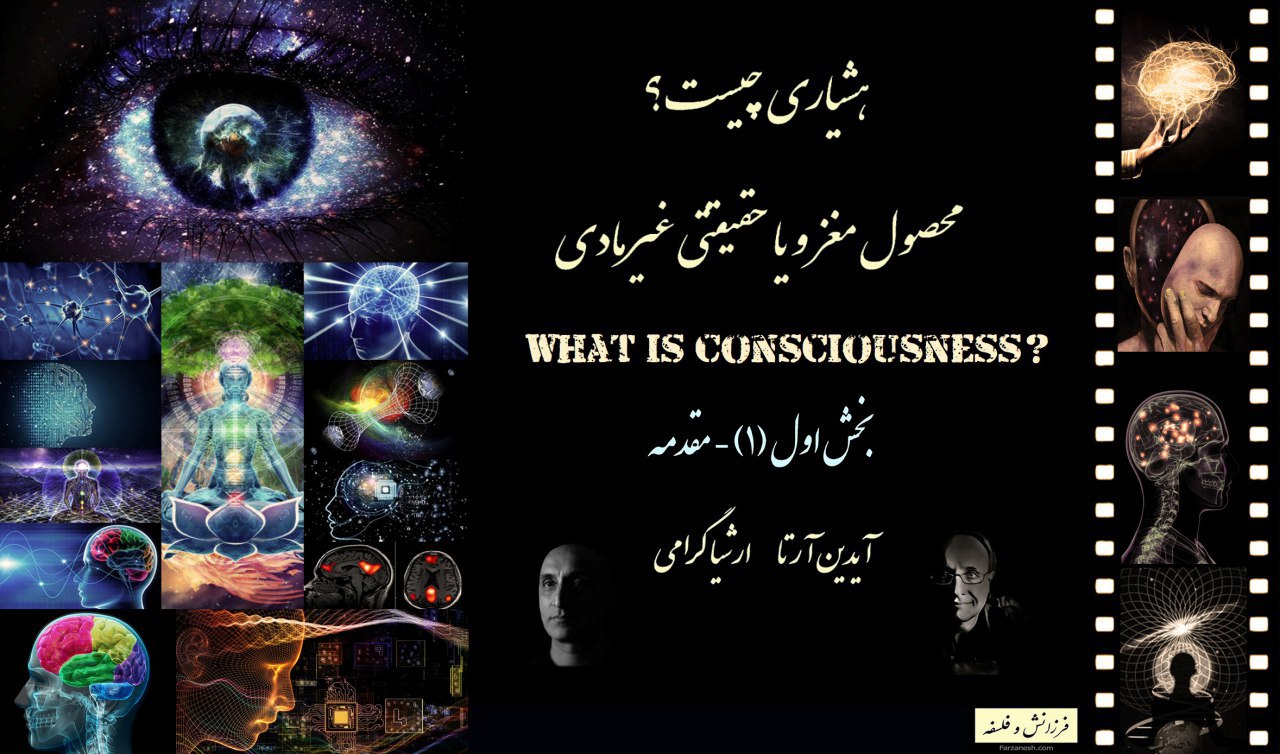
What Is Consciousness? A Product of the Brain or a Non-Material Reality?
Part One (1): Introduction
A Conversation between Aydin Areta and Arshia Gerami
In July 2005, on the 125th anniversary of its publication, the highly regarded and historic journal Science published a list of 125 scientific questions that science had not yet been able to answer. After the first question—
What Is the Universe Made Of?—
the second unanswered question was:
What Is the Biological Basis of Consciousness?
The present series, entitled “What Is Consciousness? A Product of the Brain or a Non-Material Reality?”, of which the first part and introduction are before you, emerged from a series of conversations between me and Dr Arshia Gerami, a geophysicist who also has experience working in IT. The aim is to examine transcendentalist thought in relation to scientific materialism in the domain of Consciousness and to ask whether something called mind, distinct from matter, exists in a form that can be investigated, or whether human consciousness is entirely the product of a material process in the brain.
Friends who follow my published studies and work know that I have called the philosophical approach I introduce Transcendental Existentialism. One important element of this philosophical thought is the acceptance of a Transcendental and Non-Spatiotemporal dimension of human consciousness and mind—an idea that is logocentric and belongs to the Platonic tradition.
Mentioning this subject opened a discussion between my dear friend Dr Arshia Gerami and me concerning the opposition between scientific materialism and transcendental philosophy. We therefore decided to pursue the conversation publicly, because the questions Arshia places before a transcendental view that accepts a non-material dimension of the world will certainly also be the questions of many friends who believe that whenever philosophy enters metaphysics, it should be prepared to respond to questions and challenges raised by science.
In these conversations our aim will be to remain faithful to scientific thought as accepted by materialist philosophy while examining both materialism and Transcendentalism through the criteria of philosophy and science, rather than through religious or mystical perspectives.
This is a difficult but important challenge because traditionally, especially in discussions of consciousness, religious and mystical views have concentrated on the existence and immortality of the soul as the source of human consciousness. This has not made meaningful dialogue easy with researchers and scientists committed to scientific theory, who accept as Objective truth only what can be measured and verified. Religious and mystical experience is, in its foundations, beyond science, and the reasons on which it relies are ordinarily regarded as internal to its own discourse and Subjective.
If, for example, one side appeals to contemporary neuroscience and fMRI findings to argue that consciousness is brain activity rather than something outside it, the difference between paradigms can make genuine mutual understanding impossible: each side may simply repeat the position it already believes. Religious experience and belief are in their essence extra-scientific; consequently, no shared ground emerges. This time, however, I intend to bring the field of inquiry inside territory acceptable to scientific materialism.
If successful and sustained, this multi-part conversation about consciousness may become only one part of a wider dialogue in which we test materialist thought against transcendental thought and transcendental thought against materialism. In practice, the aim is simultaneously to question, criticise and better understand both materialism and transcendentalism.
Aydin Areta
Comments
Loading…
Leave a comment