
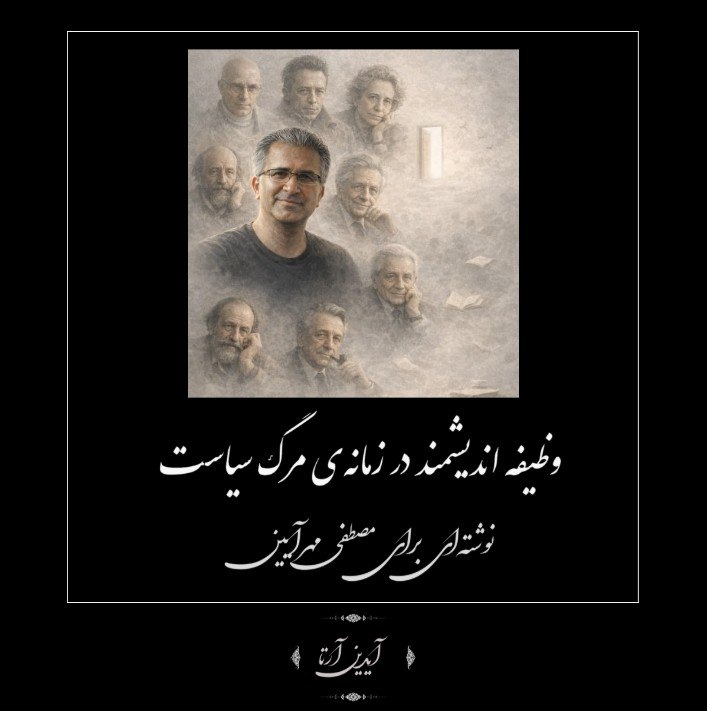
The Task of the Intellectual in an Age When Politics Has Died
A Writing for Mostafa Mehrayeen
Aydin Areta
At the height of the Woman, Life, Freedom movement, Mostafa Mehrayeen was invited to speak as a sociologist in the auditorium of the Ministry of Interior about how the atmosphere of society might be calmed. In direct and courageous remarks, rendered here in substance, he said:
In a society where politics, rather than opening the possibility of thought, blocks it, the first thing to die is politics itself. With the death of politics, what remains is the management of bodies, not a dialogue of meanings. By eliminating thought, such a system has already made reasoned defence of itself impossible. When it becomes incapable of defending itself in the field of thought, the use of force becomes the essence of that government; violence ceases to be an instrument and becomes the nature of such a government. This is why today the Islamic Republic is absolute evil.
In the months that followed, despite being prohibited from teaching at university, he did not diminish his candour or courage in the slightest. The price ultimately became a sentence of eight years’ discretionary imprisonment and supplementary punishments, which he received in Bahman of this year after several months during which he had been prohibited from writing and from activity in social space. In such circumstances, a prison sentence is not merely a legal judgement; it is a cognitive and epistemic sign of the present condition of society—a sign that his prediction has been realised: power can no longer justify itself through language.
Foucault spoke of *parrhesia*: truth-telling in a situation of danger. But parrhesia is not merely personal courage; it is a relationship between the subject and truth that leaves the speaker exposed before power. The person who speaks truth at the moment when doing so has a cost does not do so because they expect victory, but because they cannot deny their relationship to truth. It is this fidelity to truth that makes them dangerous, not their slogans. What draws this concept out of abstraction is the moment when a thinker lives this relationship rather than merely speaking about it.
Mehrrayeen did not merely quote parrhesia; he remembered it.
When, amid general excitement, he stood before power and even before part of public opinion and said that politics without thought reaches a dead end; when he said that eliminating thought means the death of the political; when he spoke of the necessity of a “responsible No,” he was doing precisely what Foucault called *courage de la vérité*: the courage of truth.
In the Greek tradition, parrhesia is not simply frank speech; it means accepting the consequences. Socrates did not retreat from his commitment to truth up to the moment he drank the hemlock, not because he imagined he would win, but because he could not distance himself from his relationship to what he regarded as truth.
He did the same.
What made him dangerous to power was not the sharpness of his language; it was the inner coherence between thought and life. Power does not fear a thinker who merely analyses; it fears a thinker who turns analysis into a way of living.
When Foucault says that parrhesia takes philosophy from the university into the public square, he is pointing precisely to such a moment: the moment when truth is no longer merely a proposition but becomes a commitment whose speaker is willing to pay its cost.
Mehrrayeen accepted that commitment.
This is why prison intensifies the meaning of his earlier words. It shows that those words were not merely a conceptual exercise. His relationship to truth was not theoretical; it was existential. Parrhesia becomes complete when the subject is willing to accept their own exposure.
Mehrrayeen accepted that exposure.
For years he tried to show that the crisis of our society is not simply a crisis of political structure; it is a crisis of love, a crisis of compassion, a crisis of the capacity to see the other. At first sight this may sound ethical, but at its depth it is entirely political. Where the other is declared expendable, politics becomes the management of elimination. I do not know how many times he repeated this disturbing and profound thought from Levinas: violence begins when the face of the other no longer addresses us and when we cease to look into the other’s eyes. Despotism is precisely this: silencing the address of faces and refusing to look into the eyes of another human being.
Within the intellectual tradition through which he thinks—from Bakhtin to Althusser, from Rancière to Agamben—language and narrative are fields of struggle. Bakhtin showed that words are never neutral; they are saturated with interests, and every system seeking to stabilise its domination first reduces polyphony to a single voice. Where language is no longer carnivalesque, society no longer has space for dialogue. And where dialogue is suspended, consciousness disappears.
Continued 👇🏼
Comments
Loading…
Leave a comment