
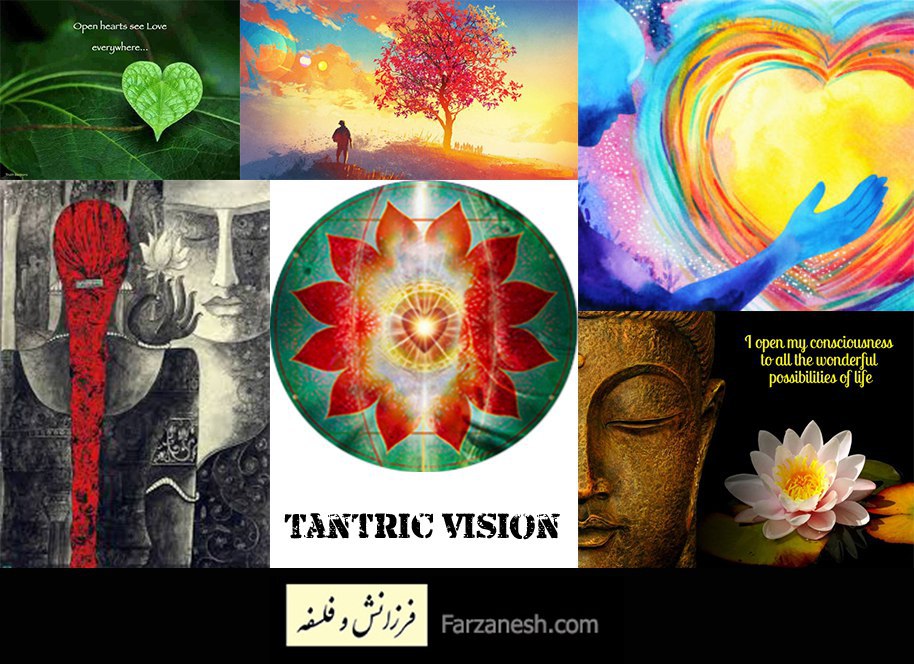
The Tantric Vision: Living Without Condemning Life — Part One
Many books have been written about Tantra, and the word has been interpreted in different ways, particularly within Buddhist and Hindu traditions. My purpose in this piece is not to review those accounts of the term, but to use it to express my own understanding of a deeply beautiful concept that I find embedded within this word as a mystical tradition.
In other words, what I refer to here as the Tantric vision does not necessarily correspond to what you may have read or heard elsewhere about Tantra. My personal reflection on this ancient vision is primarily an attempt to use it as a vessel for expressing a concept that, for me, finds its clearest meaning and expression through this vision.
The word Tantra has been understood as meaning method, and also as expansion. Perhaps both meanings may be taken as valid, so that the Tantric vision can be understood as a method for expanding the human spirit.
Tantra is not a philosophy, and for this reason it is not concerned with questions such as what truth is or why human life exists. Tantra is not primarily concerned with what and why; it is simply focused on how, and searches for the way of arriving: how, and by which path, one may expand and elevate one’s being.
There is a Zen story saying that if you see the Buddha in your meditation, remove him immediately, because your aim is not to meet the Buddha but to reach and encounter yourself. The aim is not to arrive at Buddha, but to arrive at one’s own Self; and Tantra is a method for travelling this path toward one’s own higher Self.
Along this path, Tantra as I have understood it is neither a religion, nor a philosophy, nor a theoretical system. For centuries many followers of Tantra simply wore a single blue garment, as a reminder that the human inner world is as vast as the sky and that one’s only true covering is this limitless sky.
The Tantric vision is centred on the principle that the sphere of human being can expand to the breadth of the limitless sphere of existence. To attain such expansion, one must live in the manner expected of a spirit as vast as such a horizon. For this reason, the Tantric vision and method rests upon three fundamental principles: acceptance, love, and refraining from condemnation.
For those who choose it, the Tantric vision proposes a way of living which, by embracing this vision, opens a path toward a higher truth in life. Above all, this path is centred on refraining from condemnation and from making judgement final. In a world where condemnation has been an ancient tradition of human societies, and where everything from the human body to independent individuation and even happiness has repeatedly been condemned by social traditions and many religious systems, Tantra focuses on acceptance rather than condemnation. It sees the path of arrival in living with love, joy and the peace that comes from acceptance, and in keeping the heart open in a world where living in fear, with a heart closed to oneself, to others and to life, is one of the most widespread ways of living.
Tantra asks those who embrace this vision to approach the darkness of the world, and those who have been contaminated by or even overcome by that darkness, with an open heart. Thus, although Tantra sees both the dark and the luminous sides of the world and does not remain indifferent to them, by making the realm of love boundless it sees darkness as something upon which light has not yet shone, and evil as a seed folded in upon itself and severed from love, yet still capable of opening and becoming the seed of a tree of light.
The Tantric vision asks the person who embraces it to open their being toward the duality of the world and approach it with love and without condemnation. Thus, in this vision, loving the spiritual dimension of human existence does not require condemning the human body or the material world; nor does refusing indifference toward the world’s darkness and ignorance require falling into the darkness of anger and violence.
The person who embraces such a vision does not seek to overcome others or the world. They seek to expand love in the world, not egocentric control, domination or personal power, and therefore stand at the greatest possible distance from anger, violence, and the desire to dominate. This recalls Jung’s striking statement that where love rules there is no will to power, and where the will to power is dominant, love is absent.
Tantra is an inner revolution that, by choosing love, moves beyond the calculating and fearful mind. By opening the heart toward the world it creates an empty space capable of receiving a boundless and timeless truth that cannot be contained within the limited vessel of the “mind” and can be received only by an open “heart”.
Comments
Loading…
Leave a comment