
A Path That Is Not “Positive Thinking”
In recent years, the market has remained crowded with all kinds of psychology books focused on positive thinking, as well as forms of spirituality that promise enlightenment through a few sessions, daily meditation, and vegetarianism.
I do not intend to deny the relative value of any of these things, but I would like to share something I have felt to the marrow of my bones and learned over the years: the path to illumination does not pass through yoga classes, group Zen, a domestic ashram, positive-thinking books, or New Age psychology.
The only thing capable of transforming us as human beings is “deep knowledge,” and such knowledge can be acquired only by entering and passing through the darkest chambers of our own spirit.
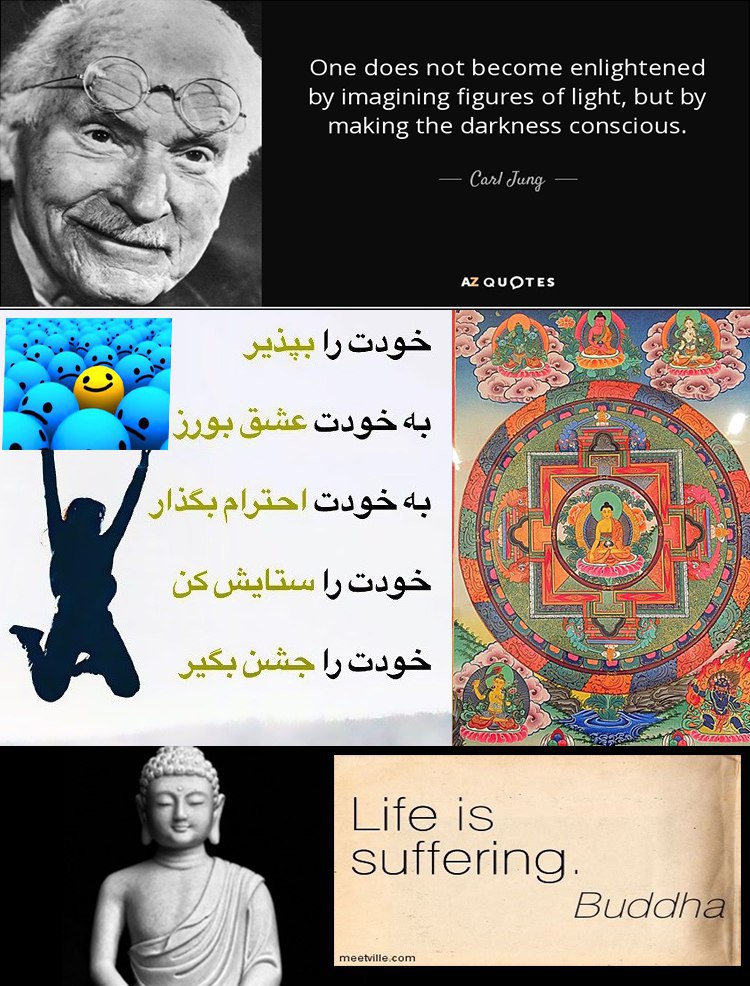
What separates Jungian psychology from the New Age current of psychology grounded in positive thinking is a key conviction in Jung’s thought: “No one becomes illuminated by imagining figures of light, but only by becoming conscious of the darkness and passing through it.”
Even the word “Buddha” itself means one who has passed through all the apparitions that seem real and then encountered truth; this is why his vision penetrates and passes beyond all these obstacles.
We know that in the story of Siddhartha—the Buddha—he is a prince whose father keeps him inside a great palace in order to protect him from the darkness of the world. Youth, music, and happiness always prevail there. Then one day Siddhartha leaves the palace. It is seeing suffering, death, and the darkness of the world that places him on the path toward becoming the Buddha and awakening.
On his journey of consciousness, the Buddha first encounters the truth of suffering and death, then Kama—the embodiment of the most earthly human desires—and passes beyond them. He then encounters Mara, the embodiment of fear, and passes beyond that as well. Finally, he faces his ultimate temptation: surrendering prematurely to moral duty toward others before attaining consciousness. He refuses that temptation too.
If positive thinking were the path to awakening and illumination, Siddhartha would have awakened in his father’s palace, where nothing but the positive aspects of the world existed, and would have become the Buddha there. Nor, after awakening, would he have begun his first teaching to his people by stating as the first principle of wisdom that “life is entirely suffering.”
Jung believed that unless we travel into the depths of the darkness of our individual and collective spirit and bring it into consciousness, that darkness—rooted in the unconscious—will take control of our lives without our knowing it, and we will call it “fate.”
Nietzsche once wrote: “I never trust a person who does not know and believe that there is a murderer within him.” In Thus Spoke Zarathustra he also asks us whether we can see both evil and goodness within ourselves and place our will above our morality. And again, through Zarathustra, he tells us: “It is from emerging out of the deepest wells that the highest heights will rise.” Jung’s statement echoes this Zarathustrian idea: “No tree will grow into heaven unless its roots reach down into the depths of hell.”
What I have come to feel with all my heart over the years, and what I share with you honestly, is an uncomfortable truth for our human preference for ease: entering the path of becoming “one person”—let alone illumination—requires a sincere will to remain a learner throughout life.
Acquiring the deep knowledge capable of transforming us from what we are into what we can become itself requires a growth and psychological maturity that we often do not complete even by the end of our lives: the maturation of the process of individuation.
The first step beyond unconsciousness and a childlike mind is nothing other than the Buddha’s departure from his colourful palace and the acceptance of his first principle of wisdom: “life is entirely suffering.” To accept this principle in the heart, we must once and for all be capable of receiving our loneliness and suffering with courage and openness, humbly taking upon ourselves responsibility for all the darkness within and in the world, and climbing the difficult hills of understanding.
Do not praise yourself as you are; do not celebrate yourself; do not even accept yourself merely as you are. But always love yourself and respect yourself. Yet this “self” is your Self, that transcendent being that exists within each of us. Behind all the darkness within is an eternal and primordial light, and the purpose of passing through darkness is to reach it. It is the self that has attained illumination, like the Buddha and the sun at the centre of the mandala.
Aydin Areta
Comments
Loading…
Leave a comment