
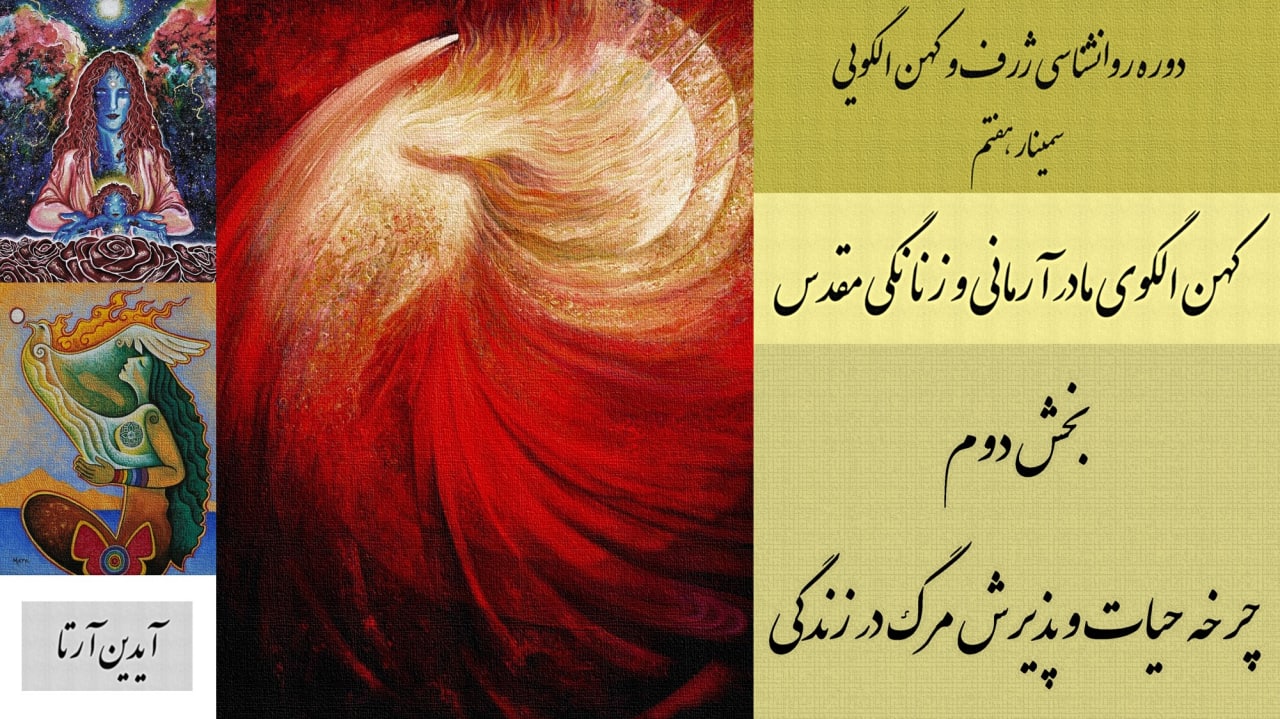
A Summary of Part Two of Seminar Seven
In mythological images of the Mother Goddess—from the Iranian goddess Anahita to the Egyptian goddess Isis—a ring is often seen either in the goddess’s hands or above her head. It symbolises the cycle of birth, death and rebirth. The Mother Goddess holds this cycle in her power, and the cycle is nothing other than a symbol of transformation in the world. This circle, also referred to as the solar disc and represented in alchemical symbolism as the serpent or dragon that devours its own tail, the Ouroboros, symbolises the cycle of transformation and eternity. It is also the ring seen in representations of the Faravahar and in the hand of Ahura Mazda, and the ring we exchange in marriage as a symbol of accepting the union of female and male consciousness, of connecting this life and consciousness to future generations, and of the continuation of the cycle of life.
In archetypal psychology, the archetype of the Mother Goddess and the anima—the feminine dimension of personality—represent forces within the structure of personality that bring about transformation and change. Within social structures too, durable change, in this account, always begins with the transformation of the women of that society. A way of keeping a society behind is therefore to keep its women behind, because the key to the consciousness of the next generation is always in women’s hands.
The Great Mother gives what she possesses but does not remove the freedom of her children along the path of their development. She does not confuse caring with a personal passion to direct her children toward a goal she has chosen for them. She is filled with compassion and care without pursuing a personal agenda or passion that takes freedom from her children. The Great Mother nurtures and protects “the possibility of becoming realised” in the world, just as the maternal spirit of nature does with its children and with life.
The Great Mother is also unafraid of death, because she knows that rebirth requires acceptance of death. To understand and activate the Great Mother archetype within the personality means activating the part of our psychological structure that allows us to accept death in life. This death is not always physical death. Again and again we encounter psychological death and the death of our past, and at times we must receive the painful death of the past with open arms in order to permit ourselves to be reborn.
The goddess Kali, or Kalika, in Indian traditions is a powerful form of the feminine spirit of the world, Shakti, who arrives in the form of death to sever life, and she also holds the key to final liberation, moksha. Sometimes only Kali’s destructive force and her power to bring something to an end can bring transformation and freedom into our lives. The power to release, let go and accept death becomes possible only through faith in birth, rebirth and the power of the Great Mother archetype. It is a force that allows us to release ourselves from a past, a belief, an ideology or a rigidified form of life. Only one who is able to accept death upon the self can be reborn.
The Great Mother is also a healing force within the structure of personality. It neutralises, in this account, three poisons that contaminate masculine energy: anger, ignorance and the authoritarian tendency within personality. The Great Mother holds the cycle of life and death, and everything in the world is her child; for that reason she is freed from fear. This freedom from fear allows her to release us from anger. She is transformative, and therefore sets stagnant consciousness in motion: she gives death to old consciousness and gives birth to new consciousness, lifting us from ignorance. Finally, the understanding she gives us of transformation and mortality releases us from the authoritarianism of an unbalanced animus and from its tendency toward domination and unlimited power.
Aydin Areta
Comments
Loading…
Leave a comment