
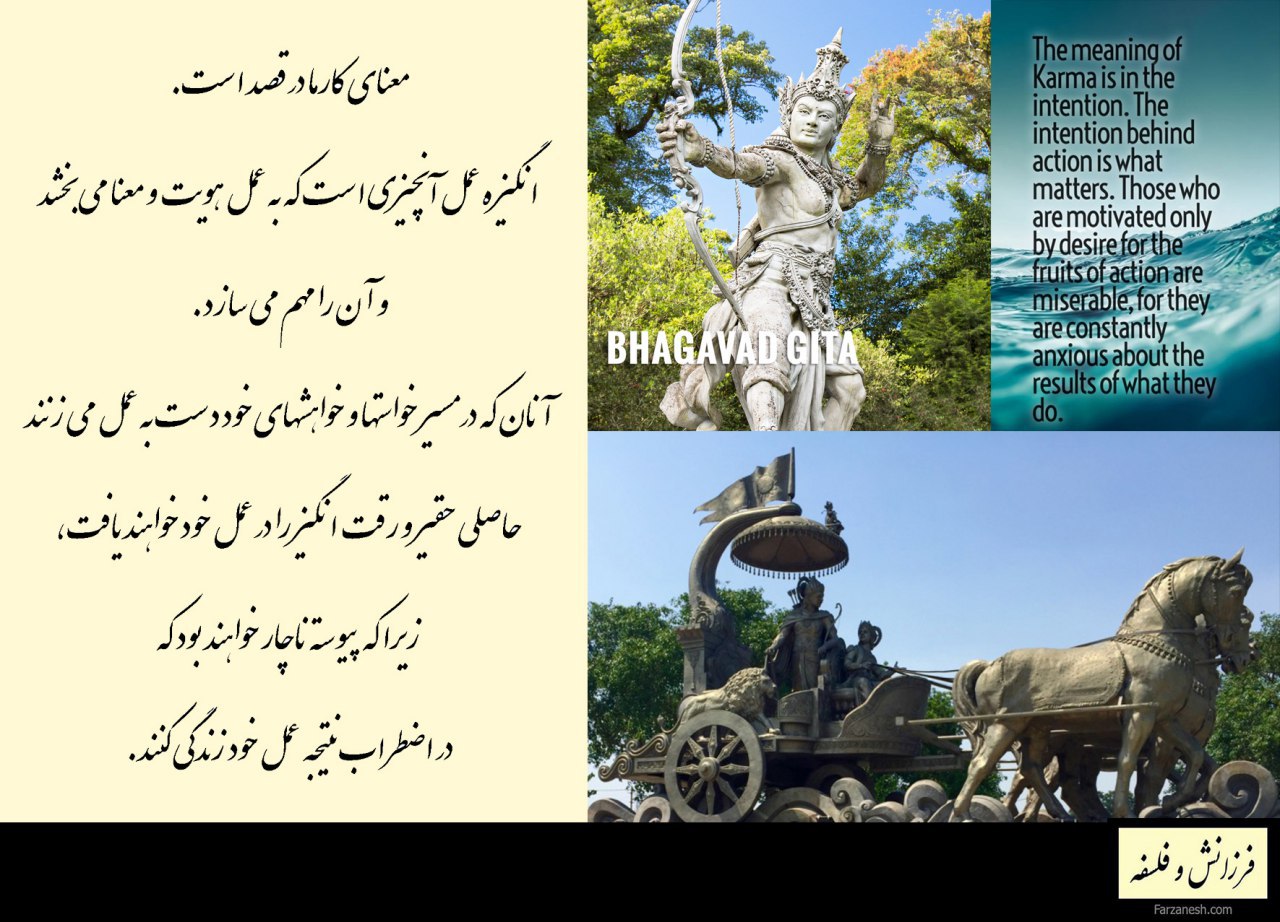
Struggle and the Path of Action in the World
A look at India’s epic Bhagavad Gita
At the height of his struggle in 1925, Gandhi referred to one of the most profound epic poems in Indian history, the Bhagavad Gita—meaning “Song of God”—which appears within one of the oldest epics of ancient India, the Mahabharata, described in the source as having been composed around 600 BCE and as the longest poem in the world. Gandhi wrote of the Gita’s profound influence upon him:
“There are moments in this struggle when doubt takes hold of my whole being. Moments when despair stares into my eyes and I cannot see even a faint light of hope on the horizon of my efforts. At such moments I turn to the song of the Gita and search in its lines for the peace I have lost. Only moments later, at the height of the heavy sorrow of life’s bitterest tragedies, the magical words of the Gita bring a smile back to my face.
My life and struggle have been full of tragedies. If the wounds they left upon my being have healed, and if I have not stopped moving forward, I have drawn all this strength from the song of the Gita.
The Bhagavad Gita is the eternal promise that the forces of light in the world will not surrender to the power and domination of darkness.”
This ancient spiritual and epic work, little known in Iran today, whose antiquity can be traced in the source back to the Vedic era of the Indo-Iranian peoples, is a magnificent legacy of a way of thought that rejects inaction and hesitation in a world where timeless forces of light and darkness stand in primordial struggle.
It is an approach to human life filled with the spirit of struggle, one whose embodiment can also be recognized in Iranian thought: in the cosmic battle between Hormazd and Ahriman and in the role of the human being within that battle.
The deep influence of the thought embodied in this epic upon Gandhi and his movement of nonviolent struggle, and the influence of Gandhi himself and his method of struggle upon other movements for social reform around the world during the past century, can be understood as an expression of the almost magical and timeless power of immortal ideas in shaping human history.
It is a history in which a poem thousands of years old can still, after centuries and millennia, affect the formation of history itself.
From Martin Luther King Jr and James Lawson in the United States to Nelson Mandela and his struggle against apartheid, Gandhi’s influence on reviving the spirit of struggle and refusing to surrender before the apparent domination of darkness over the world can be seen clearly. Martin Luther King Jr is quoted in the source as saying that if Christ showed us the way, it was Gandhi who taught us how to struggle.
It is also interesting that the American philosopher and writer Henry David Thoreau, around one hundred and seventy years ago, described civil disobedience as a way of struggling against President James K. Polk—whom the source characterizes as violent and warlike—and presented this action as inspired by the ancient Bhagavad Gita.
But what is it in this ancient poem that removes Gandhi’s hesitation in struggle and calls him from inaction into the field of action?
This is an especially important question once we recognize that, in the source’s account, the thought governing the Indian subcontinent from the world of the Vedas to Gandhi rests fundamentally upon three principles: dharma (tradition and worldly duty), karma (the reflection and consequence of action in the world), and moksha (final liberation from the cycle of life, samsara), each interpreted differently in the various traditions of the subcontinent.
The avoidance of violence, understood here as central to the principle of karma, has been so powerful in the historical thought of India that interpretations of the principle as avoidance of all action and withdrawal from the world in order to avoid the karma of one’s actions shaped, for thousands of years, dominant forms of mysticism and ways of life on the subcontinent.
In Jainism, for example, this idea is presented as receiving an absolute interpretation, to the extent that the highest liberation of its followers is described as a “fast unto death,” avoiding all food so as not to harm other living beings, even plants.
Within an Indian intellectual world in which the highest liberation is indifference to the world and the highest awakening is to become a naked, homeless seeker, a teaching that calls a person to struggle in the arena of the world despite fundamental doubts and conflicts appears as an anomaly and a departure from the prevailing intellectual tradition of the wider culture.
Comments
Loading…
Leave a comment