
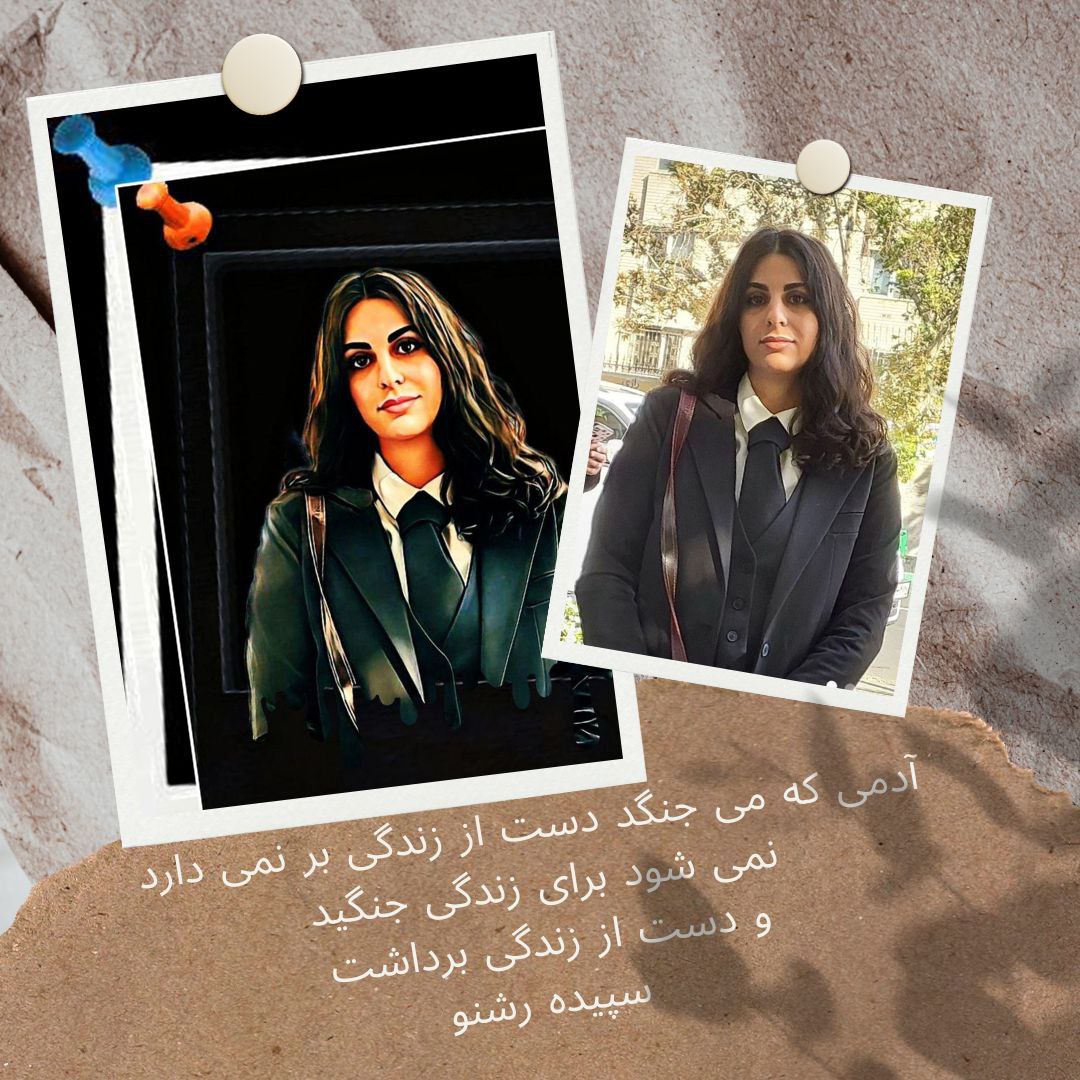
Sepideh Rashno’s Trial on Gandhi’s Birthday
Aydin Areta
Sepideh Rashno wrote that today, 10 Mehr 1402, she would appear in court to defend the right to choose her clothing, the right to write about what happened to her, and her human rights as a woman without compulsory hijab. What a meaningful coincidence that she is being tried on Mahatma Gandhi’s birthday—a leader whose legacy for every freedom campaigner who came after him, and those yet to come, can be summarised in the enduring words rendered here:
Truth cannot be destroyed. Truth always stands on its own feet even when no one finds within themselves the courage to defend it. Falsehood never becomes truth even if all power rises violently to suppress truth. I know no god higher than truth. Refusal to submit to falsehood is the duty of every human being who feels in their heart an inclination toward the light of truth, and civil disobedience is a sacred duty when falsehood and injustice acquire the audacity to call themselves law.
The image of Sepideh, simply and neatly dressed while being tried on an accusation of encouraging corruption and prostitution, is so simple and eloquent that it reverses the tribunal itself. Truth is always this simple and beautiful.
Let us remember today because a page of history is turning before us whose story will inspire generations and campaigners for freedom beyond Iran’s borders. In my view, what Sepideh Rashno did in Tir 1401, two months before the nationwide Woman–Life–Freedom uprising, is comparable in the history of civil struggle only with the role Rosa Parks played in the history of Black civil rights in the United States.
Rosa Parks is called here a leading woman in American civil-rights struggle because, in the winter of 1955, when a bus driver ordered her to give her seat to a white man, she refused. Parks was arrested and imprisoned, but her resistance to the denial of equal human rights set in motion a wave of civil struggle that continued through Martin Luther King to the dismantling of segregation laws and the securing of political rights for Black Americans. Sepideh’s resistance on that bus on 25 Tir 1401 seemed like an astonishing repetition of history.
Continued in the next post…
#Sepideh_Rashno
Comments
Loading…
Leave a comment