
Rereading the Ancient Roots of the Haji Firuz Tradition
Without doubt, in recent years one of the most controversial subjects connected with Nowruz traditions in Iran has been the symbolic figure of Haji Firuz.
Some time ago, a good friend of mine wrote, painfully, that children in the West receive gifts from Santa Claus—or Baba Noël, as we call him in Persian following French usage—and at New Year accompany this handsome and magnificent old man with beautiful songs, while we Iranians, many years after the abolition of slavery, humiliate a dark-faced and ugly man by making him dance, a man who not only gives nothing but, in the manner of a beggar, takes from others.
What this good friend wrote, together with a brief look at the organized research available in Persian texts on the history of this tradition—which I found very limited—prompted me to search as far as I could and write this essay, in the hope that it might cast a small amount of light upon the dark and little-known roots of this tradition among us Iranians.
My brief search online also made me almost certain that, at least in the Persian-language web, nearly everything available on the subject consists either of seasonal and correlational conjectures intended to give meaning to the tradition, or of arguments that it is a late development without ancient roots.
Perhaps the most important effort so far to trace the roots of this tradition has been based on the conjectures of the late Mehrdad Bahar and the later research of Ms Sheida Jalilvand, who connect the blackening of Haji Firuz’s face with his return from the world of the dead and with the Mesopotamian Semitic myth of Tammuz, which they argue was adopted by Iranians.
In the absence of an alternative theory, this view has spread throughout the Iranian online world as the main hypothesis. A search for Haji Firuz produces dozens of websites that retell it, and the theory has also been introduced by Iranians into English-language Wikipedia.
Another interesting development is criticism of this tradition as an obvious symbol of racism by academics and some groups of Iranians, mainly living outside Iran, who have called for the figure to be changed or removed. What this article offers alongside these views is only an account of thought-provoking parallels beyond Iranian borders, arising from an initial comparative study that requires further investigation. It does not claim with certainty that these notable parallels establish the original source of this ancient tradition.
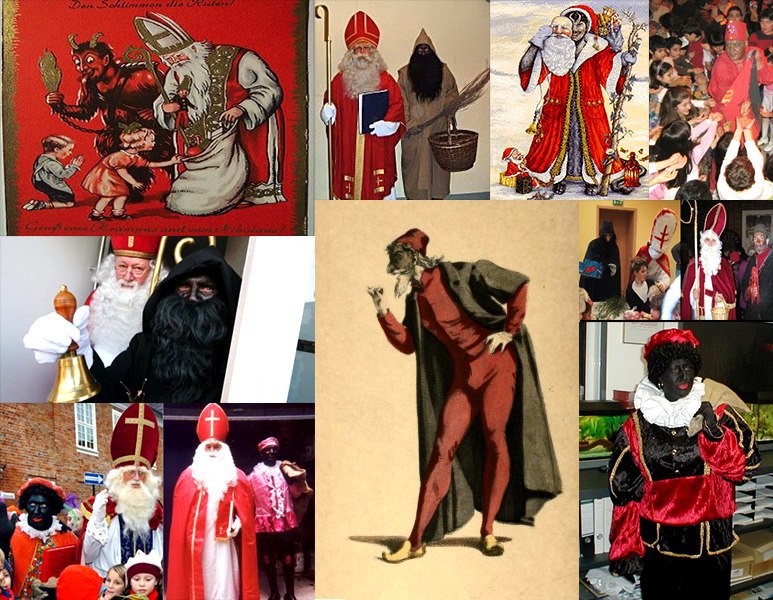
Any Iranian who has spent the Christmas and New Year season in the Netherlands or Belgium has probably seen, on 5 and 6 December, the dark-faced companion of Santa who, with cheerful and sometimes clown-like movements, distributes sweets and candy among children. That Iranian may well have thought: what an interesting resemblance. In fact, our inquiry begins from this strange similarity.
Is this resemblance merely accidental, or is it possible that these two figures, both of whom appear around the beginning of a new year in two distant cultures, share older roots?
Let us become a little better acquainted with the man standing beside Santa with a blackened face.
Black Pete, or Zwarte Piet as the Dutch call him, has for centuries been portrayed beside Santa with this same face, and the origin of his entry into the Santa story has continually been questioned. Different answers have been offered—answers remarkably similar to the attempts to trace the origins of our own Haji Firuz. Interestingly, in recent years controversies about racism in relation to this figure have intensified in the Netherlands and Belgium, just as they have with Haji Firuz. Many in Dutch academic society call for the figure to be removed. Supporters of his continued presence offer various arguments, the most important being that his blackened appearance has nothing to do with skin colour but with soot. Some even argue that the soot comes from descending household chimneys with Santa, or in Santa’s place, to deliver children’s gifts. This seems particularly interesting given the belief that Santa, with all his grandeur and imposing presence, probably does not descend the chimneys himself and leaves the task to his servant.
The complete text of this essay can be read on the Farzanesh and Philosophy website or in the attached PDF file.
With thanks,
Aydin Areta
Comments
Loading…
Leave a comment