
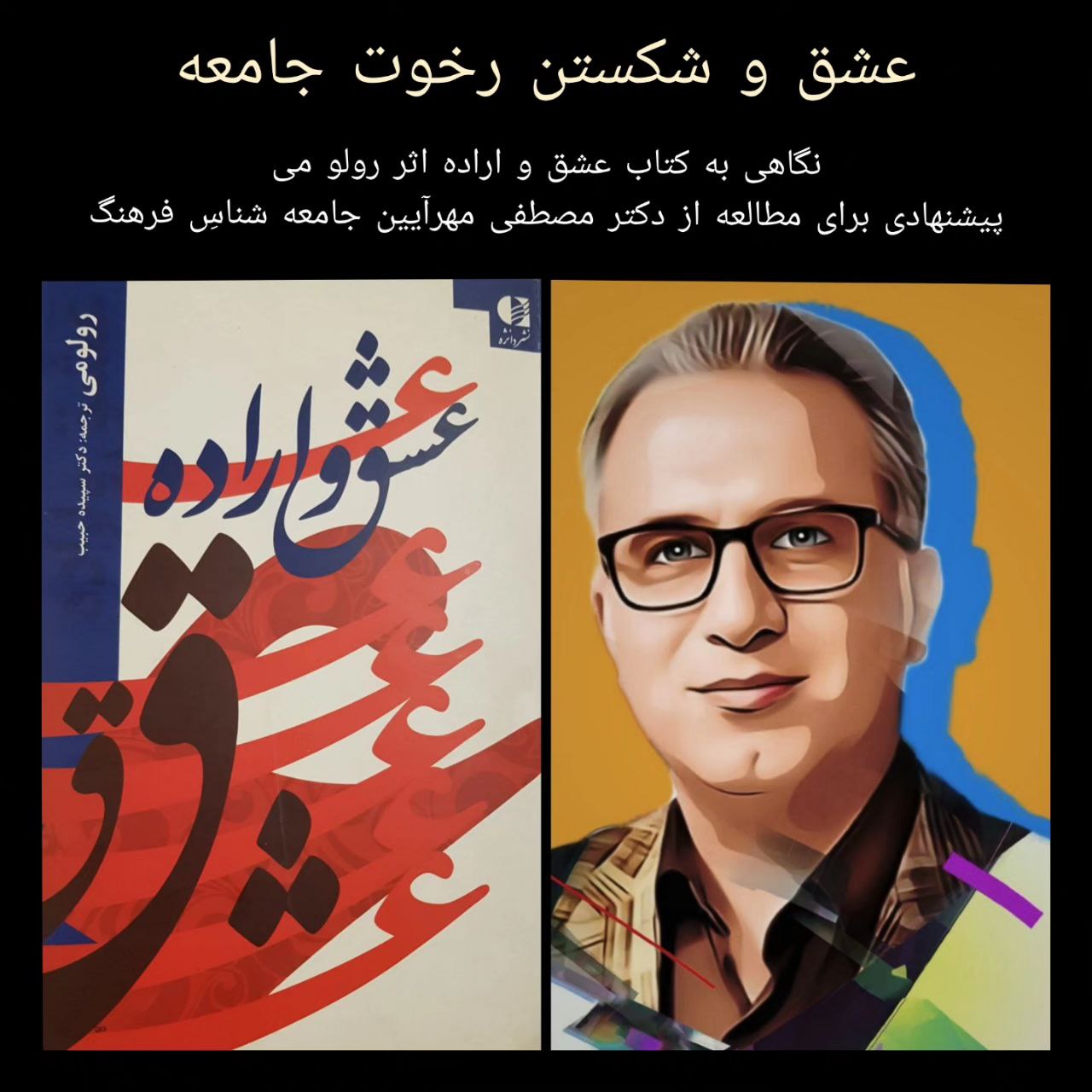
Love and Breaking Social Inertia
A Reading of Rollo May’s *Love and Will*
(A Reading Recommendation from Dr Mostafa Mehrayin)
Aydin Areta
The great problem of our society today is a crisis of love and will.
In a recent post, Dr Mostafa Mehrayin invited his readers to read Rollo May’s *Love and Will* in order to understand the conditions of Iran today and the deeper existential layers of what this society is experiencing.
Although he has not yet set out and discussed his own ideas from this work and has promised to do so soon, I would like in this short piece to present my independent view of the importance of the book and its central ideas.
In this book Rollo May searches for the roots of modern human beings’ social passivity and for the possibility of liberation from that passivity through a redefinition of love. In his view, love is not a feeling. Love belongs entirely to the domain of action. The courage to commit to it is the courage to accept responsibility for one’s own growth, for the growth of other people, and for the flourishing of the world in which we live.
In his view, modern human beings have fallen profoundly into a position of passivity and absence of will, and this is the consequence of a crisis of love. Our becoming numb and indifferent is an escape from consciousness and a desire for unconsciousness; our flight from the risk of life is a desire for non-being and death.
Will, from his perspective, is our reciprocal action toward the world: our purposeful response to an event that has entered the circle of our existence. It is our action in relation to what happens to us, what separates us from being mere spectators of life.
In May’s view, reducing love to merely a feeling has placed us in a schizoid condition. The schizoid personality is disconnected and unable to form a deep emotional relationship. Such a person is alienated from the world in which they live, without world and without society, severed from the heart of life.
Before continuing my reflection on this work by Rollo May and its relationship to conditions in Iran today, I would like to write a few lines about Dr Mehrayin, who will certainly be familiar to many readers of this text.
Comments
Loading…
Leave a comment