
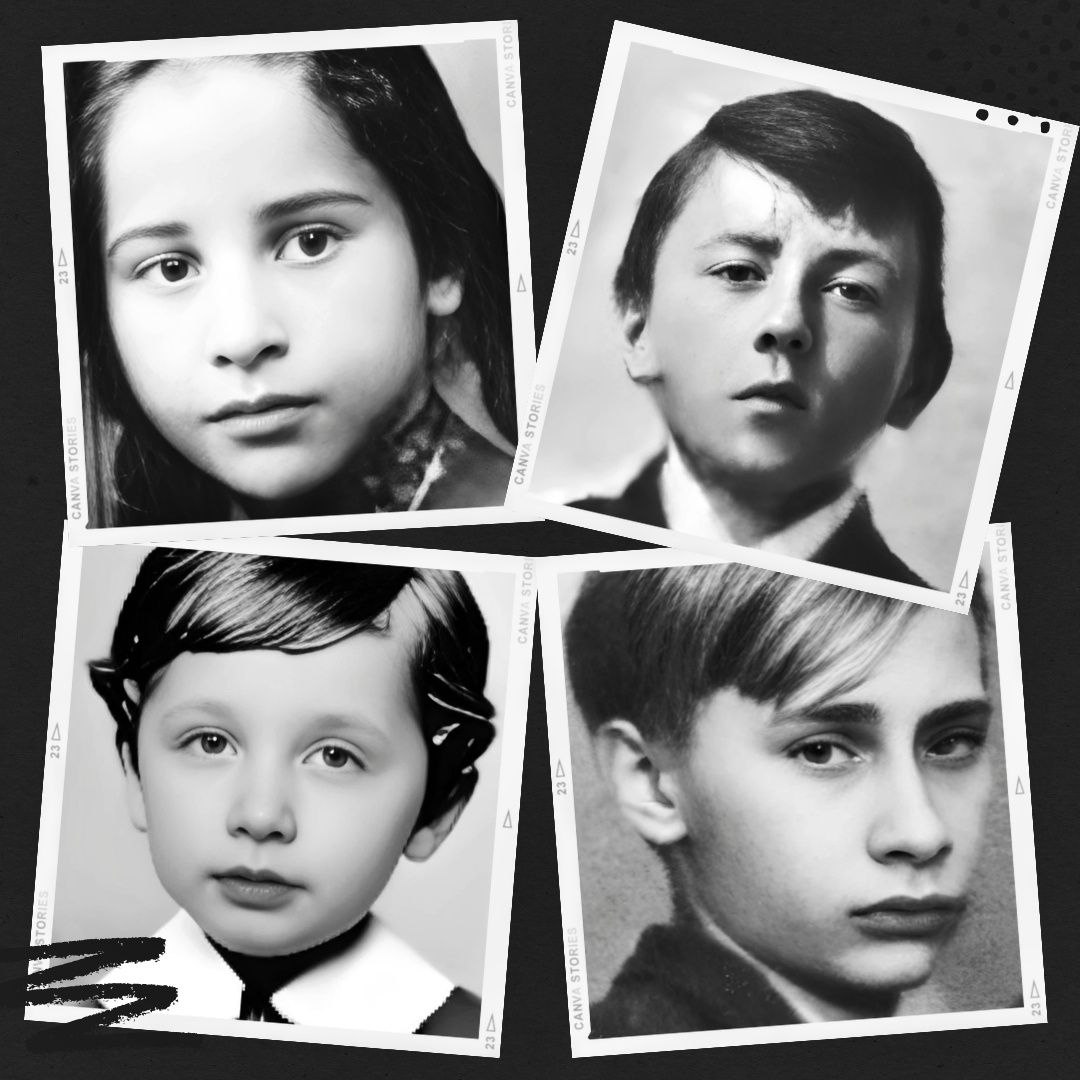
Look into the eyes of these four children. It is not difficult to recognize them.
It is remarkable that something in our eyes remains unchanged through time.
We grow, choose, experience, learn, and age, while the one behind our eyes continues, in profound silence, to look outward—unchanged and mysterious.
Someone who is us and yet is not us. We are moved by the waves of change in life, while that one sits in the depths of an ocean of stillness. Something not limited by time and place, perhaps the very thing that continues its journey after us.
On a stone that Carl Jung carved for his seventy-fifth birthday in 1950 and placed at his home in Bollingen, Switzerland, he inscribed passages inspired by an ancient alchemical text concerning this solitary and silent observer:
“I am an orphan... alone!
And yet spread everywhere and through everything!
I am one, yet in conflict with myself!
I am old and young!
I have known neither father nor mother!
As though I were drawn from the darkness of the ocean of nothingness like a fish! Or fell from the sky upon the darkness of the world like a white stone!
I travel through the mountains and forests of the world, while at the same time I am hidden in the unknown depths of human beings.
I am mortal for every human being, and yet the cycle of time and eternity will never touch me!”
This solitary observer in silence, this hidden human “Self,” and this lost philosophers’ stone—lapis philosophorum—is what lies behind our eyes. It contains within itself everything we are and become, and everything we choose, cultivate, or destroy in life, yet it is not limited to any of them. It is as though something beyond time, place, and human experience is here simply to observe. Only to observe, in profound silence, indifferent to the temporal and spatial limits of our lives.
It is everything we are and, at the same time, everything we can become and do not become. It contains both our splendour and our destruction.
Aydin Areta
@AydinArera
Comments
Loading…
Leave a comment