
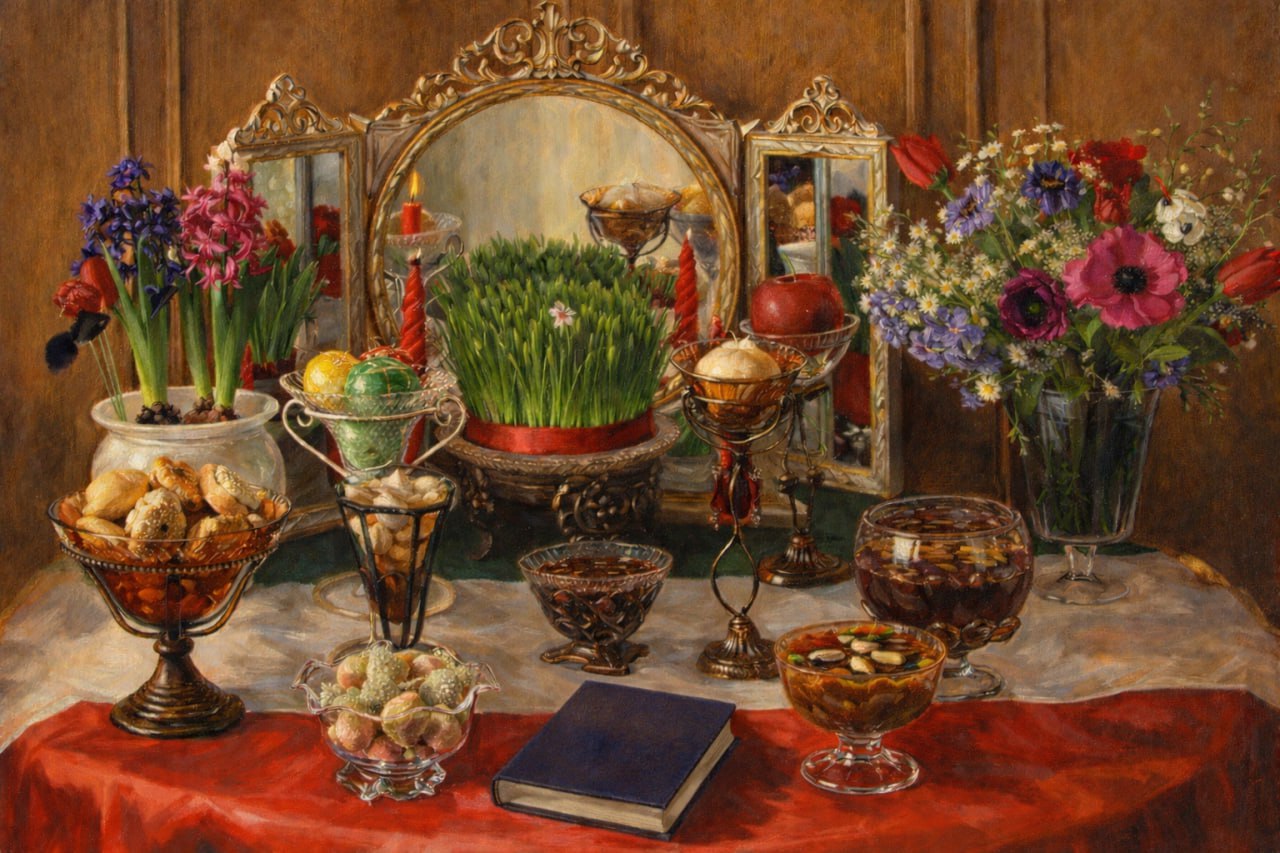
Haft-Seen: The Mandala of the Resurrection of the Iranian Spirit
Aydin Areta
The Haft-Seen table is a living field filled with symbols, each speaking to the soul in its own language. Through this ritual, once each year, society tells itself:
Despite suffering, growth is still possible.
Despite the passage of time and all forms of erosion, meaning has not been lost.
Despite winter, spring returns.
And despite darkness, light can still occupy the centre.
In this sense, Haft-Seen is a mandala of the resurrection and rebirth of the Iranian spirit: an arrangement of hope, memory, light, and the promise of being born again.
1. Haft-Seen as Mandala:
Finding the Psyche’s Centre on the Threshold of Transformation
In Carl Jung’s account, the mandala is a form of inner order that appears particularly in times of crisis, transition, rupture, or loss of centre. When human beings experience inner chaos, the unconscious moves toward creating forms that reconstruct centre, symmetry, balance, and harmony. Haft-Seen can be understood within precisely such a framework.
The table is a surface on which different elements of life are placed in relation to one another; nothing is entirely accidental. Sabzeh, mirror, candles, water, fruit, seeds, books, espand, and other elements together create a small but complete world. This “arranging” is not merely decoration; it is a symbolic rearrangement of the inner world.
The human psyche is a realm of symbols and images. The psyche thinks in images. From this perspective, Haft-Seen is not merely a historical “system of symbols,” but a living visual event—an opportunity for the spirit to display itself through objects. At Nowruz, the Iranian spirit does not merely “express” itself; it arranges itself.
2. Balance Between Nature and Culture:
A Dialogue Between Earth and Meaning
One of the most fundamental balances established by Haft-Seen is the balance between nature and culture.
Nature is present on the table in its rawness and generativity: sabzeh, hyacinth, water, apple, garlic, and sometimes fish. Yet this nature has not been left to itself. It has been placed within a cultural field, arranged, ritually ordered, and set beside mirror, candles, books, and cloth. Nature has entered the realm of meaning, and culture has not separated itself from natural sources.
The spirit makes its home precisely in this “being-between”: neither in faceless nature nor in lifeless culture, but where matter and meaning listen to one another. Haft-Seen is the ritual of that listening.
This balance matters because a healthy psyche neither dissolves into pure nature nor freezes within a dry, rootless culture.
Sabzeh here is not merely a sprout; it is the return of vital force from the heart of winter.
The hyacinth is not merely a flower; it is the embodiment of the psyche’s fragrance, a scent that carries space beyond its material surface into the realm of memory and tenderness.
The apple can be seen as a symbol of wholeness, beauty, and ripened life: round, complete, and carrying a quiet splendour.
Opposite these natural elements stands the book: the Avesta or Qur’an, the Shahnameh, and the Divan of Hafez. The book means that human beings are born not only from seasons but also from stories and narratives.
The mirror, too, is a cultural symbol of self-awareness: nature, when reflected in the mirror, learns to look at itself.
3. Balance Between Life and Death:
Spring at the Edge of Loss
No ritual of rebirth can be understood without its relation to death. Nowruz itself arises from winter; and winter is not only the season of cold, but also of stillness, erosion, silence, and proximity to death.
Haft-Seen, therefore, although outwardly a table of life, is in its depths also in dialogue with death. Sabzeh rises from a seed that was previously hidden in the darkness of the soil. Vinegar is produced through the passage of time, fermentation, and a kind of transformed decay: a reminder that life comes not only from freshness but also from processes of decomposition, sediment, and change. Sumac, with its dark red colour, can recall blood, sunset, or the boundary between extinction and awakening.
Within this field, the candle has an essential presence. In an archetypal reading, the flame symbolises consciousness: a small but living light in the heart of darkness. The candle shows that light gains meaning not by denying darkness but at its boundary with darkness.
This is where Haft-Seen tells us that despite the shadow, light can still remain at the centre.
Water, too, carries a double meaning: it is both a source of life and a symbol of unconsciousness, recalling the unknown depths of the unconscious—from which both birth and death can emerge.
The simplistic reading that “spring means happiness” is a superficial account of rebirth. Spring is not merely blossoming; it is a blossoming that rises from winter and loss. For this reason, within the Iranian psyche, Haft-Seen has always been capable of sitting beside the memory of the dead and those who have lost their lives.
Continued ... 👇
Comments
Loading…
Leave a comment