
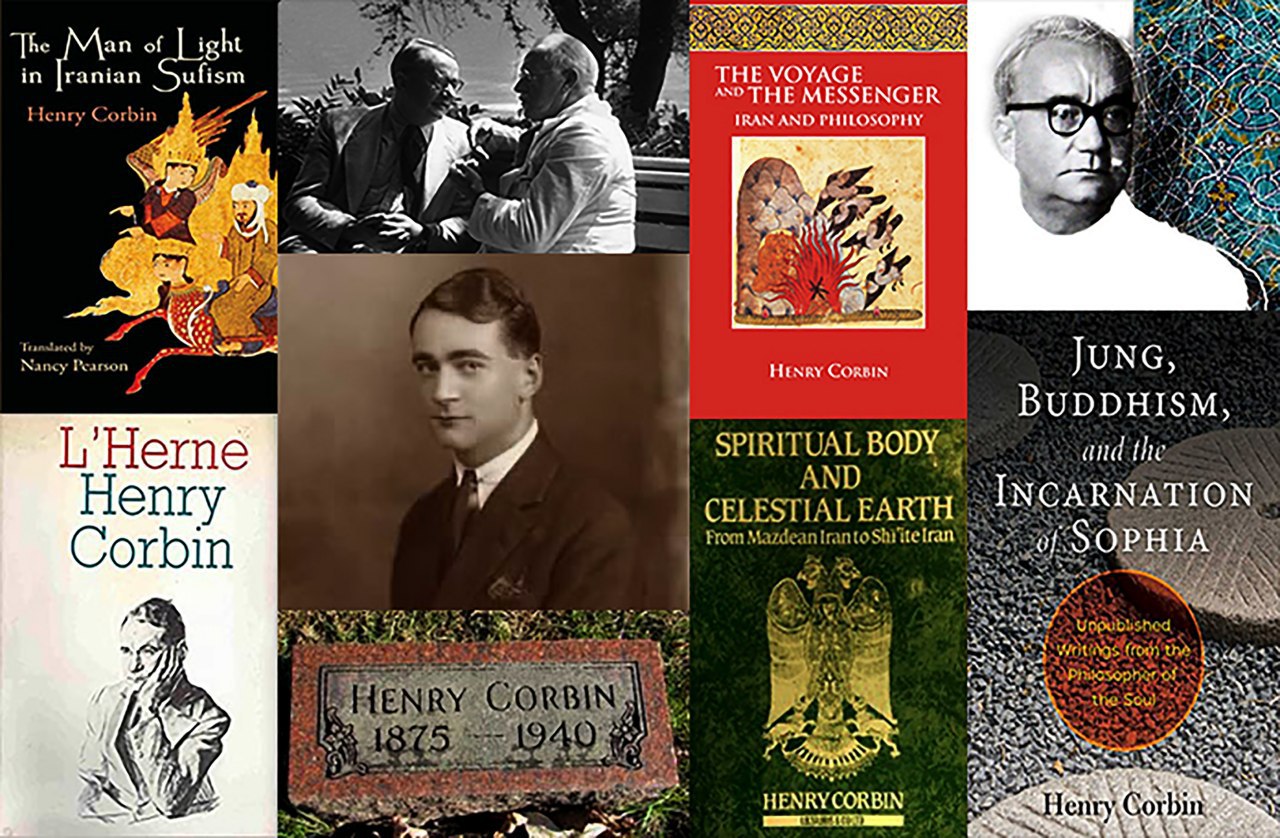
A Look at the Life and Philosophical Legacy of Henry Corbin
A Traveller of Iranian Thought and Wisdom
Aydin Areta
“The philosopher’s ideal is the transformation and change of the self, expressing a spiritual rebirth. The initiatory journey of a mystic-philosopher is an advance toward ‘light.’”
(Henry Corbin)
“For me, Iran is not merely a nation or an ancient empire. Iran is a spiritual world at the heart of the history of thought and religions.”
(Henry Corbin)
Many human lives have been transformed by the study of a single book. This happened to the young Henry Corbin when Louis Massignon, the great French scholar of mysticism and author of The Passion of al-Hallaj, gave him Suhrawardi’s Hikmat al-Ishraq and asked him to read it.
Reading that book—which Corbin later translated into French—profoundly affected the young scholar and awakened in him such an unusual passion that he decided to travel east, not only to read the other works of the Shaykh al-Ishraq but also to become acquainted with the culture that had been the source of such wisdom and had made such thought possible.
Before beginning the journey that became the spiritual path of his entire life, Corbin had already had the opportunity to learn Western philosophy from figures such as Étienne Gilson, described here as perhaps the greatest modern authority on medieval European philosophy in the past two centuries. He also obtained his doctorate in philosophy from the Sorbonne in Paris, where he later held a professorial chair.
During his philosophical studies Corbin had become deeply attracted to the phenomenology of Edmund Husserl and continued to describe himself as a phenomenologist until the end of his life. He was the first to translate works by Karl Barth from German into French. By translating three important works attributed in the source to Martin Heidegger—Being and Time, “The Phenomenology of Death,” and What Is Metaphysics?—he also introduced the German philosopher to French readers.
In translating Heidegger’s works, Corbin consulted Heidegger himself at every stage over the rendering of key terms, making his French translations distinctive and valuable. The source further states that Jean-Paul Sartre encountered Being and Time through Corbin’s translation and, inspired by Heidegger’s masterpiece but also in criticism of it, wrote Being and Nothingness, which became a turning point in existentialist philosophy. Henry Corbin remained interested in Heidegger’s philosophy until the end of his life, although after his encounter with the philosophy and wisdom of the Iranian lands he said that he had moved beyond the boundaries of Heidegger’s philosophy.
Daryush Shayegan wrote a valuable book about Corbin’s life and ideas, which I have used in reviewing the chronology of Corbin’s life for this brief account. Shayegan, who was a close friend of Corbin for years, quotes him as saying, in relation to Heidegger, that he learned from him that “philosophy means ta'vil,” or hermeneutic interpretation. This phenomenological understanding of philosophy in Corbin arose from the inspiration he found in Heidegger.
The difference, however, was that if Heidegger ended his philosophy with the human condition of “being-toward-death,” Corbin believed that through Mulla Sadra he had reached the idea that “the human being is an existence beyond death,” and that the interpretation of what a human being is must pass beyond the boundaries of “being-toward-death.”
Perhaps centuries will pass before someone from the West, possessing Corbin’s depth of philosophical insight and breadth of knowledge, again decides to choose Iran as a second homeland and devote themselves to the wisdom of this land. Henry Corbin was also a linguist who knew French, German, Arabic, and Persian, as well as Sanskrit and Pahlavi. If he was an Orientalist, he simultaneously felt a deep affinity with the German philosophical tradition; if he became a scholar of Islam, before that he had acquired deep knowledge of Christianity and the Zoroastrian tradition and, through his familiarity with Sanskrit, of Buddhism.
He travelled an unusual road from the West to becoming a seeker of perennial wisdom. What he learned of medieval philosophy from Étienne Gilson; his knowledge of Christian Protestantism and mythology; the understanding Massignon gave him of Oriental studies and Eastern mysticism; his studies of Plotinus and the Neoplatonists, Hermeticism, and the Upanishads; and his familiarity with the phenomenology of Husserl, Swedenborg, Barth, Cassirer, Heidegger, the German philosophical tradition, and finally his discovery of Suhrawardi—all came together in a distinctive synthesis of the subtlety of French thought, the depth of German philosophy, and the mysterious world of Iranian wisdom and mysticism.
Comments
Loading…
Leave a comment