
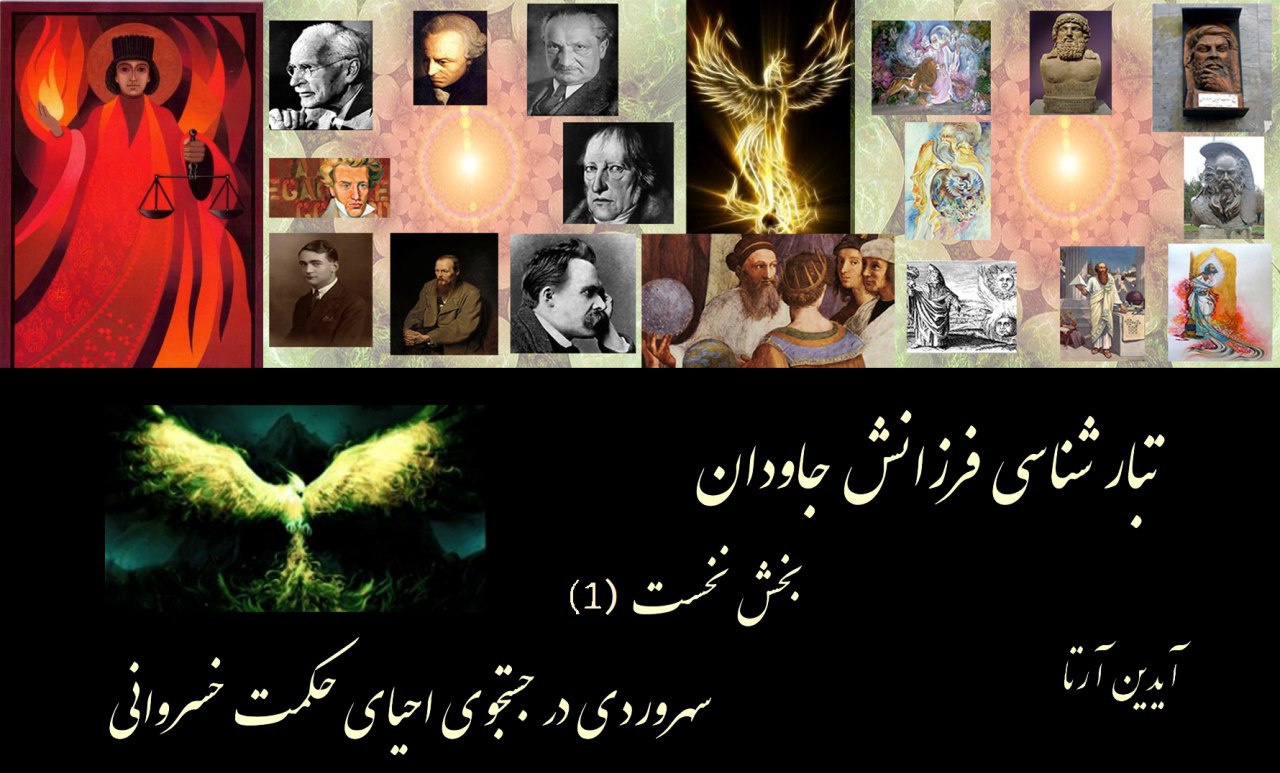
A Genealogy of Perennial Wisdom
Genealogy and Historiography of Perennial Philosophy
What is the perennial wisdom—the philosophy I am trying to restate and introduce?
Perennial wisdom is not a new concept. Throughout history it has repeatedly been introduced under different names, and its principal lines can be recognised under many names within philosophical traditions, including:
Platonic and Neoplatonic Tradition, Perennial Philosophy, Gnostic Philosophy, Prisca Theologia, Primordial Tradition, Philosophy of Illumination, Theosophical Movement.
My understanding of perennial wisdom rests on several fundamental principles:
— This philosophy is fundamentally Platonic. By this I mean that it is oriented towards transcendence: it sees the world as a possibility capable of being elevated towards something higher.
— In its approach it is compatible with a form of existentialism. It places the human being, human freedom and the importance of individuality at its centre, and understands philosophy as a way of living consciously in the world. For this reason it articulates its concepts through movement between philosophy and analytical psychology. The fluidity of this philosophy also allows art—especially poetry, literature and mythology—to acquire philosophical meaning in its own right and to become a means for communicating philosophical concepts and developing consciousness.
— Although existentialism appears, in many respects, to conflict with Hegel's structural philosophy, this philosophy takes a Hegelian view of history. It sees human history as the scene of the development of consciousness and freedom and takes a teleological view of history, seeing the human being and the world within a dialectic moving towards transcendence.
This philosophy has itself evolved through history, and throughout human history it has defended human individuality and freedom without taking its eyes from the heavens.
I believe that, in its essence, this philosophy is strikingly compatible with our own historical philosophical thought and with the foundational ideas of our mystical tradition. I do not consider this compatibility accidental, because many have believed that the birthplace of this form of philosophical thought was the Iranian world. The claim that Platonic philosophy has deeply Iranian and Mazdayasnian roots is not new, but its historical foundations have not been articulated as fully as they might be.
I believe that a modern articulation of this philosophy could lead to the rebirth of a form of philosophy in Iran that may itself be understood as the modern rebirth of an ancient and fundamentally Iranian philosophy. It could mark the beginning of perennial wisdom's return to its home.
As a first step, drawing on my research of recent years, I intend to prepare a concise genealogy and historiography of this philosophy, and in later stages to explain its philosophical foundations.
Along this path I am completing a series entitled “A Genealogy of Perennial Wisdom.” Its first section concerns Suhrawardi and his attempt to recover and reinterpret the ancient Khusrawani wisdom of Iran within the Philosophy of Illumination, as well as its continuation through the lineage of Iranian mystics and poets. In the next section I will examine historical evidence suggesting how strong and well-supported the links between Plato and his philosophy, Neoplatonism, Zoroaster and the Mazdayasnian tradition may be. The third section will look at Neoplatonic movements on the eve of the Renaissance and the dream these movements held of reviving this philosophy.
A large part of this research, particularly in the second and third sections, is being published for the first time. On Friday 14 December I will give a talk in Sydney to an interested Iranian audience entitled “Perennial Wisdom and the Lost Dreams of the Renaissance,” and I will share its recording with friends once I receive it.
The audio and video file offered below is the first part of this series, entitled “A Genealogy of Perennial Wisdom: Suhrawardi in Search of the Revival of Khusrawani Wisdom.”
With thanks,
Aydin Areta
Comments
Loading…
Leave a comment