
How is the freedom of modern human beings threatened simultaneously from “within” and “without”?
A look at Erich Neumann’s ideas in The Origins and History of Consciousness
(Part One)
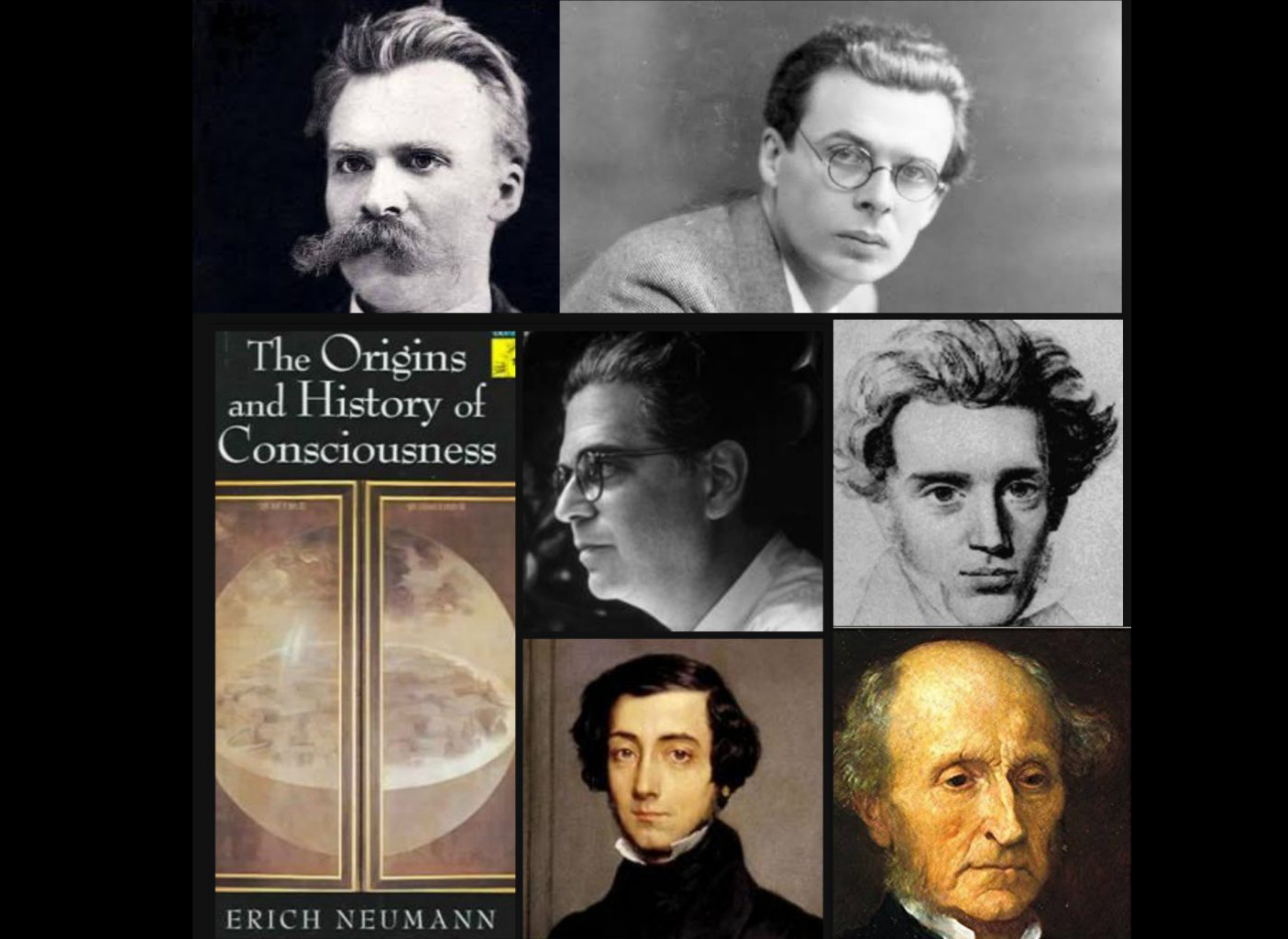
Erich Neumann, the German psychologist and philosopher and one of Jung’s most prominent students, warns us in the final chapter of his important work The Origins and History of Consciousness—under the title “Mass Man and the Phenomena of Recollectivization”—that although modern human beings appear to be freer than at any previous point in history, and although greater value seems to be placed on individuality, a new form of tyranny is taking shape through the enslavement of consciousness by our unconscious mind.
Before considering Neumann’s warning about the destruction of modern freedom from within, I want to broaden the discussion and consider how modern freedom is being restricted from both “outside” and “inside”.
Throughout history, it seems, we have struggled continuously and tirelessly against forces outside the sphere of our individuality that have sought to enslave us.
There was a time when slavery, racial superiority, and political and social inequality between men and women were treated across much of the world as self-evident and acceptable, while children’s rights, universal education and the political participation of all citizens were scarcely imaginable. Today we live in a world in which tyranny and the ugly face of such inequalities certainly remain in many places, yet their former absolute domination over human consciousness has gradually weakened, and their influence upon our collective awareness has diminished.
It is now more difficult than at almost any previous point in history openly to defend naked tyranny that enslaves human beings and promotes inequality, because a new consciousness of freedom has been taking shape within the modern mind.
Readers of my earlier writings will probably have seen me repeatedly return to Hegel’s description of human history: “The history of the world is nothing other than the progress of the consciousness of freedom.” To accept this description is to believe that human beings continually expand their awareness over time and, as that awareness develops, not only become freer but also understand more deeply the purpose and meaning of freedom itself.
While many thinkers and people around the world, intoxicated by the modern understanding of freedom, imagine that we now stand at freedom’s summit, other thinkers warn that alongside these significant and valuable developments a new tyranny is forming in both our “outer” and “inner” worlds.
With regard to the new tyranny emerging externally, Alexis de Tocqueville—the nineteenth-century French thinker best known for Democracy in America—argued, long before the great expansion of democracy in the second half of the twentieth century, that after the French and American revolutions the democratisation of societies in the following century would become an irresistible and unstoppable historical force.
He also warned that as democracy accelerated, social equalisation would accelerate with it; yet the ideal of freedom from domination might gradually be displaced by a demand for rights and equality guaranteed by the state. Tyranny could then return in the form of the democratic state, entering the details of everyday life more deeply than before and, in the name of democratic equality, reproducing its authoritarian life as regulator, inspector, adviser, educator and punisher.
Although Tocqueville admired democracy and regarded movement towards it as a powerful historical tendency, he believed that democracies retained a capacity to become centralised forms of domination and that democratic culture itself could become vulnerable to manipulative propaganda and demagoguery. He anticipated the possibility that tyranny might return in a tolerant and populist appearance, difficult even to recognise: a tyranny that would not necessarily torture human beings, but could instead reduce, diminish and degrade them.
How is the freedom of modern human beings threatened simultaneously from “within” and “without”?
A look at Erich Neumann’s ideas in The Origins and History of Consciousness
(Part Two)
In a new form, a modern aristocracy may be reconstructed within industrial and economic structures under the deceptive name of democracy. This new domination does not destroy citizens’ lives in the old manner, nor does it usually oppress through chains, executioners and naked violence. Instead, modern state power perfects and civilises its techniques of control and therefore appears less hateful and humiliating in the eyes of those subjected to it.
Peacefully, and through laws formulated and administered democratically, this domination can turn citizens into passive subjects expected to trust the benevolent power of the state while devoting themselves to family life, work and material consumption.
Freedom is placed in chains once again in history, this time under a new justification: security. Opponents of government are recast as “opponents of security”, and freedom is restricted through the weapon of security. In this way, with the return of a modernised form of domination, freedom—once the first aspiration of democracy and of the modern human being—becomes one of the first casualties of the democratic state.
If Tocqueville’s warning can be understood as one of the early warnings to modern humanity about the quiet restriction of freedom “from outside” by political power, other thinkers—long before Neumann and roughly in Tocqueville’s time or shortly after him—pointed to another painful process occurring “inside” modern human beings. This inner process may be an even greater threat to modern humanity and its struggle for freedom.
John Stuart Mill, often regarded as one of the architects of modern liberalism, warned in his historically important On Liberty, written about two decades after Tocqueville’s Democracy in America, that as political and social freedoms expanded a new slavery was taking shape without clear historical precedent: the “slavery of public opinion”. Mill’s concern, as presented here, was that people would not merely become blind followers of whatever was fashionable and publicly approved, but more troublingly would come to desire, even in the depths of their hearts, nothing beyond what the majority regarded as acceptable.
Søren Kierkegaard, the Danish philosopher and precursor of existentialism, warned at roughly the same period that modern society’s excessive concentration on freedom of speech might be a compensatory reaction to the loss of something deeper: freedom of opinion and freedom of thought. In the formulation used here, Kierkegaard suggests that we can lose independence of thought so silently that the loss of a low-value banknote troubles us more than the loss of intellectual freedom.
Only a few decades later, Aldous Huxley, in his literary and philosophical work Brave New World, imagined a dark future in which pleasure-seeking and consumerism dominate human life and thinking—and consequently philosophy, art and literature—are displaced. If George Orwell, in works such as Animal Farm and Nineteen Eighty-Four, fears the return of overt tyranny and the chaining of modern humanity, Huxley imagines that modern societies may no longer require such naked oppression at all: no one needs to steal freedom or hide truth if truth itself becomes irrelevant and freedom of thought becomes unnecessary.
Many philosophers, including Friedrich Nietzsche in the late nineteenth century, warned about collectivism and the dangers of forgetting individuality. Nietzsche sees collectivism as connected with the herd instinct and as an unconscious force hostile to thought and individuation. Liberation from domination by the collective and freedom from the herd become, in this reading, primary conditions of modern freedom at a time when individuality is increasingly crushed beneath the wheels of mass society.
The experiences of the twentieth century—from the Soviet Union and China to forms of consumer capitalism in which public opinion and widespread material desires can flatten individual distinctiveness—are presented here as reasons for taking seriously the concerns voiced by Nietzsche, Mill, Tocqueville and Huxley.
Aydin Areta
How Is the Freedom of Modern Human Beings Threatened Simultaneously from “Within” and “Without”?
A Look at Erich Neumann’s Views and Ideas in The Origins and History of Consciousness
(Part Three)
With this introduction in mind, let us now look at Erich Neumann’s views in the final chapter of The Origins and History of Consciousness, entitled “Mass Man and the Phenomenon of Recollectivization.”
Neumann believes that the project of liberating modern human beings faces a serious challenge. In his view, our consciousness and awareness—in the sense of what we do deliberately and consciously throughout each day of our lives—are deteriorating. For this reason, we remain, perhaps more than ever before, under the “tyranny of the unconscious mind.”
He describes what is called individuality and individualism in the modern world as “particulate individualism,” or “atomistic individualism.” The reason for this expression is that atomic particles are homogeneous and alike: although each has an independent existence, that existence lacks any unique characteristic, and atoms therefore possess no independent identity in themselves. Each atomic particle is only one among billions of identical particles. Neumann believes that modern human beings have met with a similar fate.
Neumann argues that as human groups grow larger, the human mind inevitably tends towards becoming a mass and a herd, and two important things happen to us. First, our consciousness deteriorates and, under the control of the herd mind, we lose our individuality. Second, the ego—or what we call the “I”—instead of establishing our connection with the unconscious and our shadow, and linking the inner and outer worlds, comes in practice to serve entirely our persona, or “social mask.” It expends all its energy constructing and maintaining our mask within the herd. In this way our connection with the unconscious is severed, giving the unconscious the opportunity to bring us under its control and tyranny. This means that throughout the day we continually do things about which we have not consciously thought—actions wholly in the service of unconscious motives, which consist primarily of instinctual and emotional impulses.
Another consequence of this rupture between the conscious and the unconscious, and of the unconscious gaining ascendancy over consciousness, is a volcano of emotional and affective impulses within us that manifests as depression and anxiety. Today we know that, in the evolutionary structure of the human brain, there are three fundamental levels. The archicortex, or ancient brain, is shared by all vertebrates. It includes very simple yet fundamental functions of life, such as breathing, hunger and the autonomic system involved in digestion and reproduction, and is common from crocodiles and snakes to human beings. The second level is the paleocortex, or emotional brain, governed by the limbic system and found principally in mammals. This part of the brain, lying beneath the cortex, is responsible for the formation of emotions, memory and some forms of learning that gradually developed in higher vertebrates. Finally, at the highest level, we have the newest and most advanced part of the brain, the neocortex—or, for short, the cortex—which is responsible for higher processes of thought, many of which, such as speech, are found only in human beings.
One might regard the “unconscious” as another name for the “archicortex and paleocortex,” and “consciousness” as another name for the “neocortex.” The loss of cortical control over underlying structures can therefore be understood as a kind of “regression,” which diminishes human beings’ humanity and turns them into animals controlled by instincts and basic, uncomplicated emotions.
Neumann believes that as the reflective part of us and the thinking structures of the brain deteriorate, a more debased human being grows within us, which he calls the “Sub-Man” or “Mass Man.” In his view, what the project of human freedom sought, and what people fought for—the liberation of the human being from collective tyranny and the expansion of individuality—is forgotten in the process he calls recollectivization.
The Threat to the Freedom of Modern Humanity
A depth-psychological analysis of the subtle mechanisms by which modern society erodes genuine human freedom — through conformity, consumerism, and the surrender of individual judgment to collective authority.
Aydin Areta / آیدین آرتا14 min read
Receive new work
Occasional updates when new work is published.
Comments
Loading…
Leave a comment