
Halloween, Our Children and the Monsters Hidden in the Dark — Part One
After a difficult week, a long day and ten hours of driving, I returned home about an hour ago and wanted to write a few lines after a week's absence.
Tonight, in this corner of the world as in many other places, people celebrated Halloween. It is a strange and frightening celebration that most children enjoy and towards which many religious Christian families hold a strongly negative view.
For years I, too, did not have a positive view of this unconventional celebration. Watching people compete to appear more frightening, more repulsive, more suggestive of violence and death, and more disgusting, in a festival that at least on its surface appeared meaningless, gave me little to like. At the same time I did not want to impose this personal view on my young son, who eagerly prepared for the celebration each year. And so, beside my son, I too experienced Halloween—with considerable scepticism.
In the past I had experienced Halloween among adults, and perhaps that less than pleasant personal experience contributed greatly to my negative view of the celebration. But I must admit that over the past few years, experiencing Halloween alongside children created an entirely different feeling in me. I would like to share that feeling, and the conclusion I reached, in this piece.
I am not concerned here with the origins of the celebration, nor with its broader philosophy and meaning, nor with why committed Christian families strongly oppose it. I want only to consider the psychology of this celebration in the small world of children, and what led me not merely to develop a positive view of it but to celebrate it enthusiastically alongside my young son.
Children instinctively fear darkness, and they also fear the monsters they imagine are hidden within it. What do you say when your child tells you he is terrified of the dark? Or when he tells you he is afraid of monsters in the darkness? You might say that darkness is nothing to fear and is not dangerous. You might say there are no monsters in the dark. Do you really believe that?
Jordan Peterson, the Canadian psychologist whose thought and work I greatly appreciate, might respond to such an answer by asking you in surprise and criticism: “Is that precisely why you have no fear of letting your child walk alone in the dark to the end of the street and back?”
The truth is that darkness is not equivalent to light, and darkness is frightening. Darkness is filled with the unknown, and the unknown may contain anything frightening. Fear of the unknown is not an unfamiliar feeling for us. Even as adults, many of us would refuse to enter the basement of a house in complete darkness, or an abandoned shed at the far end of a garden. Why are we afraid of darkness? The truth is that, in our hearts, we still believe in monsters hidden in the dark. In adulthood we may transform the frightening imaginary creature of childhood into a thief or dangerous murderer concealed in the night, or perhaps a wild animal hidden in darkness, but the roots of our fear remain. They are far more ancient and powerful than we imagine.
So perhaps it is better not to lie to our children. We should not tell them that darkness is not frightening, or that there are no monsters in it. A lie that even we do not believe in the depths of our own hearts will not make a child more courageous. Instead it may create an enduring sense of humiliation and guilt: a feeling of smallness and shame at being frightened by something that, according to adults, is not frightening at all; the feeling that not only am I cowardly, I cannot even overcome my fear—a supposedly irrational fear of something that adults say does not even exist.
As in many other difficult situations, the answer is not simple. It requires honesty, time and an answer children can understand. A better response might be something like this: “Darkness is frightening. You are not the only one who fears the dark and being alone in it, or who fills the empty darkness with monsters created by the mind. We all do this. But together we have the strength and courage to overcome this fear and step into the darkness. We even have the power to become the hero of our own story and overcome the monsters.”
Halloween, our children and the monsters hidden in darkness — Part Two
Entering the world of darkness and fighting monsters is frightening, but the courage required begins with the first night we sleep alone in a dark room away from our parents. As we grow into adulthood, the darkness of the world and the presence of monsters do not simply become distant memories of childish fantasy. Gradually we discover that darkness, cruelty and monsters have a very real and frightening existence in the world.
Imagine a child entering youth believing that all human beings are good and well-intentioned, and that the world is populated only by people resembling kind parents, uncles and aunts. Such a child knows nothing of what human beings can do in broad daylight—things so terrible that the monsters of childhood imagination would themselves flee into the deepest night. Human beings can kill one another, exchange another human being’s organs for pieces of paper, enslave one another, and commit rape, violence and murder. These are not fairy tales in the adult world. Many people who lose psychological balance after encountering the naked cruelty of the world, and who struggle for years with anxiety, depression and nightmares after such encounters, are those who in innocence and naïveté had never imagined the destructive power of the monsters that exist in the world.
There is a difference between tragedy and exposure to something experienced as evil. Human beings can endure the disasters of life and bitter tragedies such as the death of loved ones, natural catastrophes and illness. Our capacity to bear these events is greater than we often imagine. But looking evil in the eye and being wounded by it is a different experience, one from which relatively few emerge with psyche and spirit untouched.
Some time ago I retold the story of Horus, the Egyptian god associated here with attention and vision and depicted as a falcon, and his battle with Set, embodiment of evil and corruption. Set’s violence is expressed in the story through his dismemberment of his brother Osiris, the good king and the blind father of Horus. Horus goes to war against this most dangerous and powerful monster and, although he defeats him, loses an eye in the struggle. If direct battle with evil costs an eye even for a god of vision, attention and courage, we can only ask what such an encounter costs an ordinary human being who does not even know that Sets exist in this world.
The relationship between children and darkness is portrayed beautifully in Sleeping Beauty. As with other archetypal and mythic stories, attending to its deeper psychology can reveal something valuable about the structure of the human psyche.
In the story, the royal parents of Princess Aurora invite the whole city to celebrate her birth except Maleficent, the dark sorceress who embodies evil and darkness and can also assume the form of a black dragon. Symbolically, excluding her can be read as the act of parents trying to protect a child from the darkness of the world by pretending that the dark sorceress does not exist. Everyone is welcome in their house except acknowledgement of the reality of darkness and evil in the world.
The price of not inviting the dark sorceress is severe. She comes to the celebration herself and declares her curse: when Aurora reaches sixteen, touching the spindle of a spinning wheel will send her into an endless sleep. The spinning wheel is a symbol of fate. We can interpret the sorceress’s words in this way: the person who knows nothing of evil may, on reaching adulthood, fall into unconsciousness at the first touch of fate’s sharp edge. Aurora’s endless sleep becomes an image of the destruction of consciousness and a return to unconsciousness. To disappear from the world may mean retreat into drugs, alcohol, anti-anxiety or antidepressant medication, or immersion in harmful relationships while closing one’s eyes to the darkness around us. All can become forms of the endless sleep of awareness: a fall into unconsciousness after contact with the sharpness of fate.
Perhaps, then, we should neither hide monsters from our children nor make them ashamed before us for being afraid of the dark.
Halloween, Our Children, and the Monsters Hidden in the Dark — Part Three
But what does any of this have to do with Halloween and children?
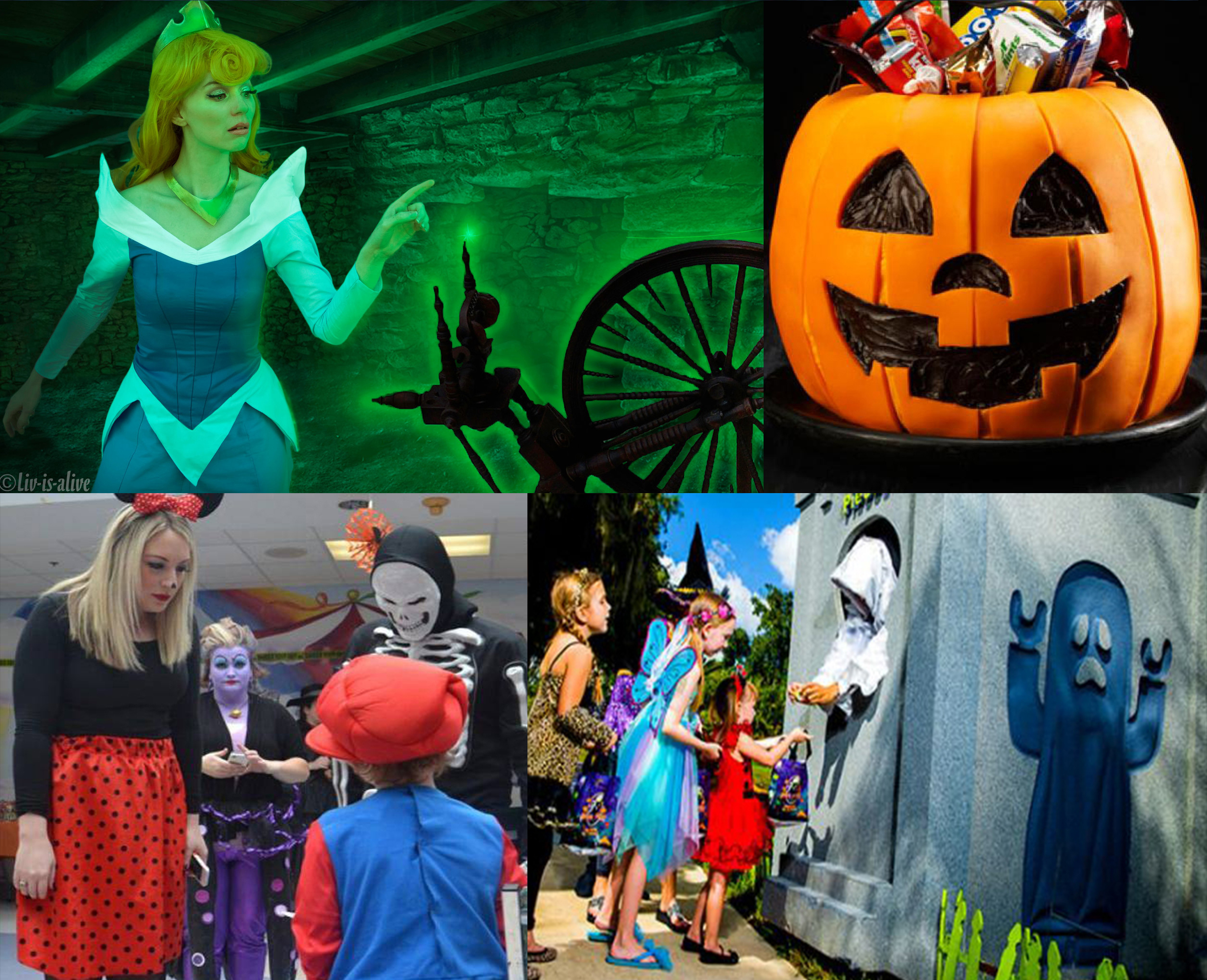
On Halloween night, children go to the darkened houses in their neighbourhood, where the residents are dressed in frightening costumes and have filled their homes with frightening dolls and decorations. The children must voluntarily approach these houses and frightening beings, and the reward for a successful encounter is the sweets and chocolates they receive and collect.
This overcoming of fear and voluntary confrontation with the deepest fears of childhood can be understood as a kind of initiation into children’s inner capacity and courage for confronting the darkness of the world. It is something like the brave hero who goes to fight the dragon and, after defeating it, obtains the gold the dragon has hidden. The encounter between hero and dragon is one of the most ancient mythic stories in the world and one of the central stories of the hero’s journey.
In the Halloween tradition of Trick or Treat, children learn to confront their fear of monsters and darkness voluntarily. The voluntary character of the encounter is especially valuable because modern psychological studies of the treatment of severe anxiety and phobias share a common principle: the importance of gradual and voluntary exposure to what the patient fears. My own close experience of this voluntary encounter changed my understanding of Halloween, making it an important and formative experience for children.
Finally, the next time our child tells us they are afraid of the dark and of monsters, perhaps we can be honest with them and with ourselves rather than saying there is nothing frightening about darkness and that monsters do not exist. Perhaps next year we might even go with them to meet the monsters on Halloween night, and after prevailing in that nocturnal encounter with darkness and the unknown, return home with hands full of sweets gathered as spoils and celebrate together the courage to face darkness voluntarily.
Aydin Areta
31 October 2018
Halloween, Our Children, and the Hidden Monsters in the Dark
A depth-psychological reflection on the significance of Halloween — and the monsters, ghosts, and darkness it celebrates — as a culturally sanctioned encounter with the Shadow and the unconscious.
Aydin Areta / آیدین آرتا9 min read
Receive new work
Occasional updates when new work is published.
Comments
Loading…
Leave a comment