
A Review of The Turin Horse
The Turin Horse (2011)
Directed by Béla Tarr and Ágnes Hranitzky
Aydin Areta
They devalued everything so that they could possess everything, and whatever they possessed they made still more worthless.
Cunningly and through deception, they possessed everything, then stripped it of value, and finally destroyed it. Sometimes through deception, sometimes through violence and cruelty, and sometimes quietly and gently, they lay in wait for everything until they could achieve that final glorious victory they imagined. Along the way toward that victory, nothing in the world remained safe from their touch and possession.
And this world emptied of all value has been destroyed by their hands. This destruction is not a natural disaster, but the verdict of a court humanity has pronounced upon itself.
Everything authentic, great, sacred and higher had first to be emptied of value so it could be acquired; once acquired, it had to be destroyed in order to reach that final victory. Whatever was authentic and great had to surrender without resistance or struggle, because their battle for victory always had to end with the sudden and silent destruction of the other side’s capacity to resist.
And so these victors, through endless raids from their hiding places, finally possessed the entire earth and came to rule it. They mastered even what they had never imagined they could master. They reached for nature, infinity, every transcendent concept and even immortality in order to possess them, and in this way everything was lost.
Those who were authentic and great looked upon what had been lost and realised that there was no longer a God or gods, and only darkness was approaching.
They stood to one side and suddenly a spark illuminated their minds: if God and the gods were dead, then no good and evil existed in the world either. But finally a moment came when they saw before their own eyes that with the collapse of everything good and transcendent, they themselves too would cease to exist.
This was the moment when the one who was authentic and higher burned and went out in a shattering realisation, like a flame left in the rain to be slowly extinguished in its own smoke.
The passages above are a free translation of the neighbour’s speech in The Turin Horse when, on the second day, he visits the old man and his daughter. The film is so filled with silence that a monologue of such force becomes a translation of all the silence surrounding its beautiful, magnificent and painful images.
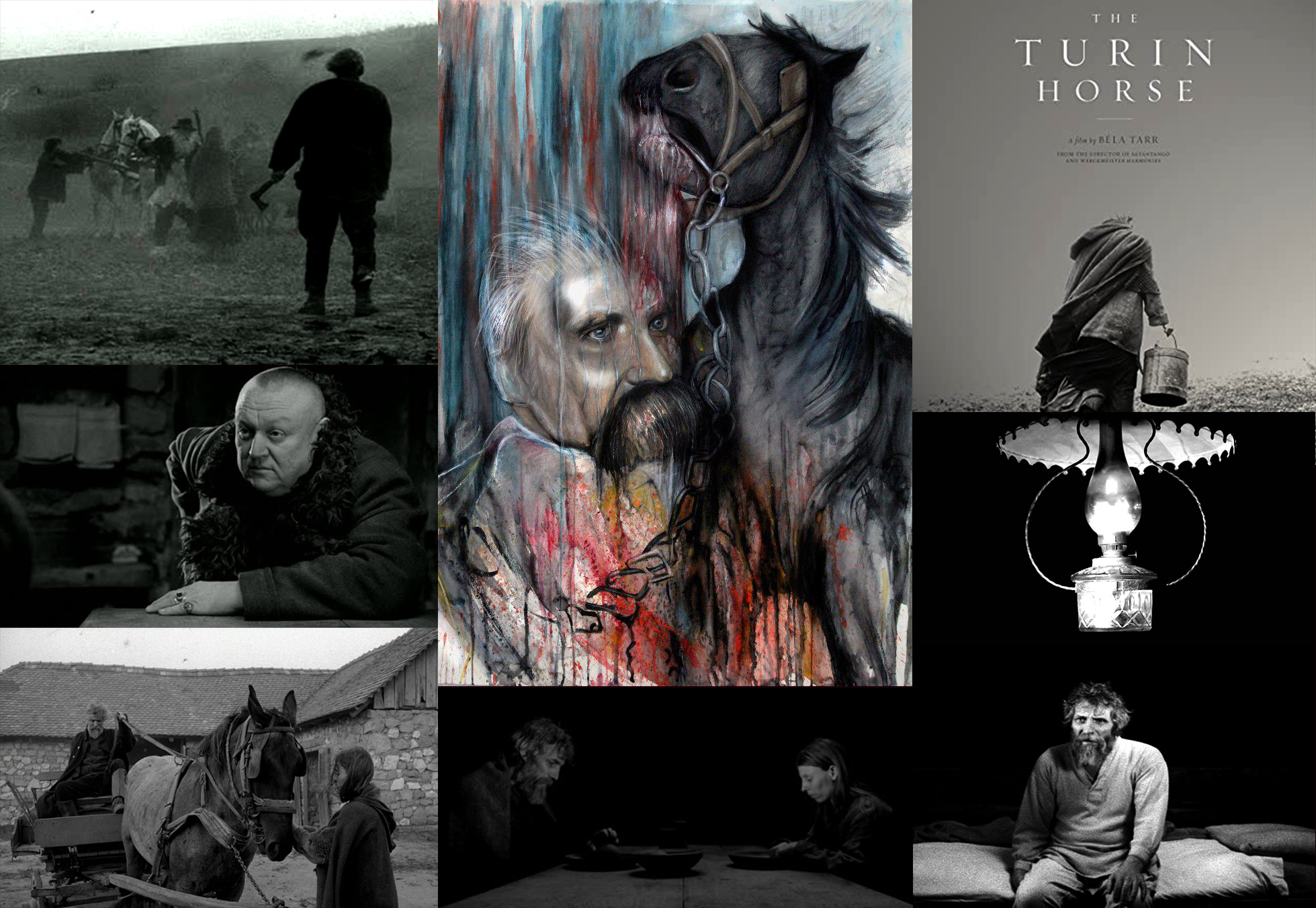
The film begins by recounting the last day on which Friedrich Nietzsche, the great nineteenth-century German philosopher, was seen in what was regarded as his normal state—the final day before the silence and madness that would forever extinguish his genius in their smoke.
On this final day Nietzsche saw a carriage horse refusing to move while its owner ruthlessly brought his whip down upon the noble, beautiful animal. The philosopher who throughout his life had treated compassion as a weakness to be overcome, in his last act before madness stopped the man, embraced the horse with tears in his eyes and said to it: “Brother, I understand you.”
Nietzsche was then taken home by his neighbour and lay on a sofa for two days without speaking. The final words attributed to him were: “Mother, I am a fool.”
After recounting this story and Nietzsche’s final sentence, The Turin Horse returns to the horse and says: but no one knows what happened to that horse afterwards.
The encounter between Nietzsche and the horse is an extraordinary story that sits at the centre of this film’s meaning and places a large question before us: what happened to Nietzsche that day, and what made his world fall into silence? On the second day, the neighbour tells us: “Finally a moment came when they saw before their own eyes that with the collapse of everything good and transcendent, they themselves too would cease to exist. This was the moment when the one who was authentic and higher burned and went out in a shattering realisation, like a flame left in the rain to be slowly extinguished in its own smoke.”
Nietzsche’s great and unfinished project was the revaluation of all values. In The Antichrist he developed this larger project in greater detail and intended to articulate it fully in the unfinished work The Will to Power, a project he either did not have the opportunity to complete or, more probably, abandoned for reasons that remained unknown to later generations.
The Turin Horse: Continued Review (1) — Aydin Areta
Nietzsche believed that the duality we carry in our minds—the idea that life is one thing, while moral values that prescribe how life ought to be lived are something separate from and higher than life—is a false dualism from which we should free ourselves. No value exists apart from life, and every virtue becomes meaningless where life itself has disappeared. This is perhaps something each of us has experienced at some point. When catastrophe strikes at the centre and foundation of life, we feel that nothing retains its former meaning. Imagine suddenly discovering that all those you love have been lost in an accident, that you yourself have no more than a week to live, or that in two weeks the Earth will be emptied of life by an asteroid impact. In the destruction of all life, what meaning would the values we constantly speak of still have for us? Would writing these lines in order to understand the hidden meaning of a film, or to understand Nietzsche's philosophy, have any meaning at all?
Nietzsche believed that precisely for this reason life itself is the highest value, and that all moral systems such as Christianity—which, in his view, reduce the human struggle in this world to a struggle against sin and, by promising another world, make death greater than life—deny this highest value: life.
In The Turin Horse, we encounter symbolically a catastrophe that strikes at the centre of life itself. Everything has been devastated, and the storm does not stop for a moment. The old man and his daughter struggle to continue living in an effort that at times appears futile and meaningless. Throughout the film, the old man appears almost devoid of human feeling. He establishes no meaningful emotional relationship with the horse; his relationship with it is meaningful only within the framework of a will to power and an attempt to dominate it, while the horse, in an admirable resistance, tries to escape this domination. The horse itself does not seek mastery. It refuses to eat, but it never attacks, nor does it flee through the door that remains open before it. On the fourth day, when it is tied behind the cart rather than in front of it, it follows without resistance.
The old man's relationship with his daughter is likewise little more than the imposition of his will. No meaningful emotional relationship develops between them. He is interested in nothing. He dismisses the neighbour's meaningful and philosophical conversation as nonsense and cuts him off. He refuses water to the Gypsies and drives them away. He sees the horse merely as an object whose task is to carry him and his heavy cart, and he never questions the tedious repetition of his own meaningless life. His only advice to his daughter is to continue living at any cost.
He is one of them: one of those who stripped everything of value in order to master it, and who press forward mercilessly in pursuit of a final victory. It is not even clear where the old man intends to take the horse. The neighbour says that the town, too, has been destroyed by the storm. Even when the old man finally takes the horse and his daughter out of the house and harnesses the daughter to the cart in place of the horse, he returns home without accomplishing anything, only to witness the final destruction.
His self-satisfied, purposeless and tyrannical cruelty places before us the question: what is the purpose of life? Are life and its continuation equivalent in meaning to moral value?
Nietzsche remained a critic of Plato and the Platonic philosophical tradition throughout his life. Plato holds that virtue has an existence beyond life itself, to the extent that even if every human being who tried to understand the meaning of justice were to vanish from the world, the concept of justice would still exist as an eternal truth independent of human life.
As catastrophe attacks the foundations of life in The Turin Horse, the film again confronts us with the question of whether life alone is the only value and the sole measure of all values; and whether human victory and conquest, as expressions of the will to power, constitute the fundamental meaning of life.
Perhaps on that day when Nietzsche saw cruelty and injustice fall like a whip upon the noble and magnificent being of the horse, he encountered something greater than what everyone else saw. Before his eyes he saw that great and noble being whose very existence would disappear with the collapse of everything good and transcendent. And his Übermensch can rise beyond the Last Man—the ape struggling merely to conquer the world—only if greatness and nobility themselves have meaning.
The Turin Horse: Continued Review (2) — Aydin Areta
In this film we see a horse that refuses to submit without resistance to the old man's cruelty and his will to dominate it. The horse refuses to pull the cart and eventually stops eating as well. In many scenes, the daughter's loose hair falling across her back and face recalls the horse. She, too, understands the horse, and eventually she also refuses to eat.
The Gypsies who stop at one point in the film to draw water from the well belonging to the old man and his daughter represent another way of living. Their horses are companionable and lively. In the scene where they descend from their wagon, one of them remains beside the horses and strokes them. They are not all of one kind. One is an elderly religious man who gives the girl a Bible before they leave; another recalls the rebel who, as they depart, cries out, “We will return, and the earth will be ours!” The others are carefree travellers in search of a new land and their dream.
It is as though even the storm does not trouble them. Its intensity seems greater in the presence of the old man than in the presence of these travelling Gypsies. In them one can feel passion, emotion and life, and this has nothing to do with whether they are religious or not.
They embody a passionate way of living life, much as Nietzsche demands of the human being. Yet they place another large question before us: is the person who lives only to master life, oriented entirely toward his own will and emptied of compassion and belief in God, necessarily more full of the passion of life than one who carries a Bible, or than the free Gypsy who is neither master nor servant? Does this not itself suggest that values give meaning to life, rather than life giving meaning to values?
Nietzsche spent his life trying to put an end to philosophical binaries and to overcome the dualisms of the human mind. Yet perhaps he too became caught in another form of dualism, one that helped determine the limits of his philosophy.
I believe Nietzsche correctly recognised that life cannot be separated from moral values, and that destroying life in the name of values does nothing but empty the human being of life. Yet he completed this equation by destroying the concept of values in the name of a value called life, whereas perhaps life itself is nothing other than the human struggle to realise those values.
God created the world in six days and rested on the seventh. In this film the storm and the human struggle continue for six days; afterwards everything sinks into darkness, and the storm itself comes to an end. It is as though, once God leaves the scene, everything passes beyond the reach of human understanding. Before that there is suffering and struggle, and an opportunity to choose how to live; afterwards there is only silence and darkness.
At one point, as the girl reads the Bible, we encounter these words: “When a holy place has been defiled by an act of injustice, no prayer offered there will any longer be accepted unless sorrow and grief are felt for what has been done. If that grief is felt, the day will end in a dark night, but the night too will finally come to an end.”
These lines again confront us with the question of whether what makes a place sacred is the place itself, or the value that made it sacred in the first place. If that value is no longer realised, the place is no longer sacred—just as life acquires value not simply because it is life, but because justice and what is virtuous and valuable can be realised within it.
When the realm of life is contaminated by injustice, life becomes little more than a futile and unfulfilled struggle. And when the sorrow and grief of what has occurred are truly understood, a dark night will arrive—but that night too will come to an end.
In the final scene, grief reaches the old man as well. He too stops eating, and everything disappears into darkness and silence. Yet the daughter's voice can still be heard reading from the Bible: “A dark night will come, but that night too will come to an end.”
A Critique of the Film 'The Turin Horse'
A philosophical reading of Béla Tarr's film 'The Turin Horse' — a meditation on the end of meaning, the silence of God, and the bare persistence of life in the face of absolute darkness.
Aydin Areta / آیدین آرتا11 min read
Receive new work
Occasional updates when new work is published.
Comments
Loading…
Leave a comment