
The Anima in Chains and the Soulless Body of Modern Humanity
In a unique coincidence this year, International Women’s Day and Iran’s National Men’s Day have fallen together. This convergence places two different worlds beside one another in a rare event and may offer an opportunity to look more deeply at gender in the modern world and what it means in each of our lives, in a world where gender, rights and equality between women and men remain matters of widespread debate and disagreement.
Forty-two years have passed since 8 March was designated as Women’s Day by the United Nations. Many countries have adopted the day as a celebration of women and femininity, including it as an official public holiday, while feminist movements around the world organise protests on this day against inequality between women and men.
“An equal world is an enabled world.” This is the slogan chosen for International Women’s Day in 2020. Equality is the central issue of feminism in the modern world. Even Webster’s Dictionary defines feminism as a political, economic and social theory based upon equality between women and men.
In my view, the problem facing our world today is much deeper than the modern equality feminism has chosen as the goal of its struggle. The great problem of the modern world is not equality, but the dangerous severance of humanity from the feminine dimension of its own being. Even what the modern world describes as feminism, in its ultimate realisation, becomes little more than an expansion of the masculine dimension of the world. Yet in the masculine world of kings, fathers and warriors, recovering feminine spirit and wisdom is the path toward the evolution of consciousness and the salvation of the human spirit.
In Jungian analytical psychology, every human being possesses both feminine and masculine dimensions. The feminine dimension of being is called the anima, and the masculine dimension the animus. Anima and animus are the feminine and masculine energies of our being that flow within our inner personality regardless of biological sex and, over the years of life, move toward a greater balance. If you look at an elderly man, you may find that time has softened him, completed his emotional life and made his outlook more holistic. Likewise, in an elderly woman one may see that she has become firmer, more attentive to detail and, at the same time, more complete than in her youth. The truth is that at eighty the psyche of a woman and a man may resemble one another more than at any earlier point in life, having reached a greater inner balance in what they are.
The anima, or the feminine energies of being, can be understood here as corresponding to functions associated with the right cerebral hemisphere—non-linear, intuitive, creative, generative and holistic—while the animus, or masculine energies of being, is associated here with functions attributed to the left hemisphere—linear, mathematical, action-oriented, ordering and attentive to detail.
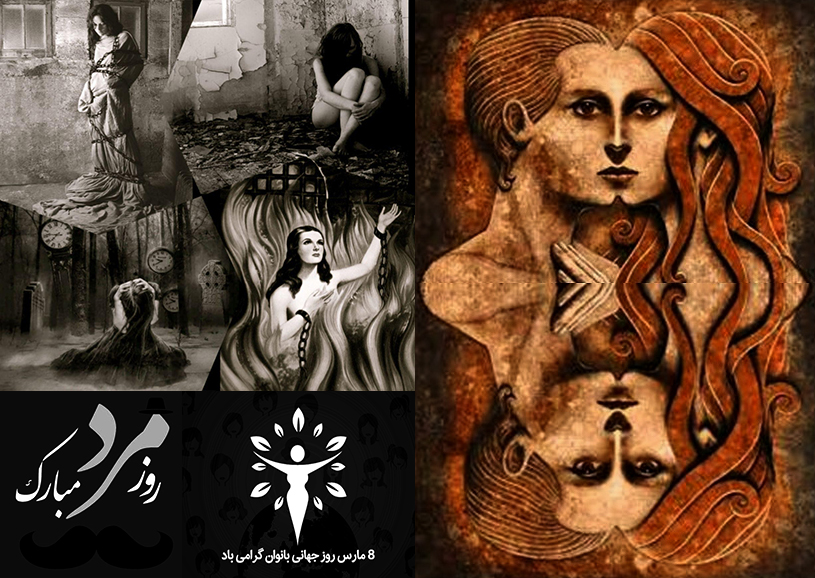
The more a man is emptied of anima, the more mechanical, one-sided, linear and judgement-driven his personality becomes. This is why, within this symbolic account, anima is associated with soul and animus with body; a man who has chained the anima within himself becomes only a body in which no soul can be found.
The technological modern world is, in this interpretation, a world governed and dominated by animus and the left hemisphere. The ideals it presents for human life are therefore the ideals animus recognises as its own, and along this path it even attempts, in the name of equality, to draw women under its control. The price of this modern equality, in this account, is the further chaining of the feminine soul of the world.
Until now our individual and collective psyche has remained trapped in an imbalance between anima and animus, feminine and masculine dimensions, for one astonishing and rarely spoken reason. This imbalance arises from the animus’s continual tendency toward domination, because at heart—contrary to what is generally assumed—the animus, in this interpretation, regards itself as inferior to the anima, just as technē and technology regard themselves as inferior to imagination and creativity. To compensate for this unfounded sense of inferiority, the animus has for centuries imposed its domination upon the earth, women and children throughout human history—an imposition that has stood as an obstacle in the path of the evolution of consciousness.
Anima in Chains and the Soulless Body of Modern Humanity
A depth-psychological diagnosis of the spiritual condition of modern humanity — the imprisonment of the Anima, the loss of genuine feeling and relatedness, and the resulting experience of inner emptiness and meaninglessness.
Aydin Areta / آیدین آرتا5 min read
Receive new work
Occasional updates when new work is published.
Comments
Loading…
Leave a comment