
The Tantric Vision: Living without Condemning Life
(Part Two — The Songs of Saraha)
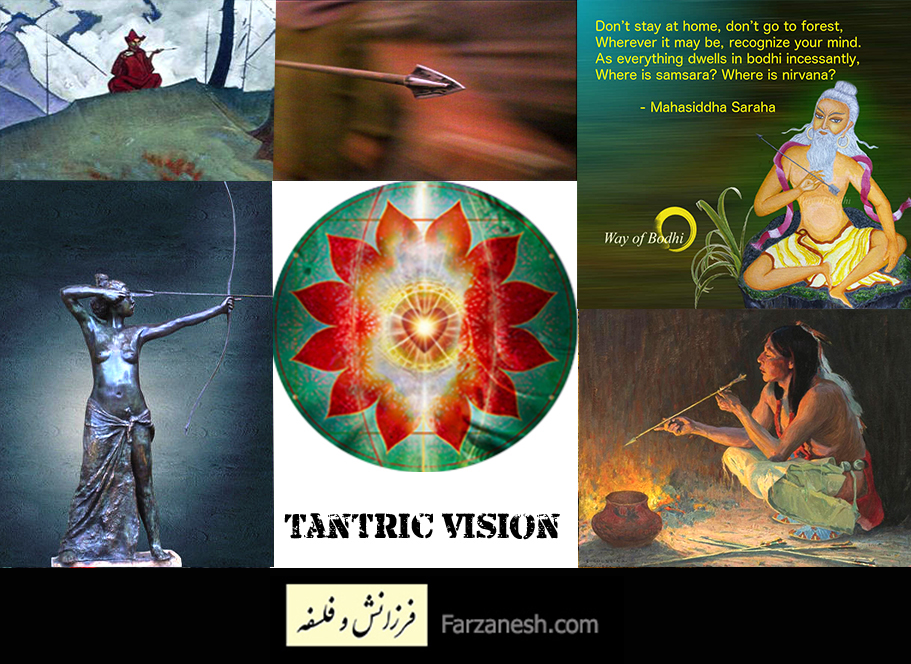
The founder of what is called the Tantric Vision—which took root and developed on the Tibetan plateau—is described as a figure named Rahula, later known as Saraha, a name said in Tibetan to mean “one who has released the arrow from the bow.”
Saraha was born in Vidarbha in southern India, only about a century after the Buddha, during the reign of a king named Mahapala. He was the son of a prominent Brahmin priest and began studying the Vedas while still very young. His reputation spread across the subcontinent, and King Mahapala became fascinated by his intelligence and learning.
Despite this influence and reputation, Saraha ultimately decided to abandon Brahmanism and the social position and privileges he possessed as a Brahmin priest, despite opposition from his family and King Mahapala, who admired him. He became a disciple of a great Buddhist monk named Sarkirti, who in the source is described as a disciple of Rahula Bhadra, the Buddha’s only son. In practical terms, the text presents Buddhism after the Buddha’s life as having followed two principal paths. One path, through Bodhidharma, a disciple of Mahakasyapa—described as one of the Buddha’s ten apostles and direct disciples—went to China and then Japan and Korea, giving rise to Zen. A second path, through Rahula Bhadra, the Buddha’s only son and another of his ten close apostles, then Sarkirti and finally Saraha, went to Tibet and became the source of Tantric Buddhism on the Tibetan plateau.
Thus, in this account, only two generations separated Saraha from the Buddha. Saraha’s deep knowledge, as a Brahmin priest, of the ancient Vedic traditions of the Indian subcontinent, together with the close transmission he received through Sarkirti, is presented as making it possible to understand the Tantric Vision that became his legacy—given the ancient roots of Vedic traditions, themselves described here as a legacy of peoples who migrated from the Iranian plateau to the Indian subcontinent around three thousand years BCE—as a condensation and culmination of thousands of years of philosophical and mystical tradition across the East.
Saraha expressed his vision in a collection of poems at three different levels of complexity and symbolic opacity, known as the Songs of Saraha. The third collection is introduced in the Persian source with these lines:
The ignorant man whose eyes see double
looks at one lamp and sees two,
though what is there to be seen is only one:
it is the mind of the beholder that sees them apart.
Though the lamp in the house has been lit,
the blind person still remains in darkness.
Though what is needed
is available and within reach,
to the one who cannot see the truth
it always appears beyond reach.
Though the rivers are many,
when they join the sea they become one.
Though falsehoods are many,
truth will finally overcome them.
And when the sun appears over the horizon,
darkness, with all its greatness, will disappear.
The fundamental vision of the Songs of Saraha and of the Tantric outlook is that the world is not divided into high and low but is a single reality. The high contains the low within itself, and the low the high. Earth is itself the seed of heaven, and heaven is not separate from earth. The body is the temple of the spirit, not something to be condemned.
In a world where what is “lower” is continually condemned and human beings come to feel guilt over everything from food to the body and sexuality, even over material life itself, Tantra remains focused not on condemnation but on transformation and transcendence. In the Tantric vision, the higher has always been latent within the lower. The lower should therefore not be condemned but transformed, because it contains the higher within itself. Precisely for this reason, when we condemn something we obstruct its possibility of transformation.
The Tantric Vision is not a vision of negation and fear, but of acceptance and love. By condemning the swamp, we fail to see within it the possibility of the lotus and prevent that possibility from being realized. The person who chooses the Tantric Vision tries instead to see the lotus hidden in the swamp and to release the beauty of the lotus rising from the depths of darkness toward the light, thereby transforming the world from what it is into what it can become.
This fundamental Tantric vision recalls the beautiful poem by Rumi, rendered in the Persian source as follows:
When you reach the colourlessness you once possessed,
Moses and Pharaoh are reconciled.
If a question comes to you about this,
how can colour ever be free of dispute and clamour?
How strange that this colour arose from colourlessness—
how did colour and colourlessness come to war?
If oil has been mixed from water,
why have water and oil become opposed?
If the rose is from the thorn, and the thorn from the rose,
why are the two at war and in conflict?
Or perhaps this war is for the sake of wisdom,
like the contest in the goldsmith’s craft.
Or perhaps it is neither this nor that, but bewilderment:
a treasure must be sought—this is a ruin.
What you imagine to be the treasure
is the very imagining through which you lose the treasure.
The Vision of Tantra: Living Without Condemning Life — Part Two / The Songs of Saraha
The second part of the exploration of Tantric philosophy, focusing on the Songs of Saraha — the great Tantric master — as expressions of the non-dual vision of reality that lies at the heart of the Tantric tradition.
Aydin Areta / آیدین آرتا15 min read
Receive new work
Occasional updates when new work is published.
Comments
Loading…
Leave a comment