
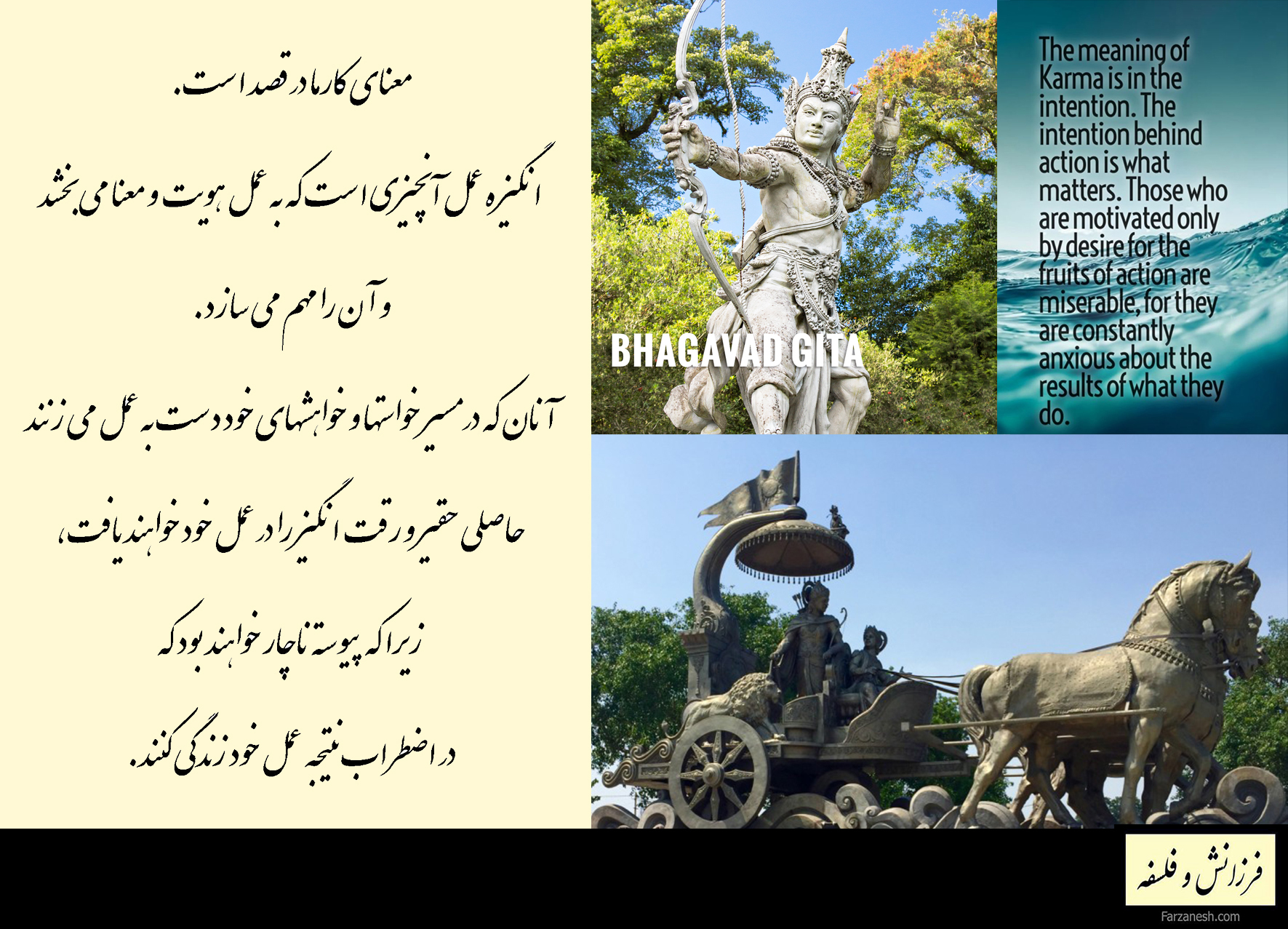
In the story told by the Bhagavad Gita, a moment arrives when a prince named Arjuna, riding in his chariot, reaches a battlefield. On the other side stand the forces of darkness and the people who fight on their behalf and for their victory. Arjuna, whose heart is full of compassion and whose mind is well-intentioned and averse to battle, drops his bow to the ground and begins to speak:
“My hands and knees are trembling, my mouth is dry with anxiety and my mind is disturbed. I recoil from accepting my role in this struggle. How can I enter a battle whose outcome will be injury and suffering for other human beings? Within myself I find nothing but compassion and sorrow for these people. I see no glory in overcoming others or harming them. I do not want power or bread stained with such suffering.”
Arjuna’s hesitation and refusal do not arise from fear of struggle, of being wounded, or even of being killed and defeated. What throws him into turmoil is the conflict among his inner values, and the suffering that others will endure even if he wins this battle.
He stands before the choice of a path whose victory he abhors no less than its defeat.
He first came to the battlefield carrying his bow because he knew that, if he chose inaction, darkness would advance another step into his fate, his world and the world of his people, extending its domination. Yet now that the moment of struggle has arrived, his hands tremble and he is unable to lift the bow, because he understands war and its consequences, and the injuries suffered by both sides whether in victory or defeat.
In this story, Arjuna symbolises each of us when, at moments in life, we find ourselves facing a decision we wish were not ours to make. We are compelled to struggle on a battlefield we detest and to choose an option that brings our inner values into profound conflict.
Such a moment does not arise only in the life of a soldier or a social activist. At any moment in our lives, each of us may confront a decision, small or large, that creates a deep conflict within us: a young person who must choose between remaining beside ageing parents and continuing study in another city; a young woman who must choose between continuing to live with domestic violence and exposing her children to the pain of divorce and parental separation; an employee who must choose between refusing an unethical or unlawful instruction from a superior and leaving his children hungry; and thousands of other examples in which our decision to struggle carries the price of suffering for others who, guilty or innocent, may be deeply harmed by the consequences of our decision—people whom at times we love with all our heart.
Which of us has not wished, at moments in life, that life’s decisions could be a simple and clear choice between right and wrong, and that their consequences would remain confined to the decision itself?
But the truth of life is otherwise. We are continually unsettled by the consequences of our choices, and if we are honest with ourselves we cannot look into the mirror without remembering the faces of all those whom our decisions have caused to suffer, and without trembling inwardly at what we have done or must do. This is why many of us bow our heads. We allow ourselves to be harmed so that no one else will suffer. Yet the truth is that even this inaction, even this decision of ours, is itself an action with consequences—consequences we sometimes see and sometimes do not, and which, if we could see them, might haunt us with nightmares for the rest of our lives.
Arjuna drops his bow on the battlefield, and at that moment the greatest magic of the epic occurs. The one who has driven his chariot to the battlefield is Krishna, the earthly embodiment in time and space of Vishnu, the divine preserver of the eternal order of the world and its ultimate truth.
Krishna lifts Arjuna’s bow and returns it to him, and an extraordinary conversation begins between them, filled with a deep wisdom of which I will mention only a small part.
Krishna tells Arjuna to cast weakness from his heart, take up the bow and enter the battlefield to prevail.
Among Krishna’s words—as the worldly manifestation of the highest truth of the universe and the order governing existence—addressed to Arjuna so that he may overcome his profound hesitation in acting amid the conflict of values to which he is inwardly committed, is this:
- Inaction is itself action. One cannot seek refuge in inaction in order to escape karma—the consequences of action in the world. When we fail to act when action is required, that failure also produces consequences that may increase harm to others and suffering in the world, and we remain responsible for our inaction as well.
Struggle and the Path of Action in the World
A philosophical reflection on the Iranian tradition of engaged action — the understanding that genuine wisdom is not passive contemplation but active engagement with the world in the service of truth and justice.
Aydin Areta / آیدین آرتا10 min read
Receive new work
Occasional updates when new work is published.
Comments
Loading…
Leave a comment