
I wrote this piece inspired by the philosophy of Søren Kierkegaard, the Danish philosopher and forefather of existentialism, and I have read it aloud in the audio file below. Kierkegaard believed that there are three ways of living:
1) Aesthetic mode of life (living with the aim of seeking pleasure and loving beauty)
2) Ethical mode of life (living with the aim of realising a moral belief or purpose)
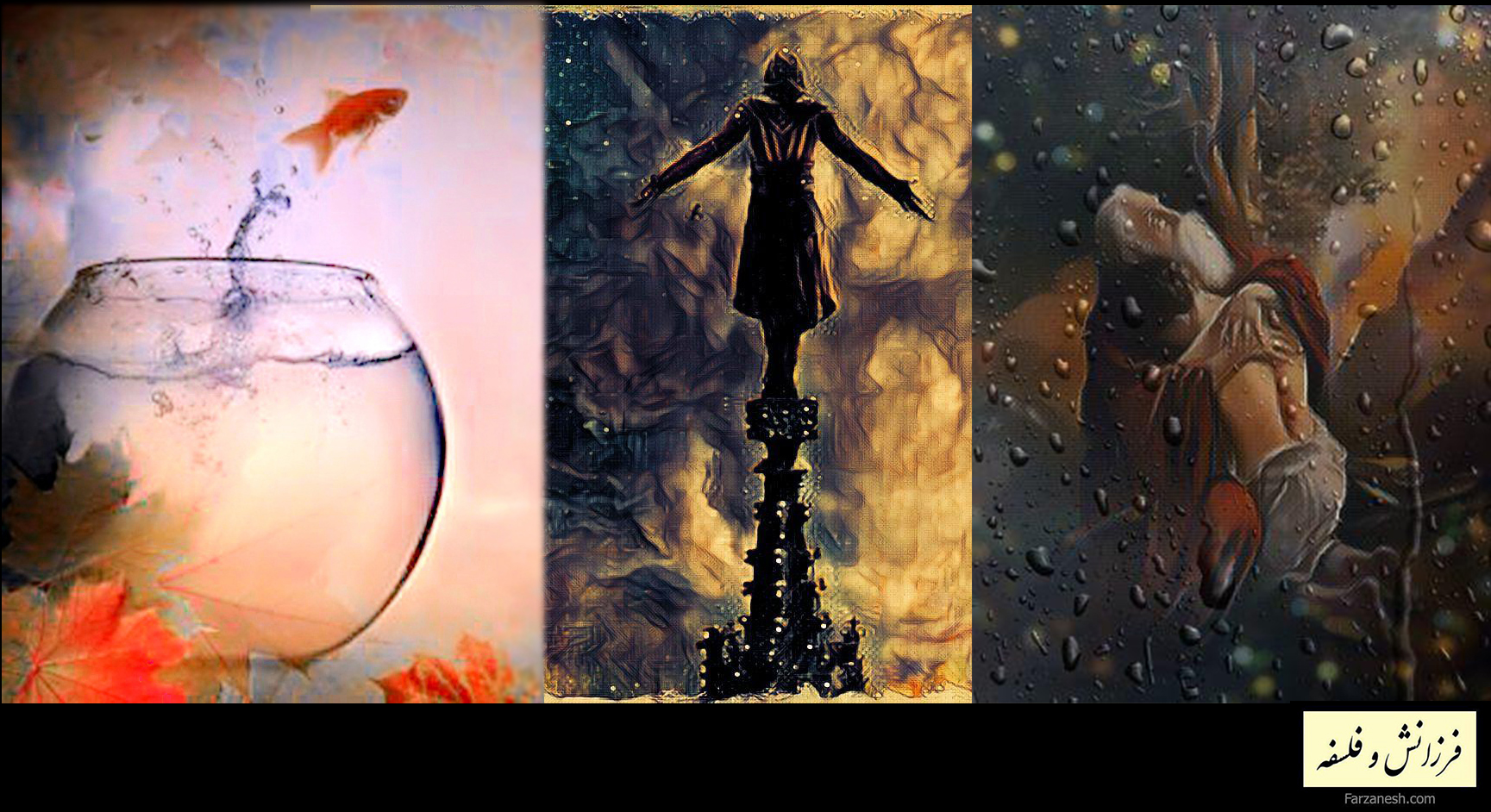
3) Religious mode of life - leap of faith (the leap of faith)
This discussion is presented in three acts. The first concerns the first level of life, which encompasses the dominant approach most people take to living: a condition in which the purpose of every action is to find some pleasure in it and to obtain a good feeling. A person who lives according to this mode is constantly in search of variety and novelty and tries to keep life's suffering at a distance. Yet the truth is that such a person ultimately encounters despair, suffering and purposelessness.
The second part concerns the second mode of living: living in order to fulfil a duty grounded in a belief held in the mind. One lives in order to discharge a duty because society, religion, tradition or morality has dictated it. This mode of life is approved by tradition, society and morality, but Kierkegaard does not regard it as the highest form of living. He sees a profound distance between this kind of devotion and faith. Many religious believers and rigid adherents of different ideologies who dedicate themselves to their belief belong to this group. Kierkegaard calls the highest form of this way of living the knight of infinite resignation: a person who gives up everything in existence for the sake of a belief. This way of living is consistent with rationalising and attempting to justify one's conduct on the basis of what has been learned through belief. It is devotion to a belief dictated to us from outside.
For Kierkegaard, the highest level of living is the leap of faith. Faith, for Kierkegaard, is not profound conviction in a belief. Faith is a leap into the unknown and into darkness, one that may stand in conflict with morality, social traditions and even the outward forms of religious belief. The leap of faith is not the recognition of truth but surrendering oneself to it, and in its essence it is irrational and beyond discourse. It is filled with passion and a will that springs from within, rather than with submission to something external. The leap of faith overcomes all hesitation and doubt and, in Kierkegaard's view, is not merely higher than reason but in conflict with it.
In Fear and Trembling, Kierkegaard closely examines the story of Abraham and Isaac/Ishmael and interprets it through his philosophy. In Kierkegaard's view, if Abraham took Isaac to the place of sacrifice with the thought, “I sacrifice Isaac because this is God's command; I have no choice, and Isaac is condemned to destruction by this command,” that would make him merely obedient and believing, not what Kierkegaard calls the knight of faith. For Kierkegaard, the story symbolises the way faith overcomes social morality, religion, rational command and everything that appears right, and how the knight of faith casts himself beyond good and evil. In this story, Isaac/Ishmael is Abraham's beloved and long-awaited child. Isaac/Ishmael symbolises the most desired and precious possessions of our lives, and to kill him—to perform an act of child sacrifice—is to commit an act condemned by, and indefensible before, morality, religion and ordinary social convention. The leap is not only Abraham's leap; it is Isaac's leap as well. From a Kierkegaardian perspective, we might read the story in this way: to kill the greatest desire of one's life and cross the boundaries of morality, society, tradition and logic is to leap into the darkest darkness with the faith that everything you kill will be returned to you through your inexplicable leap—and no one, no one except the person who chooses the leap of faith, will understand the meaning of what is being done.
In Kierkegaard's thought, faith is neither asceticism nor belief. Faith is an irrational leap beyond good and evil, and within this incomprehensible leap into the depths of darkness there is something infinitely personal and beyond discourse, known inwardly only to the person who chooses the leap of faith.
Kierkegaard believed that what our world suffers from is a lack of passion and faith. In his view, true faith gives us individuality, whereas traditional religion and ideology take individuality away from us. Kierkegaard and Nietzsche were two entirely different faces of a common conviction: a view that sees the human being as powerful and singular, and wants the human being to stand strong before the suffering of life.
The text and audio file follow below....
Aydin Areta
The Leap of Faith as a Way of Living in Søren Kierkegaard's Philosophy
This week's discussion concerns the idea of the “Leap” in Kierkegaard's philosophy as a way of living. Kierkegaard also calls this leap the Qualitative Leap, and it later became widely known as the Leap of faith.
Søren Kierkegaard is a philosopher whose writing has a power, directness and intensity of feeling comparable to what one experiences when reading Nietzsche. It is therefore unsurprising that, given the deep humanism visible in the thought of both, the two philosophers are regarded as nineteenth-century forebears of modern existentialism.
Despite a difference as fundamental as Kierkegaard's theism and Nietzsche's atheism, neither philosopher hesitated to stand against public opinion, speak his convictions plainly, or defend human individuality passionately against the collective. Neither solitude, poverty nor the pressure of public opinion prevented them from expressing what they believed, and until the end of their lives both continued forcefully to live their philosophies.
Kierkegaard was a fierce defender of recognising “individual inner experience” — Subjective Truth — as a truth to be lived alongside “external objective experience” — Objective Truth — as a truth to be known.
During his lifetime Kierkegaard simultaneously opened three fronts of attack in his society:
1) an attack on the Christian Church, condemning it for destroying human individuality and religious faith;
2) an attack on journals and newspapers for attempting to make public opinion uniform and erode individual thought and the importance of thinking;
3) an attack on Hegel's philosophy, the dominant and virtually unrivalled force in the nineteenth-century European philosophical tradition, for removing the individual human being from philosophy and reducing humanity to human history.
Kierkegaard paid a heavy price for fighting on all three fronts. During his lifetime his critics and enemies included powerful figures in the Christian Church, proprietors of newspapers and public journals, and philosophers of his time. He naturally became a kind of public enemy, yet he never ceased passionately defending individual human beings whose individuality, as he saw it, was being crushed beneath the hammer of Church, mass media and the Hegelian philosophical system.
In his private papers dated 14 May 1847, Kierkegaard wrote this wish:
“My wish is that on my grave you write only: ‘The Individual.’”
In his philosophy Kierkegaard believed there were three ways of living:
1) Aesthetic mode of life
(living for pleasure, enjoyment of life and the love of beauty)
2) Ethical mode of life
(living in order to remain committed to and realise a moral belief and purpose)
3) Religious mode of life - leap of faith
(the leap of faith: throwing oneself into unknown darkness in order to live passionately what one has faith in, even when it conflicts with public beliefs and the forces governing one's life)
In the attached audio file, I have rewritten this idea in a simple literary form and used examples to make it more accessible.
The discussion is presented in three acts.
Act One:
The first part concerns the first level of life, the Aesthetic mode of life, which encompasses the dominant way human beings approach life.
It is a way of living in which the aim of everything we do is simply to find pleasure in the activity and thereby feel good.
In this mode of life, Pleasure is the principal motivation and aim (a form of psychological hedonism).
A person who lives in this way is constantly searching for variety and novelty and trying to keep life's suffering at a distance. But can such a person find meaning, enduring happiness and pleasure without suffering, and sustain them in life?
Can a life founded solely on enjoyment encompass and realise the full feeling and capacity of being human?
Act Two:
The second mode is living for moral duty: the Ethical Mode of life. At this stage we live in order to fulfil duties we have taken upon ourselves.
A person entering this stage can rise above life's pleasures and disregard them in order to realise a goal regarded as important. Yet that goal is still carried as a duty placed upon the person by family, tribe, society, religion or public opinion.
2
To understand more clearly the meaning of the Qualitative leap, or leap of faith, we should recognise that perhaps each of us has made such a leap somewhere in life, or knows people who have lived in this way. Such examples are deeply personal and difficult to describe, because not every renunciation of a desire is a leap of faith. If the renunciation or sacrifice is made in fulfilment of a duty we understand ourselves to have, or a duty placed upon us, then in Kierkegaard's terms we remain a Knight of infinite resignation; such an act is not the leap of faith.
Consider a father who gives up personal pleasures and works late into the night because he understands himself to have a duty towards his family, or a religious person who helps a poor neighbour because religious belief has imposed that duty. This does not mean such actions lack value. In Kierkegaard's view, living within the Ethical Sphere has a higher value than living within the sphere of pleasures, the Aesthetic sphere. But describing the leap of faith is something different from giving up life's pleasures for moral duty.
Kierkegaard describes the leap of faith as a Qualitative leap because the leap transforms the quality of who we are. It is like the transformation from H2 and O into water: not merely a combination but a change in the nature of the elements as a new thing emerges.
Imagine, for example, that you work in an organisation. Advancement in that organisation matters greatly to you, and you also depend upon the salary for your livelihood. One of your colleagues is subjected to an obvious injustice, and you know that because the colleague refused to perform an unethical act, false accusations have been constructed and dismissal is imminent. If you decide publicly to defend the person being wronged, what stands between your personal desires—financial security and professional advancement—and what you believe you must do is not simply the relinquishing of a desire. By standing up, you cast yourself into an unknown darkness in which anything may happen, perhaps far beyond losing the thing you wanted. If the power you confront is large and corrupt, your livelihood and even your family may be placed at risk. Such renunciation entails a qualitative leap in your Being and might be called a Leap of faith.
Or imagine you are a psychiatry trainee. You chose the specialty with love and have devoted several years of your life to it, but reach a point where you realise that the system you are about to join works according to values that are not yours. Treating patients with high doses of antipsychotic drugs, the absence of a psychotherapy system and social support, and other features are not aligned with what you had imagined. Leaving specialist training means not only abandoning the investment of previous years but also creating a serious professional and social crisis in your life. Such an act entails a leap into unknown darkness.
You might instead decide to remain and fight to change the system, which could itself entail a leap. As these examples suggest, it is not the external action that determines whether a “leap of faith” has occurred, but the fulfilment of two principles that, in Kierkegaard's language, elevate the person into a Knight of faith:
1) relinquishing pleasure and even responsibility or duty in the service of a higher value;
2) leaping into the unknown through a decision grounded in faith in a higher, personal truth for which one is willing to live and even to give up life.
We Iranians may understand inwardly the difference between the Knight of infinite resignation and the Knight of faith through contrasts in our intellectual and spiritual history: the faith of Muhammad al-Ghazali and Husayn Hallaj; the faith of Nasir al-Din Tusi and Nasir Khusraw; the faith of figures such as Nizam al-Mulk and Salah al-Din Ayyubi, and the passionate, loving faith of Suhrawardi. Faith of this kind, woven from passion and love, is not of the order of belief, and its place is not simply in the head. Perhaps this is why those who choose the leap into such faith ascend without a head.
Aydin Areta
The Leap of Faith in Kierkegaard's Philosophy
An exploration of Søren Kierkegaard's concept of the leap of faith — the moment of existential commitment that transcends rational calculation — and its significance for understanding the relationship between reason, existence, and authentic selfhood.
Aydin Areta / آیدین آرتا9 min read
Receive new work
Occasional updates when new work is published.
Comments
Loading…
Leave a comment