
Yalda / Chelleh / Khor-Ruz, a Legacy of Ancient Iranshahr
(1)
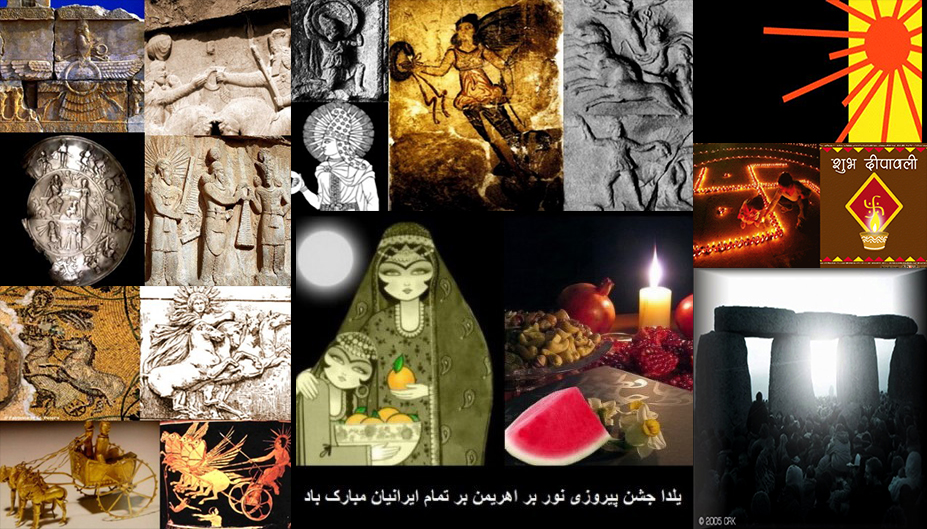
Yalda is a celebration wrapped in ancient mysteries, an enduring reminder of light’s victory over darkness. A large part of the peoples of the ancient Iranian world—from southern Russia and the Iranian plateau to the Indian subcontinent—will celebrate this night, although many are unaware of the celebration’s geographical reach, its historical sacredness, and the mysteries concealed within it.
Festivals such as Yalda and Nowruz, celebrated from Iran to western China, remind us Iranians that “Iranshahr” is not merely a geographical territory but a cultural expanse whose true boundaries extend far beyond the borders that have separated the peoples of this ancient world from one another.
Yalda Night is an opportunity to remember once again the forgotten dream of Iranshahr, which, in today’s fragmented world, continues itself within myths, traditions, and ancient rituals, and through that continuity remains alive even if we have been divided into a thousand pieces. As a unifying force, this dream connects all of us—at home and in migration, wherever we may live.
Over millennia, celebrations such as Yalda have helped preserve us against some of the most destructive storms of history, storms that erased the names and memories of many peoples and civilizations from the pages of history. They still retain the capacity to safeguard the seeds of our identity.
In the Iranian calendar, this night falls on the evening of 30 Azar and the winter solstice and is celebrated as the longest night of the year. What gives this night its special meaning, however, is not its length but the fact that the whole night is understood as a struggle: darkness stands at the height of its dominion, but with the birth of the sun and the triumph of light over this longest and widest darkness, its rule comes to an end.
Yalda is a symbol of the ultimate victory of goodness and light over Ahrimanic forces. The struggle between light and darkness is one of the most fundamental beliefs in the Iranian worldview.
The darkness of Yalda Night recalls the history of us as a people who have grappled with suffering and darkness through the long night of history, yet have never believed that this suffering is stronger than us or that this darkness is permanent and eternal. Yalda reminds us of our faith in Hormazd’s promise that in the end Ahriman will be destroyed with the birth of light.
Yalda, or the ancient Khor-Ruz, is a symbol of the archetype of the birth of the sun and the destruction of darkness. The archetype of the struggle between light and darkness and the victory of light is among the oldest and most powerful archetypes of the ancient Iranian world.
Yalda / Khor-Ruz / a Legacy of Ancient Iranshahr — Continued (2)
Although celebrations of the winter solstice can also be found among some peoples other than the ancient Iranians, the source presents the observance as a common feature of Indo-Iranian peoples and a legacy of their ancient shared culture from a time when they lived alongside one another.
The text traces forms of this ritual celebration to around 4000 BCE among different branches of what it calls the Aryan peoples: from northern Nordic and Germanic peoples, from Iran to Germany and Lithuania, and onward to India and the peoples of southern Russia.
It even proposes that the influence of this celebration can be studied among distant peoples such as those of Japan, through the Ainu—described in the source as Aryan peoples who entered Japan from Russia and strongly influenced the important Yamato dynasty—and in Egypt through connections between Egyptians and the Aryan Hittites.
There are also lands whose relationship with this tradition remains a distant mystery, such as the remarkable Maya civilization of South America, which is likewise described here as having celebrated this night with a similar understanding of the birth of a solar deity. These parallels are discussed further below.
In this essay I intend to look at peoples who celebrate this night and to consider noteworthy correspondences among their traditions.
This night coincides with the ancient solar observance of “Khor-Ruz,” celebrated in the ancient Iranian and later Roman tradition of Mithra. Among both Iranians and Romans who followed this tradition, it is presented as coinciding with the birth of Mithra, regarded by Iranians and Romans before the birth of Christ as a sacred day.
Ancient Iranians called this day “Khor-Ruz,” the day of the sun, and celebrated the night as the night of the birth of Mithra or the sun. The source describes an ancient practice in which people on the slopes of the Alborz remained awake until dawn waiting for sunrise and celebrated the victory of Mithra and defeat of Ahriman by reciting a prayer called “Niyad.”
People are described as celebrating this night from the Iranian plateau to the Indian subcontinent, and the text states that people in Bangladesh still honour it as a “night of light.” In later periods, Mazdakites and Khurramites are also said to have called and honoured the day “Khorram-Ruz.”
It may also be interesting to note that in Persian the word mehr can mean both the sun/Mithra and love or affection. Understanding affection as light points to the special importance of this word and to a correspondence between the concepts of light and love in Iranian culture.
Yalda / Khor-Ruz / a Legacy of Ancient Iranshahr — Continued (3)
This day also stands in relative proximity to the celebration of the birth of Jesus Christ on 25 December among Christians around the world. The source argues that, according to its reading of the Gospel of Luke, Jesus was born not in winter and December but in summer.
It states that, according to the Jewish religious calendar, the month in which Gabriel appeared to Mary was the final month of summer and therefore Christ’s birth should have taken place at the beginning of the following summer. The source further points to Luke’s account of Christ’s birth during the season when sheep were grazing, adding that shepherds would not take sheep out to pasture in winter, and notes the absence of other signs of winter in the birth narrative.
The question, then, is why 25 December was chosen as the date of Christ’s birth.
The text connects this question to the spread of Mithraism in Rome and to the popularity of “Sun Day” and the belief in darkness being defeated on this night, a day regarded as the birthday of Mithra.
It further states that the calendar used by the Romans was Greek and attributes the movement of the date from 21 to 25 December to a calendrical miscalculation, a possibility it says many historians have emphasized.
Have we ever asked why the sacred weekly holiday among Christians is called Sunday—a combination of Sun and Day?
Is it merely accidental that both Mithraism and Christianity called their sacred day of the week Sun Day? (In the Mithraic tradition, the final day of the week is described here as Mehr-Shid, the day of the sun.)
The source notes that Constantine, the first Roman emperor to do so, made this day a holiday in 321 CE under the name Day of the Sun. It attributes this to the spread of Mithraism in Rome and the sacred status of the day among Roman people and soldiers, suggesting that the most effective way to spread Christianity rapidly was to use existing traditions and change their meaning.
The text describes 21 December, or Yalda Night, as one of the greatest national festivals in the Roman Empire before the adoption of Christianity, celebrated under the name Divalia in honour of the “returning sun.”
In recent years, the remains of Mithraic temples and sanctuaries have been found not only across Asia Minor and the Iranian plateau but extensively throughout Europe, from Italy to Germany, Ireland, and England. Images preserved in these temples have contributed to new information about Mithra, this mysterious figure of history.
The source interprets this evidence as indicating a figure distinct from the ancient Iranian deity: Mithra as saviour and Iranian prophet, representing a highly organized yet esoteric religion. It describes a prophet who appears under the signs of Mithra and his return, and argues that dozens of images, statues, and surviving temples reveal the distinctive spread of this religion shortly before the birth of Christ, especially in the Roman Empire. It further argues that today the Catholic Church, and consequently many institutions even in Western universities, seek to pass over this religion by subsuming it under the broad label of paganism, polytheism, or heresy.
There is much to say about the relationship between Catholic Church traditions and Mithraic practices, especially those connected with New Year celebrations—Christmas—and that discussion is deferred to a later point. One important detail noted here is that 17–25 December are celebrated in Christian traditions as the final week before Christ’s birth, with each day carrying a particular name, songs, and prayers. The especially interesting point, in the source’s argument, is that 21 December—the birthday of the solar deity Mithra in ancient Indo-European traditions—is known in these devotional antiphons as Oriens, or the rising sun. The Latin word oriens also means east, the point from which the sun, or Mithra, appears and is born.
Yalda / Khor-Ruz / a Legacy of Ancient Iranshahr — Final Part (5)
Another Indigenous people of the American continent, the Zuni, of whom only around seven thousand are described here as living today near the Mexican border and as descendants of the Pueblo peoples, also celebrate 21 December and the birth of the sun god.
These people believe that their ancestors came to America hundreds of years ago through a secret gateway from another dimension, which they call Shipapu. Their language is said here to bear no relation to other Indigenous languages of the Americas, while their traditions, to which they are deeply attached, are distinctive to them. In the original post, two of their sacred symbols are shown below.
The source also states that in Japan, around the seventh century CE, a celebration was held in honour of Amaterasu-ōmikami (天照大神/天照大御神), the sun goddess whose name is described as meaning “the light that shines in heaven.” She is also regarded as protector of Japan’s imperial family. At the beginning of this essay reference was made to what the source calls the influence of Aryan-origin Ainu upon the earliest known civilizations of Japan. In relation to this claim, Dr Shahab Sotoudeh-Nejad’s The Yamato Dynasty in Japan and Ancient Persian Civilization is described as a comprehensive and noteworthy study.
Before bringing this essay to an end, it may be useful to look once more at the use of the sun symbol in Iranian mythology and deities.
Consider the images below in the original post: the circle is presented as a symbol of the sun, and a ring symbolizing Mithra—simultaneously the deity of love/covenant—is visible in them. What is offered as support for an Iranian/Aryan origin of this symbol, seen in the hands or above the heads of the Faravahar, Mithra, Horus, Vika, and Median Magi, is the antiquity of the symbol among peoples described here as Aryan.
The closest alternative possibility, because of the antiquity of Egyptian civilization, would be that Egyptians first used the symbol and other peoples later adopted it from them. The source argues that this can be rejected because the symbol also appears among the Hittites, described here as Aryan, with a chronology claimed to be older than the Egyptian examples, and because it appears on the tomb of Cyaxares, founder of the Median kingdom, who is described as buried in Kurdistan. This is presented as evidence that the symbol existed among Iranian peoples before the Achaemenids.
Vika, sun deity of Nordic and Germanic peoples, with the ring of Mithra in hand.
The ring of Mithra / sun / covenant in the hands of Mithra—the images are described as having been found mainly in Armenia and Anatolia rather than in representations of Mithra in Roman Mithraism.
Finally, the source proposes that the root of the word Messiah can be traced to the Sanskrit word mi, meaning “friendship,” and that mitr was likewise used with the same meaning, while midh carried the meaning of mediation and intercession. It then connects English words such as mediator, medium, medicine, and media with this semantic field, arguing that the term later appeared in forms such as mishi and misi and ultimately Messiah, and was probably unrelated to the Arabic word mas'h in the sense of being anointed with water or oil.
Pahlavi writings likewise contain forms of Mithra rendered as Mithr, Mihr, and Mir.
The belief in the appearance of a saviour can, in this account, be understood as one of the most deeply rooted beliefs among Iranian peoples, manifested in the festival of Mithra—Yalda—and reflecting for millennia their faith in the final triumph of light over darkness, good over evil, the expulsion of Ahriman from the world, and the victory of monotheism.
The archetype of the birth of the sun and the destruction of darkness can therefore, in the argument of this essay, be understood as deeply rooted among Indo-Iranian peoples and branches that migrated into Europe, and as still symbolically celebrated across this cultural world. The text argues that the power of this archetype was so strong that it even contributed to changing the Christian calendar so that the birth of Christ would coincide with the night of the birth of light.
Yalda / Khorrouz: The Archetype of the Sun's Birth, Legacy of Ancient Iran
An exploration of the ancient Iranian festival of Yalda — the winter solstice celebration — as a living expression of the archetypal symbolism of the sun's rebirth and the triumph of light over darkness.
Aydin Areta / آیدین آرتا18 min read
Receive new work
Occasional updates when new work is published.
Comments
Loading…
Leave a comment