
Our Relationship as Iranians with Our Cultural Past and Historical Civilization — Part Two
(Through the myth of Osiris and Horus in ancient Egypt)
As time passes, Osiris grows old and his sight declines. His brother Seth impatiently looks for an opportunity to remove the old and blind king of the world. Because Osiris has no child and successor, Seth, as the second-born of the world, can become king and bring chaos and darkness to rule over it.
Isis, who knows Seth’s plan, continually protects and cares for her husband Osiris. Eventually, however, Seth finds Osiris alone and kills him, places his body in a coffin, and casts it into the Nile. After a long search, Isis finds Osiris and, through her healing power, restores him to life.
At another opportune moment Seth kills his elderly brother again. This time he cuts Osiris into pieces and hides each part in a different corner of Egypt so that Isis cannot restore him to life.
When Isis learns of her husband’s death, she first weeps for him, but ultimately, in a tireless search, gathers the pieces of his body from across Egypt. She then takes the form of a bird and, using her magical power, draws the essence of Osiris from his body and becomes pregnant by it. Thus, from Isis—the goddess of magical knowledge and healing—conceiving from the reassembled remains of Osiris—the guardian of human beings in life and death and king of the world, murdered by his destructive brother—a child is born with the head of a falcon. His name is Horus, and his eyes carry the radiance of the sun and moon. In this way, nothing by day or night can remain hidden from the keen sight of Horus.
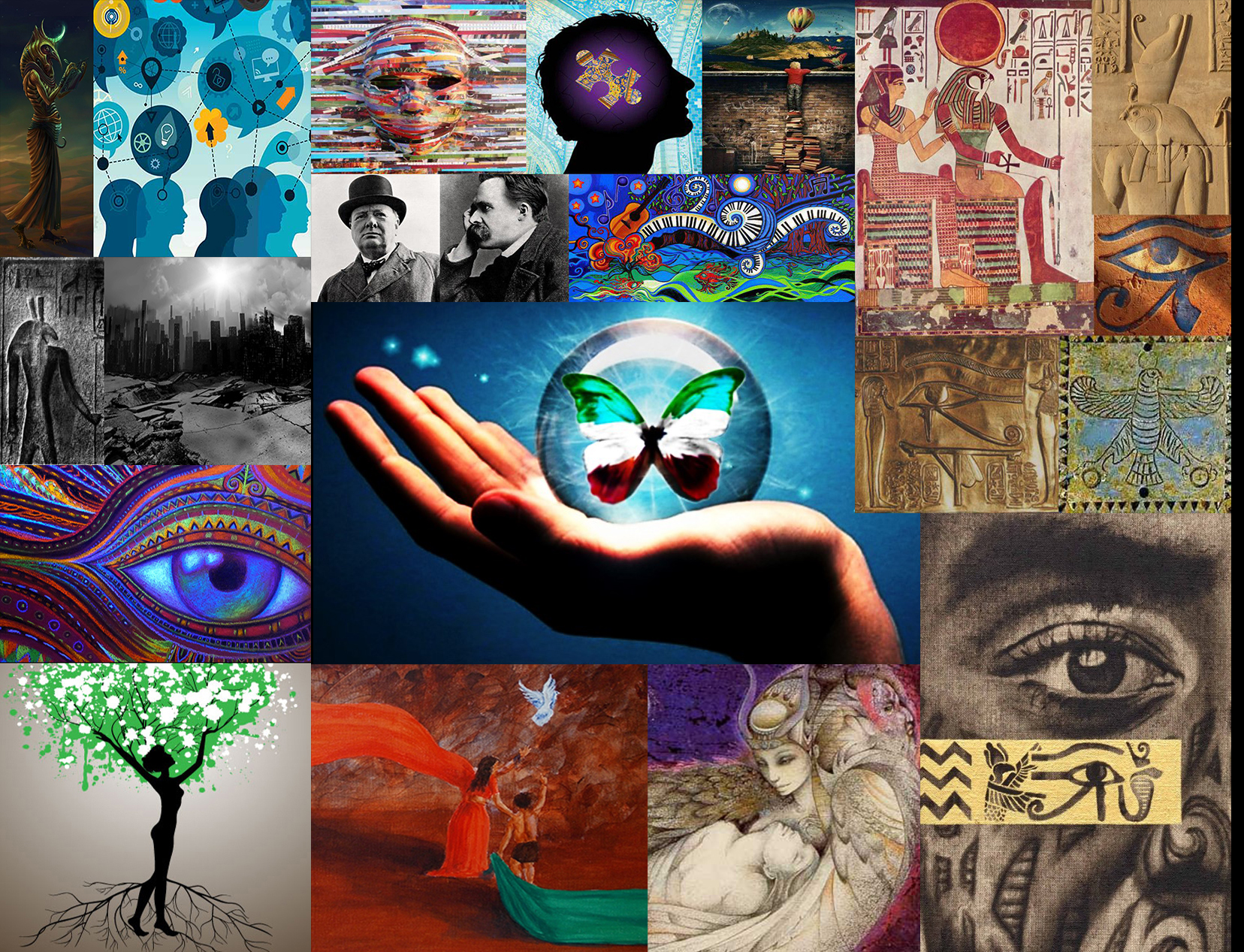
The Eye of Horus is a well-known symbol in the history of religious mysticisms around the world. In many images Horus bears the sun above his head and is himself an embodiment of the sun. Regarding the etymology of the word Horus, reference has also been made to the Indo-European root hor, meaning sun, creating the possibility that this very ancient myth may fundamentally have an Indo-European origin. What is striking is the remarkable similarity between the falcon depicted on the standard of Cyrus the Great, the Achaemenid king, and the image of Horus visible in the illustration used above for this piece. (The royal emblem of Cyrus, dating to a time before the Iranian conquest of Egypt, can be seen in the centre of the image above, at the bottom.)
Perhaps, if an appropriate opportunity arises later, I will write about this resemblance, its importance, and some more recent archaeological findings concerning the ancient roots of the Horus myth. Here I will say only that if we understand Horus and the falcon depicted on the Achaemenid standard as connected to a shared source, this story and myth is no longer wholly foreign to us.
In older versions of this story, Thoth, god of ancient knowledge and wisdom and creator of writing, science, and the earliest inscriptions in the world, is the one whose magical knowledge makes possible Isis’s conception from the lifeless body of Osiris.
Ultimately Horus goes to war against Seth, god of darkness, both to avenge his father Osiris and to save the world. He triumphs in a decisive battle, although in that battle he loses his left eye, the eye that gives him the ability to see in darkness. At the end of the battle, however, Thoth—the god of knowledge who, among his many other qualities, is also god of the moon—appears on the battlefield and restores Horus’s left eye.
The most astonishing and meaningful moment of the story comes after Horus regains his eye. At this point he makes an unexpected choice.
Having recovered his eye, he could become the young and powerful king of the world. Instead, he does something unforeseen. He takes his left eye, which possesses the power to see into the world’s darkness, descends into the underworld of the dead, finds his old and blind father Osiris, and gives the eye to him. In this way Osiris is reborn and recovers his sight. Horus returns him to the world and asks that they rule it together.
Osiris entrusts kingship of the world to Horus and ascends to the heavens, becoming lord of the world after death and judge of the purity of the souls of human beings who have departed from this world.
Aydin Areta
Our relationship as Iranians with our cultural and civilisational past — Part Three
(A reading of the myth of Osiris and Horus in ancient Egypt)
Having summarised the myth, let us now reflect on its meaning and ask why Egyptians transmitted this mythic story for thousands of years as one of their most important epics, and why it became one of the most frequently repeated narratives in the inscriptions of Egyptian monuments.
In psychological and symbolic interpretations of myths and stories, much as in interpreting films, one foundational principle should be kept in mind: the characters and names in the story are not simply historical persons. They can be read as embodiments of active forces within the psyche or in the external world. By replacing each mythic figure with the force or meaning it represents, we can begin to decipher the structure of the myth.
1) Osiris can be read as an embodiment of culture and of the traditional structures governing a society. Culture is like a generous father who teaches each generation how to live and establishes and preserves social systems. Yet, as the story itself suggests, the culture and traditions of every society eventually age, and over time can lose both usefulness and vision. As traditions and social structures grow old, another and darker aspect of existence—decay, disorder and disintegration—enters.
2) Set, the second-born figure in this story and embodiment of forces of chaos, destruction and disintegration, emerges as traditions, culture and social structures become exhausted. He draws the old and infertile society towards corruption and decay and eventually kills it. The fate of a society that fails to renew itself and loses its capacity for youthful creation is blindness to what is happening to it, followed finally by the death of civilisation at the hands of corruption and disintegration as these forces envelop its institutions.
3) Isis embodies the force of fertility, repair and renewal: that which preserves culture and carries it from one generation to another. Isis protects Osiris against Set and possesses the power to bring Osiris—culture—back towards life. This vital force exists within every culture, however old and blind it may become, and for a time can preserve Osiris. But eventually a point may come when decay, corruption and chaos not only kill Osiris—the old civilisation and culture—but dismember him, until people remember almost nothing of their own traditions. The forces of disintegration aim at complete fragmentation. In such a condition, pieces of a dead culture are scattered across history and across the geography of its former world. We Iranians understand well the meaning of such fragmentation. Our culture and traditions have been broken apart by historical storms and by the inevitable decay accompanying age and exhaustion. If we search, we can still find fragments here and there, yet the old and blind king is no longer alive; he sleeps in the depths of history.
4) Here Isis—the mother of the world and symbol of protective, restorative and life-giving forces—can finally search for the pieces of Osiris/culture and gather them together with the help of knowledge. Older Egyptian versions in which the god of knowledge, Thoth, assists in this gathering express the point in a direct way: knowledge, together with the generative power of love for an ancient civilisation and culture, can recover the fragments. By placing them together it can reconstruct an integrated but still lifeless body of the old civilisation, bringing it one step closer to rebirth.
5) Isis, who loves Osiris, discovers his essence and becomes pregnant by him. Love of culture, together with knowledge, makes it possible to bring forth from the body of an old, blind and destroyed culture a new child who, although born of the father, does not simply resemble him. The aim of the myth is not the literal return of Osiris. Osiris is old, blind and no longer adequate to the new world. However deeply we love the corpse, it will not become a powerful and intelligent ruler. The truth is that it is dead and weak before corruption. The significant message of the myth is that no people attains greatness merely by reassembling the fragmented corpse of its civilisation. The ancient civilisation must give life to a new generation and be reborn through that generation in a new form.
Aydin Areta
Our relationship as Iranians with our cultural and civilisational past — Part Four
(A reading of the myth of Osiris and Horus in ancient Egypt)
6) In this story, the great magic by which a civilisation can overcome inevitable decay and disintegration—the final victory of Horus over Set—is the birth of a young and powerful child, Horus, from the aged and lifeless body of a nation’s culture and civilisation, Osiris. Horus is depicted as the opposite of Osiris. He has the head of a falcon, itself a symbol of precision, sharp vision and attention, because a people that cannot recover attention and awareness will not be able to see Set and the forces of corruption, decay and destruction within its society, just as Osiris failed to see them and was destroyed. In this story, Horus’s right eye is the light of the sun and the capacity to see truth and goodness in the world; his left eye is the light of the moon and the capacity to see evil concealed in darkness.
7) Horus’s greatest weapon, as a symbol of civilisation reborn from its past, is his sharp sight, precision and awareness. In contrast with his aged father, Horus embodies wakefulness. He sees and locates corruption and decay and goes to battle with them using this awareness as his weapon. The next meaningful image in the myth is Horus losing his left eye in the struggle with evil. No matter how alert we may be and how powerful our rebirth, the struggle with destructive forces is never simple. Although the story promises eventual victory, it also reminds us of the price. Every people that has chosen to survive and prevail must be prepared to pay a heavy price in the greatest struggles of its history. The image suggests that one sacrifice in the struggle with darkness is the loss of the very eye that helps us see darkness. We recognise the forces of decay through the left eye, the eye that sees in darkness and embodies moonlight. Yet what finally allows Horus to prevail is the eye that remains: the right eye, symbol of sunlight and the capacity to see truth and goodness. Once Horus has found Set in the darkness, he no longer requires the left eye to know where the enemy is. The wound Set inflicts becomes, in that sense, futile; once Horus has drawn Set out of darkness, he can overcome him even with his eyes closed.
8) At the end, Horus regains his eye through the power of wisdom and is able to rule the world. Yet he chooses to descend underground and give his left eye to his blind father Osiris, restoring him to life and inviting him to return to the surface so that they may rule together. What might this unexpected turn mean? Why should Horus surrender his own eye, restore the blind old man to life, and share rule with him?
We can read the story in this way: the young generation—modern civilisation/Horus—which is itself the child of the lifeless civilisation and culture of the past, Osiris, uses awareness as its greatest weapon. After overcoming the forces of decay, corruption and disintegration surrounding its society and world, it finally returns to its history, culture and roots—its father, Osiris. In that return, the young generation gives its modern awareness and vision, capable of seeing defects and the paths through which corruption enters, to the old and blind culture of the past. The “left eye of Horus” becomes the modern sight given to Osiris, making rebirth possible.
The old and blind culture—Osiris, father and root of the young civilisation—returns to life, but now with new and modern vision. This cultural resurrection is not the simple revival of the old, exhausted and blind corpse of the past. What makes resurrection possible is giving the ancient culture a contemporary way of seeing. And strikingly, the eye modern civilisation gives to ancient culture is Horus’s left eye: the eye capable of seeing corruption in the present world without being defeated by it. With the new vision received from its young and powerful child, culture is no longer blind to the corruption and darkness that seek to destroy it.
Aydin Areta
Archaism or Resurrection? A Look at the Myth of Osiris and Horus
A depth-psychological reading of the Egyptian myth of Osiris and Horus as an archetypal narrative of death, dismemberment, and resurrection — and its relevance to the perennial human question of renewal and transformation.
Aydin Areta / آیدین آرتا16 min read
Receive new work
Occasional updates when new work is published.
Comments
Loading…
Leave a comment